Laser cutting cost per meter sounds like one number, but two jobs with the same cut length can have very different prices. One may be a few long cuts, the other hundreds of small holes. This guide shows a simple way to see where the money goes, using clearly labeled example numbers you can swap for your own.
Short answer
Cutting cost per meter = (shop cost per minute + gas cost per minute) ÷ cutting speed in meters per minute. Pierces, setup and overhead are added on top, and material is priced separately. In the example below, one 10 m part costs about $1.06 per meter to process, and the same length with 200 pierces costs about $1.69 per meter. All prices in this guide are examples, not market prices.
Last reviewed: October 2026. The gas information comes from a page dated February 2022, so check it against your own machine and supplier.
Two Jobs, Same Cut Length, Different Price
Imagine two parts, both with 10 m of total cutting length. Part A has 20 pierces (the moments the laser first burns through the sheet). Part B has 200 pierces, for example a plate with many holes. Everything else is the same.
Here are the example inputs. They are made-up numbers for teaching, so replace them with your own shop's figures.
| Input (example) | Value |
|---|---|
| Cutting speed | 3 m/min |
| Time per pierce | 1 second |
| Machine rate | $80 per hour |
| Labor rate | $30 per hour |
| Assist gas flow | 250 L/min while cutting |
| Assist gas price | $0.003 per liter ($3 per m³) |
| Overhead / margin | 15% |
| Setup / programming | 15 minutes per job |
| Cost line (without setup) | Part A: 20 pierces | Part B: 200 pierces |
|---|---|---|
| Cutting time (10 m ÷ 3 m/min) | 3.33 min | 3.33 min |
| Pierce time | 0.33 min | 3.33 min |
| Machine and labor ($110/h = $1.83/min) | $6.72 | $12.22 |
| Assist gas (cutting time only) | $2.50 | $2.50 |
| Subtotal | $9.22 | $14.72 |
| Overhead 15% | $1.38 | $2.21 |
| Total | $10.61 | $16.93 |
| Per meter of cut | $1.06 | $1.69 |
Same cut length, but Part B costs about 60% more to process, only because of its pierces. That is why a price per meter alone can mislead. It helps to ask two questions: how many meters, and how many pierces.
The Formula in Plain Steps
The BytePriva estimator page describes the same building blocks: cutting time is total cutting length divided by cutting speed, pierce time is the number of pierces times the time per pierce, and assist gas is flow rate times cutting time times gas price. Setup time is spread across the batch, and overhead or margin is applied at the end.
Pierce time (min) = number of pierces × seconds per pierce ÷ 60
Machine and labor cost = (cutting time + pierce time) × shop rate per minute
Gas cost = gas flow per minute × cutting time × gas price
Cutting cost per meter, without pierces = (shop rate per minute + gas cost per minute) ÷ speed
The last line is a shortcut for a quick check. With the example numbers, shop cost is $1.83 per minute and gas is $0.75 per minute, so the total is $2.58 per minute. At 3 m/min that is $0.86 per meter before pierces and overhead.
How Cutting Speed Moves the Price per Meter
Because speed sits under the fraction, it has a strong effect. Using the same example rates, here is the cost per meter of cutting only (no pierces, setup or material), with 15% overhead:
| Cutting speed (example) | Cost per meter before overhead | With 15% overhead |
|---|---|---|
| 1 m/min | $2.58 | $2.97 |
| 2 m/min | $1.29 | $1.49 |
| 3 m/min | $0.86 | $0.99 |
| 4 m/min | $0.65 | $0.74 |
| 6 m/min | $0.43 | $0.50 |
Doubling the speed halves the time-based cost per meter. This guide does not give a speed for any metal or thickness, because speed depends on the machine. The BytePriva estimator page also says to take the speed from your own cut chart, since speeds change with nozzle wear, lens condition and gas pressure.
The Gas Choice Changes Both Speed and Edge
The gas cost in the formula depends on which assist gas you use. The Role of Assist Gases in Laser-Cutting Applications compares the three common choices:
| Gas | What the article says |
|---|---|
| Oxygen | Low cost and usable on thicker material, but it is slower than nitrogen on thinner material, and every oxygen cut leaves an oxidized edge. |
| Nitrogen | Used for faster speeds on thinner material (¼ in and under) and leaves a clean edge, but it is the most expensive of the three. |
| Compressed air | The lowest cost, with speeds comparable to nitrogen on mild steel. It leaves an oxygen layer on mild steel, and its thickness range depends on laser power. |
The same article notes that gas consumption goes up as laser power goes up. So the right gas is a balance of price, speed and the edge your customer needs.
Setup Time Shrinks as the Batch Grows
Setup and programming happen once per job, so each part carries only a share. Here is Part A (10 m, 20 pierces) with 15 minutes of setup at the example $1.83 per minute, which is $27.50 per job, and 15% overhead on the total:
| Quantity | Setup per part | Cost per part (without material) | Per meter of cut |
|---|---|---|---|
| 1 | $27.50 | $42.23 | $4.22 |
| 10 | $2.75 | $13.77 | $1.38 |
| 50 | $0.55 | $11.24 | $1.12 |
| 100 | $0.28 | $10.92 | $1.09 |
A single part costs about four times as much per meter as a batch of 100. For a quote, the batch size can matter more than a small change in cutting speed.
A Checklist Before You Quote
- Measure the total cutting length of all contours, including holes.
- Count the pierces, meaning the points where the laser has to start a cut.
- Take the cutting speed from your own cut chart for that material, thickness and gas.
- Use a shop rate that covers the whole machine cost, including depreciation, maintenance and overhead, not just electricity.
- Price material separately, and allow for nesting scrap, offcuts and kerf loss in the material price.
- Add setup per job and divide it by the quantity.
Questions People Ask About Laser Cutting Cost per Meter
How do you calculate laser cutting cost per meter?
Add your shop cost per minute and your gas cost per minute, then divide by the cutting speed in meters per minute. Add pierces, setup and overhead afterwards, and price the material separately.
Why does a part with many holes cost more?
Every pierce takes time, and machine and labor time is paid for. In the example, 200 pierces at 1 second each added 3 minutes, which raised the cost per meter by about 60% compared with 20 pierces.
Is the price per meter the same for every material?
No. Cutting speed, pierce time and gas depend on the material and thickness, so the cost per meter changes with them. Use your own cut chart values for each one.
Which assist gas is cheapest?
The linked article calls compressed air the lowest cost, oxygen low cost, and nitrogen the most expensive of the three. The right choice also depends on the edge you need and the thickness you are cutting.
Does the cost per meter include material?
Not in this guide. Material is priced separately, by area or by weight, and nesting scrap and kerf loss should be included in that material price.
Can I use the example prices as a quote?
No. The prices here are examples to show the method. Use your own machine rate, labor rate, gas price and cut speeds.
Summary
Laser cutting cost per meter depends on speed, shop rate and gas, and then pierces, setup and overhead change the final price. Count meters and pierces separately, take speeds from your own cut chart, and spread setup over the batch. That gives a quote you can explain.
This guide is for general information and estimating. All prices and speeds used here are examples. Real costs vary with the machine, material, thickness, gas, nesting and shop overhead, so please check your own data before you quote or buy. Links to other websites are provided for reference only, and BytePriva is not responsible for their content. Read our full disclaimer.
Sources and Further Reading
- The Role of Assist Gases in Laser-Cutting Applications (February 2022). Comparison of oxygen, nitrogen and compressed air.
Estimate Your Own Laser Cutting Cost
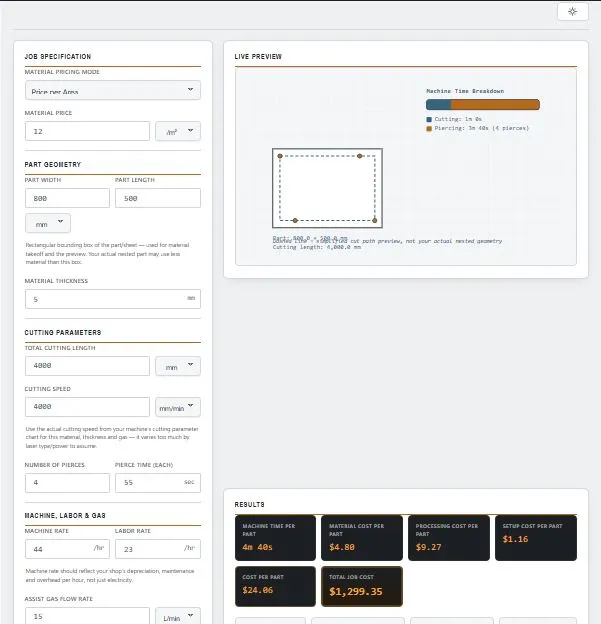
BytePriva's Laser Cutting Cost Estimator splits a price into material, cutting time, pierces, assist gas, setup and overhead. You enter the part size, thickness, cutting length, cutting speed, number of pierces, pierce time, machine and labor rates, gas flow and price, setup time, quantity and margin. It shows the machine time, material cost, processing cost, setup cost, cost per part and total job cost.
Its page lists no preset speeds or prices, so you enter your own. It also notes that nesting scrap, offcuts and kerf loss should be included in your material price, because the calculator does not do this directly.
Tool link: https://bytepriva.com/laser-cutting-cost-estimator/