Use this free pipe weight calculator to instantly find the weight of round pipe, square tube, or rectangular tube — for steel, stainless steel, aluminum, and other materials.
Simply enter the outer diameter (or width/height), wall thickness, and length — the calculator instantly returns weight per meter, weight per piece, and total weight.
Formula used: Weight = Cross-sectional Area of Metal × Length × Material Density
Pipe & Tube Weight Calculator
Calculate the weight of round pipe, square tube, or rectangular tube — steel, stainless, aluminum & more.
Round Pipe — 60mm OD, 3mm wall
Formula used: Weight = (Cross-sectional area of metal) × Length × Density
Table of Contents
How the Pipe & Tube Weight Calculator Works
This calculator supports three shapes — round pipe, square tube, and rectangular tube. Each shape uses a slightly different formula to find the cross-sectional area of metal, but the core principle is the same: subtract the hollow (inner) area from the outer area, then multiply by length and material density.
Round Pipe Formula
Weight = π × (R² − r²) × Length × Density
Where:
R = Outer radius (Outer Diameter ÷ 2)
r = Inner radius (R − Wall Thickness)
Example: A 60mm OD steel pipe with a 3mm wall thickness weighs approximately 4.22 kg per meter.
Square Tube Formula
Weight = (Side² − Inner Side²) × Length × Density
Where:
Inner Side = Outer Side − (2 × Wall Thickness)
Example: A 50mm × 50mm steel square tube with a 3mm wall thickness weighs approximately 4.43 kg per meter.
Rectangular Tube Formula
Weight = (Width × Height − Inner Width × Inner Height) × Length × Density
Where:
Inner Width = Width − (2 × Wall Thickness)
Inner Height = Height − (2 × Wall Thickness)
Example: An 80mm × 40mm steel rectangular tube with a 3mm wall thickness weighs approximately 5.37 kg per meter.
Material Density Table
| Material | Density |
|---|---|
| Mild / Carbon Steel | 7850 kg/m³ |
| Stainless Steel 304 | 7900 kg/m³ |
| Stainless Steel 316 | 8000 kg/m³ |
| Aluminum | 2700 kg/m³ |
| Copper | 8940 kg/m³ |
| Brass | 8500 kg/m³ |
| Galvanized Steel | 7870 kg/m³ |
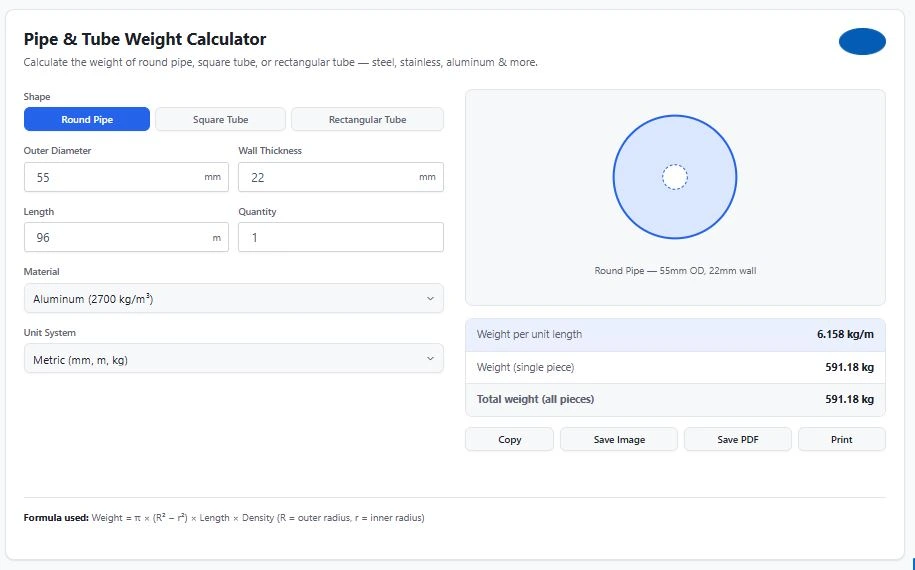
Why Use This Pipe & Tube Weight Calculator
Most online pipe tube weight calculators only handle round pipe — this tool covers round, square, and rectangular tube in one place, so you don't need to search for separate calculators for each shape.
- Instant results — no waiting, no page reloads, weight updates as you type
- Visual confirmation — a live diagram shows the exact cross-section shape and proportions of your pipe or tube, so you can visually confirm your dimensions before ordering material
- Seven material options — including steel, stainless steel (304 & 316), aluminum, copper, brass, and galvanized steel, plus a custom density option for materials not listed
- Metric and Imperial support — switch between mm/m/kg and inch/ft/lb without re-entering your numbers
- No login, no ads, no signup — just enter your dimensions and get your answer
- Export options — copy the result, save it as an image or PDF, or print it directly for your records or quotes
Materials & Densities Guide
Material density is the single most important factor in weight accuracy — using the wrong density (even for a "similar" material) can throw off your result by 5-15%. Here's a quick guide to the materials supported in this calculator:
Mild / Carbon Steel (7850 kg/m³) — The most common structural and fabrication steel. Used for general construction, machinery frames, and most everyday pipe/tube work.
Stainless Steel 304 (7900 kg/m³) — The most widely used stainless grade, offering good corrosion resistance for kitchen equipment, food processing, and general industrial use.
Stainless Steel 316 (8000 kg/m³) — Higher corrosion resistance than 304, commonly used in marine environments, chemical processing, and medical equipment.
Aluminum (2700 kg/m³) — Roughly a third the weight of steel, used where weight savings matter — aerospace, automotive, and lightweight structural framing.
Copper (8940 kg/m³) — Dense and highly conductive, used mainly for plumbing, electrical, and heat-transfer applications.
Brass (8500 kg/m³) — A copper-zinc alloy, common in fittings, decorative work, and low-friction mechanical parts.
Galvanized Steel (7870 kg/m³) — Mild steel with a zinc coating for corrosion resistance, widely used in outdoor structures and ductwork.
Density values can vary slightly between suppliers and exact alloy grades. For critical engineering applications, always cross-check with your material supplier's certified data sheet. You can also refer to The Engineering ToolBox's material density reference for additional verified values.
Who This Calculator Is Built For
This pipe tube weight calculator is built for anyone who needs to estimate pipe or tube weight quickly and accurately, without opening a spreadsheet or digging through supplier catalogs:
- Fabricators & welders — estimating material weight before cutting or ordering stock
- Procurement teams — calculating shipping and freight costs based on total material weight
- Structural & mechanical engineers — quick weight checks during early-stage design, before final specification
- Metal suppliers & distributors — providing quick weight estimates to customers
- Students & hobbyists — learning how pipe/tube weight formulas work, with visual confirmation of the shape and dimensions
- Construction estimators — budgeting material costs for projects involving structural tube or piping
Tips for Getting Accurate Results
- Measure the actual wall thickness, not the nominal size — manufacturing tolerances mean actual dimensions can differ slightly from the "nominal" or catalog size, especially on older or non-standard stock.
- Double-check your outer diameter — for round pipe, always measure the true outer diameter, not a rounded or estimated figure. Even a 1-2mm difference changes the result noticeably on thin-wall tube.
- Use the correct density for your exact grade — stainless steel 304 and 316 have different densities (7900 vs 8000 kg/m³). Mixing them up on large orders can create a real cost difference.
- Account for coatings and finishes separately — this calculator estimates the base metal weight. Galvanizing, painting, or powder coating adds a small amount of extra weight not included here.
- For multiple pieces, use the Quantity field — rather than manually multiplying the total weight yourself, let the calculator handle it to avoid rounding errors.
- Switch units carefully — when toggling between Metric and Imperial, double-check your dimension fields after switching, since the calculator converts your existing numbers automatically.
FAQs
How do I calculate the weight of a steel pipe?
Multiply the cross-sectional area of the pipe wall (outer area minus inner area) by its length and the material's density. For a round pipe, the formula is: Weight = π × (R² − r²) × Length × Density, where R is the outer radius and r is the inner radius (outer radius minus wall thickness).
What is the density of steel used in pipe weight calculations?
Mild or carbon steel has a density of approximately 7850 kg/m³. Stainless steel 304 is slightly denser at 7900 kg/m³, and 316 grade is 8000 kg/m³. Using the correct grade matters — the difference can affect large orders noticeably.
Does this calculator work for square and rectangular tube, not just round pipe?
Yes. This calculator supports round pipe, square tube, and rectangular tube. Simply select the shape you need at the top of the calculator, and the input fields and formula update automatically.
What's the difference between pipe weight and tube weight calculations?
The underlying formula is the same — both calculate the volume of metal (outer shape minus hollow inner shape) multiplied by density. The only difference is the cross-sectional shape used: circular for pipe, square or rectangular for tube.
Can I calculate the weight for multiple pipes or tubes at once?
Yes. Enter the quantity of pieces in the Quantity field, and the calculator will show the weight of a single piece as well as the total combined weight for all pieces.
Does this calculator support both metric and imperial units?
Yes. You can switch between Metric (mm, m, kg) and Imperial (inches, feet, lbs) using the Unit System dropdown. Your entered dimensions convert automatically when you switch.
Is this pipe tube weight calculator free to use?
Yes, this calculator is completely free, requires no login or signup, and has no usage limits.
How accurate is this pipe and tube weight calculator?
The calculator uses standard engineering formulas and material densities, giving results accurate for most fabrication, procurement, and estimation purposes. For critical structural or safety-related applications, always verify with your material supplier's certified data sheet, as actual manufacturing tolerances can cause small variations.
Quick Summary
This free pipe and tube weight calculator instantly calculates the weight of round pipe, square tube, and rectangular tube using standard engineering formulas. Simply select your shape, enter the outer diameter (or width/height), wall thickness, length, and material, and get accurate weight results in metric or imperial units — no login, no ads, no signup required. Whether you're a fabricator estimating material costs, a procurement team calculating shipping weight, or an engineer doing a quick design check, this pipe weight calculator gives you instant, reliable results.
Disclaimer
The Pipe & Tube Weight Calculator and all information on this page are provided by BytePriva for general estimation and informational purposes only. While we strive for accuracy using standard engineering formulas and commonly accepted material densities, actual weights may vary due to manufacturing tolerances, material grade variations, coatings, and supplier-specific specifications.
This tool is not a substitute for certified engineering calculations, official material data sheets, or professional structural analysis. Users are solely responsible for independently verifying all measurements, material properties, and calculations before using them for purchasing, structural design, load-bearing applications, safety-critical projects, or any decision involving financial or physical risk.
BytePriva, its owners, and contributors make no warranties, express or implied, regarding the accuracy, completeness, or reliability of this calculator or its results. To the fullest extent permitted by law, BytePriva shall not be held liable for any direct, indirect, incidental, or consequential loss, damage, injury, or cost arising from the use of, or reliance on, this calculator or the information provided on this page.
By using this calculator, you acknowledge and agree to these terms. If you require guaranteed or certified weight calculations, please consult a licensed engineer or your material supplier directly.