Round bar weight calculator for solid round bars using diameter, length, material, and quantity. Get weight per piece, total weight, and results in kilograms or pounds for steel, stainless steel, aluminum, copper, brass, and other common materials.
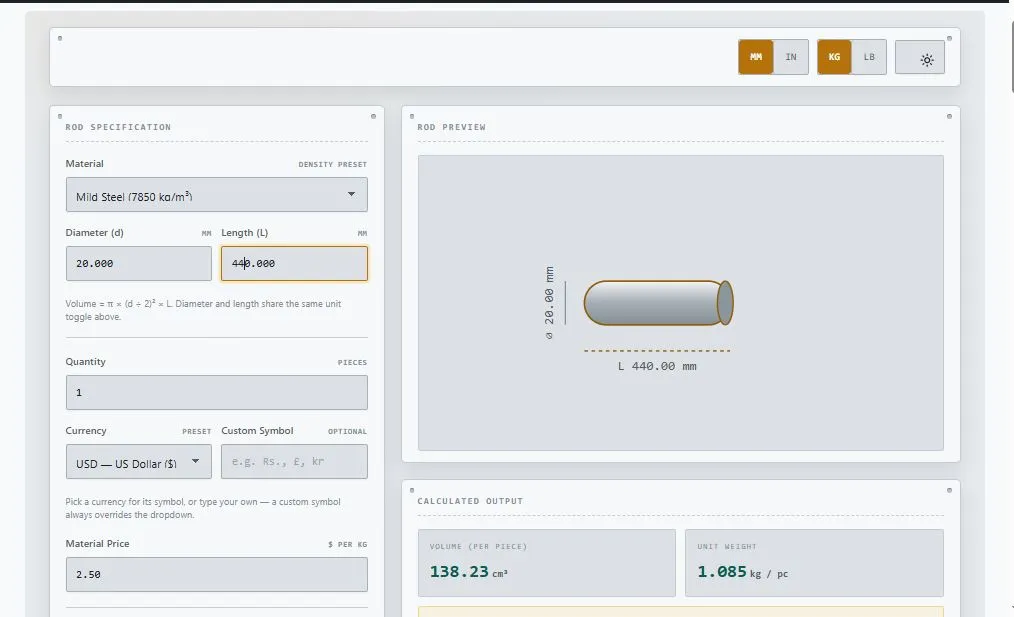
Table of Contents
How to Calculate Round Bar Weight
The weight of a solid round bar can be calculated from its diameter, length, and material density. Because a round bar has a cylindrical shape, its volume is calculated from the diameter and length, then multiplied by the density of the selected material to determine its theoretical weight.
The Round bar weight calculator above performs these calculations automatically and supports different materials and measurement units.
Round Bar Weight Formula
Weight = Volume × Material Density
Volume = π × (Diameter ÷ 2)² × Length
For accurate results, the calculator converts the entered measurements into consistent internal units before calculating the volume and weight. The final result is then converted into the selected units for display.
Common Round Bar Weight Chart
The table below shows the approximate weight per metre of solid mild steel round bars based on common diameters. These values are calculated using a standard steel density of 7,850 kg/m³. Actual weight may vary slightly depending on the material grade, manufacturing tolerances, and dimensional accuracy.
Table
| Round Bar Diameter | Approx. Weight per Metre |
| 6 mm | 0.222 kg/m |
| 8 mm | 0.395 kg/m |
| 10 mm | 0.617 kg/m |
| 12 mm | 0.888 kg/m |
| 16 mm | 1.579 kg/m |
| 20 mm | 2.466 kg/m |
| 25 mm | 3.853 kg/m |
| 30 mm | 5.551 kg/m |
| 32 mm | 6.316 kg/m |
| 40 mm | 9.865 kg/m |
| 50 mm | 15.413 kg/m |
| 60 mm | 22.199 kg/m |
| 75 mm | 34.735 kg/m |
| 80 mm | 39.584 kg/m |
| 100 mm | 61.652 kg/m |
These are theoretical weights calculated from nominal diameter and standard mild steel density. For a specific round bar, use the calculator above and select the appropriate material density for a more relevant theoretical weight estimate.
Round Bar Material Density
The weight of a round bar depends not only on its diameter and length but also on the density of the material. The calculator uses standard reference densities for common metals to estimate theoretical weight. Actual weights may vary slightly depending on the specific alloy grade, composition, and manufacturing tolerances.
| Material | Reference Density |
| Aluminum | 2,700 kg/m³ |
| Steel | 7,850 kg/m³ |
| Stainless Steel | 8,000 kg/m³ |
| Brass | 8,500 kg/m³ |
| Copper | 8,960 kg/m³ |
| Titanium | 4,500 kg/m³ |
These density values are standard reference values used for theoretical calculations. For applications requiring exact material weight, use the density specified by the material manufacturer or relevant material standard.
For reference, typical densities of common metals and alloys can vary by material grade and composition. See this metals and alloys density reference for additional material-density information.
Round Bar Weight Calculation Example
For example, consider a solid mild steel round bar with a diameter of 20 mm and a length of 1 metre. Using a standard steel density of 7,850 kg/m³, the theoretical weight can be calculated from the cylindrical volume of the bar.
Given:
- Diameter = 20 mm (0.02 m)
- Length = 1 m
- Material = Steel
- Density = 7,850 kg/m³
Calculation:
Radius = 0.02 ÷ 2 = 0.01 m
Volume = π × (0.01)² × 1
Volume ≈ 0.00031416 m³
Weight = 0.00031416 × 7,850
Weight ≈ 2.47 kg
Therefore, a 20 mm diameter solid mild steel round bar with a length of 1 metre weighs approximately 2.47 kg. The actual weight may vary slightly due to material density and manufacturing tolerances.
Round Bar Weight in Different Units
Round bar weight can be expressed using different units depending on the measurement system and application. The calculator supports common metric and imperial measurements and provides weight results in kilograms and pounds.
Weight per Metre and Weight per Foot
Weight per metre (kg/m) shows how much a round bar weighs for every one metre of length. Weight per foot (kg/ft) provides the equivalent weight for every one foot of length. These values are useful when estimating the weight of different bar lengths or comparing material requirements.
Weight per Piece and Total Weight
Weight per piece represents the calculated weight of one round bar based on the selected diameter, length, and material. If you enter a quantity greater than one, the calculator multiplies the weight per piece by the number of bars to provide the estimated total weight.
Kilograms and Pounds
The calculator can display weight in both kilograms (kg) and pounds (lb). When working with imperial measurements, you can enter dimensions in inches or feet and still receive the calculated weight in the selected output units.
Frequently Asked Questions About Round Bar Weight
How do you calculate the weight of a round bar?
The weight of a solid round bar is calculated by multiplying its cylindrical volume by the density of the material. The volume is determined from the bar's diameter and length. The Round Bar Weight Calculator performs this calculation automatically after you enter the diameter, length, material, and quantity.
What is the formula for round bar weight?
The basic formula is Weight = Volume × Material Density. For a solid round bar, the volume is calculated using π × (Diameter ÷ 2)² × Length. The result depends on the bar's dimensions and the density of the selected material.
How much does a 20 mm steel round bar weigh per metre?
A 20 mm diameter solid steel round bar weighs approximately 2.47 kg per metre when calculated using a standard steel density of 7,850 kg/m³. The actual weight may vary slightly depending on the material grade and manufacturing tolerances.
Does round bar weight change with the material?
Yes. Round bars with the same diameter and length can have different weights because each material has a different density. For example, aluminum is much lighter than steel, while copper is significantly denser. Select the appropriate material in the calculator to estimate the theoretical weight.
Can I calculate the weight of a round bar in pounds?
Yes. The calculator supports weight results in both kilograms and pounds. You can also enter dimensions using supported imperial units such as inches and feet.
Can I calculate the total weight of multiple round bars?
Yes. Enter the number of bars in the quantity field. The calculator calculates the estimated weight of one bar and then multiplies it by the quantity to provide the total weight.
Is the calculated round bar weight exact?
The result is a theoretical weight based on the entered dimensions and the selected material density. Actual weight can vary slightly due to material composition, alloy grade, manufacturing tolerances, surface condition, and dimensional variations.
What materials can I use in the Round Bar Weight Calculator?
The calculator supports common materials including aluminum, steel, stainless steel, brass, copper, and titanium. You can select a material preset or use a custom density when a specific material grade requires a different reference value.
Using the Round Bar Weight Calculator
The round bar weight calculator makes it easy to estimate the weight of solid round bars by entering the diameter, length, material, and quantity. It is useful for quickly checking estimated bar weight when planning material requirements, comparing different materials, or preparing preliminary calculations.
Important Notes & Disclaimer
The results provided by this calculator are theoretical estimates based on the dimensions, quantity, and material density selected or entered by the user. Actual round bar weight may vary depending on the material grade, composition, manufacturing tolerances, and measured dimensions.
For applications where precise weight is important, users should verify the material specifications and actual dimensions with the relevant manufacturer or supplier before making purchasing, shipping, fabrication, or engineering decisions.
BytePriva provides this calculator as a general-purpose estimation tool and does not guarantee that calculated results will exactly match the weight of a specific physical product.