A welding wire consumption calculator works out exactly how much filler wire a weld actually needs — not a rough estimate, but a real number based on your joint's geometry, welding process, and deposition efficiency. Enter your joint type, dimensions, material, and process, and it instantly calculates the deposited weld metal weight, the wire you need to buy after efficiency and wastage losses, and the total cost.
Most calculators online only handle one weld shape or assume a fixed density and efficiency for every process. This one works across fillet welds and both square and V-groove butt welds, uses the real geometry-based area formula for each, and lets you set your own material density and process efficiency instead of guessing — because a stick electrode and a submerged-arc process don't waste wire at the same rate.
Weld joint & geometry
Filler wire & process
Labor & overhead (leave blank / 0 if not applicable)
Live weld cross-section preview
Results
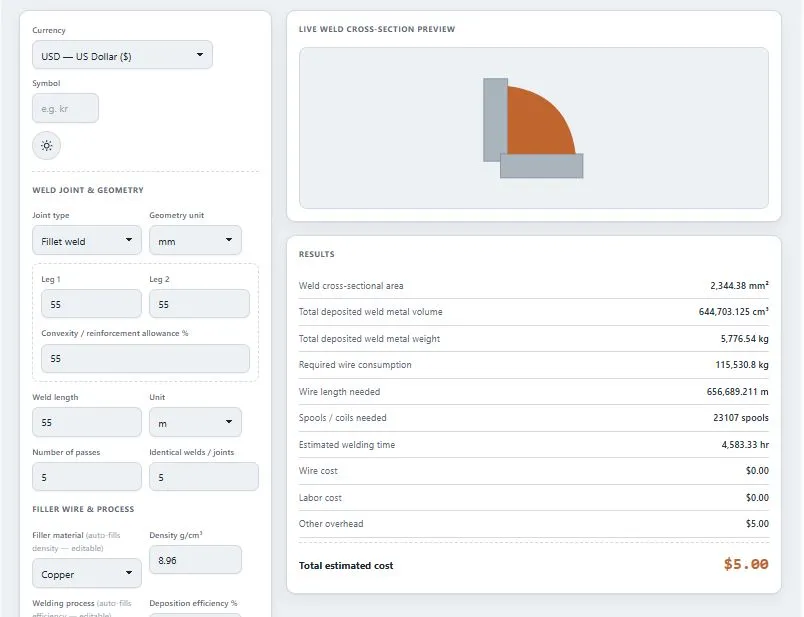
Table of Contents
How the Welding Wire Consumption Calculator Works
The calculator runs on your joint's real geometry, not a lookup table, and works through five stages.
Step 1 — Cross-sectional area. Depending on the joint type you select, the calculator computes the weld's cross-sectional area from actual geometry: a fillet weld uses leg lengths and a convexity allowance for the reinforcement bulge; a butt weld (square or V-groove) uses plate thickness, root gap, root face, groove angle, and reinforcement width and height. Each shape has its own real formula — a V-groove, for example, accounts for the triangular bevel area created by the groove angle in addition to the root gap and cap reinforcement.
Step 2 — Deposited weld metal volume and weight. The cross-sectional area is multiplied by the weld length to get volume, then by the material density you enter (or select from a reference list) to get the actual weight of metal deposited. Multiple identical welds are multiplied through; multiple passes are not, since passes build up the same total fill rather than adding extra metal.
Step 3 — Wire consumption. Not all wire fed into the arc ends up in the weld — spatter, stub loss, and fume account for the rest. The deposited weight is divided by your chosen deposition efficiency (which varies significantly by process) to get the wire actually consumed, then divided again by any additional wastage/handling allowance you specify.
Step 4 — Wire length and spools. If you provide a wire diameter, the calculator works out the wire's linear mass from its diameter and density, then converts your total wire weight into a length. If you provide a spool weight, it also tells you how many spools to order.
Step 5 — Time and cost. If you enter a travel speed, the calculator estimates welding time (passes × length ÷ speed) and multiplies it by your labor rate. Wire cost, labor cost, and any other overhead you enter are added together for the total estimated cost.
Why Use This Welding Wire Consumption Calculator
Wire consumption estimates are easy to get wrong when a calculator assumes one weld shape or one fixed efficiency number for every process. This welding wire consumption calculator is built to avoid both problems:
- Real geometry, not a guess. Fillet, square-groove, and V-groove joints each use their own actual area formula based on the dimensions you enter.
- Process-aware efficiency. Deposition efficiency differs a lot between SMAW, GMAW, FCAW, GTAW, and SAW — you set the real number for your process instead of one average figure covering all of them.
- Your own material. Density is entered or selected, never assumed, so mild steel, stainless, aluminum, and other alloys are all handled accurately.
- Passes counted correctly. Multiple passes add welding time, not extra deposited metal — a detail many simple calculators get wrong.
- Wire length and spool count. Enter a wire diameter and spool weight and get a direct answer on how many spools to order, not just a weight figure.
- One clear total cost. Wire cost, labor time, and overhead all roll into a single final number, visible instantly as you adjust any input.
Filler Material & Process Reference Guide
The material dropdown auto-fills a typical density (g/cm³) for common filler metals — mild steel, stainless steel, aluminum, copper, silicon bronze, nickel alloy, and titanium — and the process dropdown auto-fills a typical deposition efficiency for SMAW, GMAW, FCAW, GTAW, and SAW. Both are starting points, not fixed rules: actual density varies slightly by alloy grade, and actual deposition efficiency depends on your specific parameters, technique, and equipment condition, so both fields stay fully editable.
For the official definitions behind these welding processes, joint terminology, and process classifications, the American Welding Society is the standard reference used across the industry. It's a good place to confirm the exact process designation and typical parameter ranges for your application before finalizing a wire order.
Who This Calculator Is Built For
- Welders and fabricators estimating wire needed for a job before ordering, so they don't run short mid-project or over-order and tie up budget
- Welding supervisors and estimators quoting jobs that need an accurate wire and labor cost, not a rough guess
- Procurement staff calculating how many spools or coils to purchase for a production run of identical joints
- Welding students and trainers who want to see how joint geometry, process efficiency, and passes actually translate into real consumption numbers
Density & Deposition Efficiency Reference
Table 1 — Material Density (tool ke "Filler material" dropdown ke exact values):
| Material | Density (g/cm³) |
|---|---|
| Mild / Carbon Steel | 7.85 |
| Stainless Steel (304/316) | 8.00 |
| Aluminum & Al Alloys | 2.70 |
| Copper | 8.96 |
| Silicon Bronze | 8.80 |
| Nickel Alloy | 8.90 |
| Titanium | 4.51 |
Table 2 — Deposition Efficiency by Process (tool ke "Welding process" dropdown ke exact values):
| Process | Typical Deposition Efficiency |
|---|---|
| SMAW — Stick electrode | 65% |
| GMAW — Solid wire (MIG) | 95% |
| FCAW — Gas-shielded flux-cored | 85% |
| FCAW-S — Self-shielded flux-cored | 80% |
| GTAW — TIG with filler rod | 98% |
| SAW — Submerged arc | 99% |
These are the same starting values used in the calculator's material and process dropdowns — selecting either one auto-fills the matching field above, which you can then adjust if your actual material or process differs.
Tips for Getting Accurate Results
Here's how to get the most accurate number out of this welding wire consumption calculator:
- Match your geometry unit before entering dimensions. Switch the geometry unit to mm or in first, since it applies to every dimension field including wire diameter.
- Use your actual process efficiency, not just the auto-filled figure. The dropdown gives a typical starting value — if you know your real deposition efficiency from experience or documentation, enter it directly.
- Only fill in wire diameter and spool weight if you want those specific outputs. Leaving them blank simply hides the wire length and spool count results — it doesn't affect the weight or cost calculation.
- Enter travel speed only if you want a time and labor estimate. Without it, the calculator still gives you full wire consumption and wire cost — travel speed only unlocks the time and labor rows.
- Double-check root face against thickness on V-groove joints. The root face can't exceed plate thickness — the calculator caps it automatically, but entering a realistic value gives a more accurate bevel area.
Frequently Asked Questions
Does this calculator use a fixed price list for wire?
No. There is no built-in wire price list. You enter your own wire rate per kg or per pound, and the calculator uses exactly that figure.
Which weld joint types does it support?
Three: fillet welds, square-groove butt welds, and V-groove butt welds. Each uses its own real geometry-based area formula.
Does the number of passes multiply the amount of wire needed?
No. Passes only affect the estimated welding time. The total deposited weld metal is based on the joint's full cross-sectional area, since multiple passes build up the same total fill rather than adding extra metal.
Are the material density and process efficiency values fixed?
No. Selecting a material or process auto-fills a typical reference value into an editable field. You can change either number at any time.
What happens if I don't enter a wire diameter or spool weight?
The calculator still gives you full wire weight and cost. The wire length and spool count results are simply hidden until you provide a diameter and spool weight.
Does it calculate welding time and labor cost?
Only if you enter a travel speed and labor rate. Both are optional — without them, wire weight and wire cost are still calculated normally.
Can I use different units for geometry and weld length?
Yes. Geometry (leg lengths, thickness, root gap, wire diameter) uses the geometry unit you select (mm or in), while weld length has its own separate unit (mm, cm, m, in, or ft).
Is this calculator free to use?
Yes, this welding wire consumption calculator is free with no sign-up required, and it runs entirely in your browser.
Quick Summary
A welding wire consumption calculator gives you the real amount of filler wire a job needs, based on actual joint geometry rather than a rough guess. This calculator supports fillet, square-groove, and V-groove butt welds, uses your own material density and process deposition efficiency, correctly separates passes (which affect time) from repeat joints (which affect metal quantity), and rolls wire cost, labor, and overhead into one total estimated cost — all fully driven by the numbers you enter.
Disclaimer
This welding wire consumption calculator is provided by BytePriva for general estimation purposes only. It uses standard geometric and metallurgical formulas but does not account for every real-world welding variable, and results depend entirely on the dimensions, material, process, and rate values you enter. BytePriva makes no warranty as to the accuracy of any result and accepts no liability for decisions, orders, or job costs based on this tool. Always verify wire quantities and joint specifications against your approved welding procedure (WPS) before ordering material or quoting a job.