The Square Bar Weight Calculator helps you quickly estimate the weight of a square bar based on its dimensions, length, material, and quantity. Enter the required measurements and select your preferred units to get an instant estimate of the square bar weight for common materials such as steel, stainless steel, aluminum, brass, copper, and titanium.
Bar Specification
ρ = 7,850 kg/m³
Bar Preview
Formula Reference
- Sharp corners
- Area = A²
- Rounded corners
- Area = A² − (4 − π) r²
- Weight
- Weight = Area × Length × Density
Estimates are for reference only. Actual bar weight can vary with mill tolerance, alloy composition and surface finish. Always confirm against a certified mill test report before ordering or invoicing.
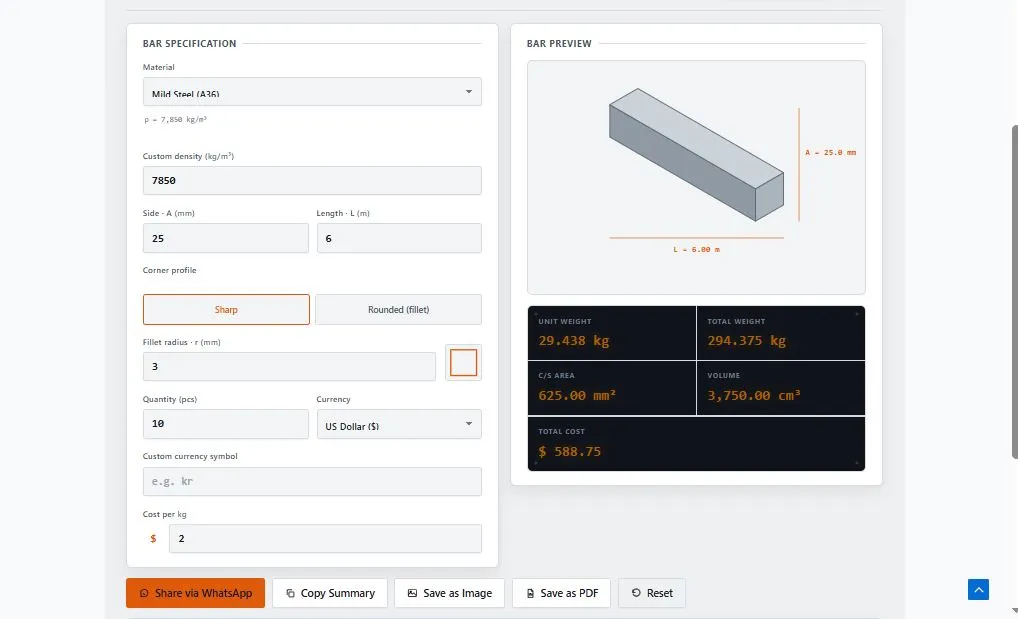
Table of Contents
How to Calculate Square Bar Weight
To calculate the weight of a square bar, first determine its volume using the square cross-sectional area and the bar's length. The volume is then multiplied by the density of the selected material to estimate the total weight. The Square Bar Weight Calculator performs these calculations automatically, allowing you to enter the bar dimensions, length, material, and quantity without doing the calculations manually.
Square Bar Weight Formula
The basic formula for calculating the weight of a square bar is:
Volume = Width × Width × Length
Weight = Volume × Material Density
For example, when dimensions are entered in millimeters, the measurements should be converted to meters before calculating the volume if the material density is expressed in kg/m³. The Square Bar Weight Calculator handles these unit conversions automatically and uses the selected material density to estimate the bar's weight.
For multiple bars, the estimated weight of one bar is multiplied by the quantity entered in the calculator.
Square Bar Weight Calculation Example
For example, suppose you want to estimate the weight of a steel square bar with a width of 50 mm and a length of 2 meters.
First, convert the width from millimeters to meters:
50 mm = 0.05 m
Calculate the cross-sectional area:
0.05 × 0.05 = 0.0025 m²
Calculate the volume:
0.0025 × 2 = 0.005 m³
Using a standard steel density of approximately 7,850 kg/m³:
0.005 × 7,850 = 39.25 kg
Therefore, a 50 mm × 50 mm steel square bar with a length of 2 meters has an estimated weight of approximately 39.25 kg.
Actual weight may vary depending on the material grade, density, and manufacturing tolerances.
Square Bar Weight Chart
The following square bar weight chart provides approximate weight values for common square bar sizes. These values are based on standard steel density of approximately 7,850 kg/m³ and are intended as a quick reference. Actual weight may vary depending on the material grade, density, and manufacturing tolerances.
| Square Bar Size | Weight per Meter (kg/m) | Weight per Foot (kg/ft) |
|---|---|---|
| 10 × 10 mm | 0.785 kg/m | 0.239 kg/ft |
| 12 × 12 mm | 1.130 kg/m | 0.344 kg/ft |
| 15 × 15 mm | 1.766 kg/m | 0.538 kg/ft |
| 20 × 20 mm | 3.140 kg/m | 0.957 kg/ft |
| 25 × 25 mm | 4.906 kg/m | 1.496 kg/ft |
| 30 × 30 mm | 7.065 kg/m | 2.153 kg/ft |
| 40 × 40 mm | 12.560 kg/m | 3.828 kg/ft |
| 50 × 50 mm | 19.625 kg/m | 5.982 kg/ft |
| 60 × 60 mm | 28.260 kg/m | 8.615 kg/ft |
| 75 × 75 mm | 44.156 kg/m | 13.459 kg/ft |
| 80 × 80 mm | 50.240 kg/m | 15.316 kg/ft |
| 100 × 100 mm | 78.500 kg/m | 23.927 kg/ft |
Square Bar Weight by Material
The weight of a square bar depends not only on its dimensions and length but also on the density of the material. For the same square bar size, materials with higher density will produce a greater estimated weight, while lower-density materials will weigh less. The Square Bar Weight Calculator allows you to select the appropriate material so you can compare estimated weights based on the selected material density.
Common Material Densities
| Material | Approximate Density (kg/m³) |
|---|---|
| Steel | 7,850 |
| Stainless Steel | 8,000 |
| Aluminum | 2,700 |
| Brass | 8,500 |
| Copper | 8,960 |
| Titanium | 4,500 |
The density values above are standard approximate values used for weight estimation. Actual density can vary depending on the specific alloy, grade, composition, and manufacturing specification. For precise commercial or engineering requirements, always verify the material specification provided by the manufacturer or supplier.
For additional information about material properties and density, you can refer to the Engineering ToolBox reference on material densities.
Square Bar Weight in Different Units
Square bar dimensions and weight can be expressed using different measurement systems depending on the application and region. Common dimensions include millimeters, centimeters, meters, inches, and feet, while weight is commonly measured in kilograms or pounds.
The Square Bar Weight Calculator makes it easier to work with different units by allowing you to enter dimensions and length in your preferred measurement system and view the estimated result in the available weight units. This helps reduce manual conversion errors when working with international specifications or different measurement standards.
When comparing square bar weights, always make sure the dimensions, length, material density, and weight units are consistent before using the results for calculations or material planning.
Factors That Affect Square Bar Weight
Several factors can affect the estimated weight of a square bar. The most important factors are the bar's cross-sectional dimensions, length, material density, and quantity.
Bar Dimensions: Increasing the width of a square bar increases its cross-sectional area and therefore increases its weight significantly.
Length: A longer square bar contains more material and has a proportionally greater weight than a shorter bar of the same size and material.
Material Density: Different materials have different densities. For the same dimensions and length, a steel square bar will weigh more than an aluminum square bar because steel has a higher density.
Quantity: When calculating the total weight of multiple square bars, the weight of one bar is multiplied by the number of bars required.
Material Grade and Manufacturing Tolerances: The actual weight of a physical square bar may vary slightly from a theoretical calculation because of differences in material composition, grade, manufacturing tolerances, and actual measured dimensions.
Frequently Asked Questions
How do you calculate the weight of a square bar?
The weight of a square bar is calculated by multiplying its volume by the density of the selected material. The volume is found by multiplying the square cross-sectional area (width × width) by the bar's length.
What is the formula for square bar weight?
The basic formula is: Weight = Width × Width × Length × Material Density. The dimensions must be converted into compatible units before applying the material density.
How accurate is a square bar weight calculator?
A square bar weight calculator provides a theoretical weight estimate based on the dimensions and material density entered or selected by the user. Actual weight may vary slightly due to material grade, composition, manufacturing tolerances, and dimensional variations.
How do I calculate the weight of a steel square bar?
Enter the square bar's width, length, and quantity, then select steel as the material. The calculator uses the selected steel density and the entered dimensions to estimate the total weight.
Does square bar size affect its weight?
Yes. A larger square cross-section contains more material, so a square bar with greater width will weigh more per unit length than a smaller bar made from the same material.
Can I calculate square bar weight in kilograms and pounds?
Yes, if the calculator provides both units, you can use the available unit options to calculate or display the estimated square bar weight in kilograms or pounds.
Does material type change square bar weight?
Yes. Different materials have different densities. For the same dimensions and length, a material with higher density will have a greater estimated weight than a material with lower density.
Can I calculate the total weight of multiple square bars?
Yes. Enter the required quantity along with the dimensions, length, and material. The calculator uses the estimated weight of one bar to determine the total estimated weight for the specified quantity.
Important Notes & Disclaimer
The results provided by this Square Bar Weight Calculator are theoretical estimates based on the dimensions, length, quantity, and material density selected or entered by the user. Actual square bar weight may vary depending on the material grade, composition, manufacturing tolerances, and measured dimensions.
For applications where precise weight is important, users should verify the material specifications and actual dimensions with the relevant manufacturer or supplier before making purchasing, shipping, fabrication, or engineering decisions.
BytePriva provides this calculator as a general-purpose estimation tool and does not guarantee that calculated results will exactly match the weight of a specific physical product.