Use this free welding cost estimator to calculate the real cost of a weld job — filler metal, shielding gas, and labor — instead of guessing or under-quoting.
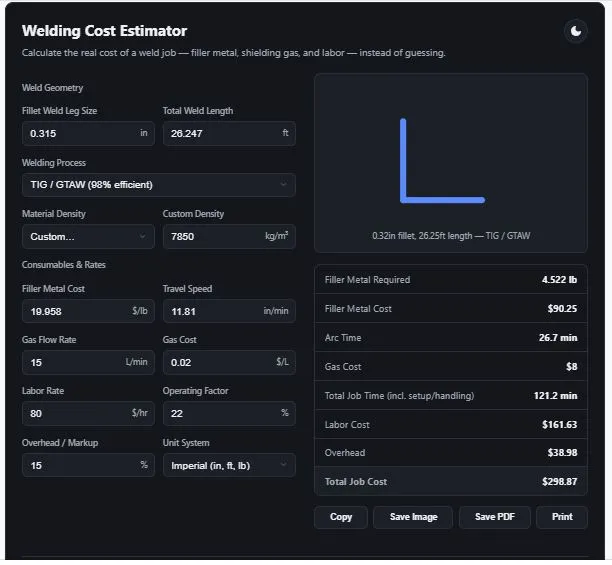
Enter your weld size, length, and welding process, along with your material and labor rates, and get an instant breakdown: filler metal required and its cost, arc time, gas cost, total job time (including realistic setup and handling time), and labor cost — all rolled into a final total.
Formula used: Weld Metal Weight = 0.5 × Leg² × Length × Density, then divided by deposition efficiency to get actual filler metal required.
Welding Cost Estimator
Calculate the real cost of a weld job — filler metal, shielding gas, and labor — instead of guessing.
Weld Geometry
Consumables & Rates
6mm fillet, 2m length — MIG/GMAW
Formulas used: Weld Metal Weight = 0.5 × Leg² × Length × Density | Filler Required = Weight ÷ Efficiency | Arc Time = Length ÷ Travel Speed | Job Time = Arc Time ÷ Operating Factor | Labor Cost = Job Time × Labor Rate
Table of Contents
How This Welding Cost Estimator Works
This welding cost estimator breaks a weld job into four real cost components, instead of giving you one vague number.
Step 1 — Filler Metal Weight: For a fillet weld, the cross-section is roughly a right triangle, so weld metal weight is calculated as: 0.5 × Leg Size² × Weld Length × Material Density.
Step 2 — Actual Filler Required: Not all filler metal ends up in the weld — some is lost to spatter, slag, or fumes. Dividing by the deposition efficiency (which varies by process) gives the real amount of wire or rod you need to buy.
Step 3 — Arc Time and Gas Cost: Weld length divided by travel speed gives arc time, which is then used to calculate shielding gas consumption and cost.
Step 4 — Job Time and Labor Cost: Arc time alone isn't the whole job — setup, positioning, and handling take real time too. Dividing arc time by the operating factor gives a realistic total job time, which is then used to calculate labor cost.
Typical Deposition Efficiency by Welding Process
| Welding Process | Typical Deposition Efficiency |
|---|---|
| TIG / GTAW | 95 – 100% |
| MIG / GMAW (Solid Wire) | 90 – 95% |
| Flux-Cored / FCAW | 80 – 90% |
| Stick / SMAW | 60 – 70% |
Lower efficiency means more filler metal is wasted, which directly increases material cost — this is one reason process choice matters as much as material price when estimating a job.
For official welding standards and procedures, see the American Welding Society's standards page, the industry authority for welding codes including the widely-referenced D1.1 Structural Welding Code.
Who This Calculator Is Built For
This welding cost estimator is built for anyone who's tired of guessing at a job price:
- Fabrication shop owners — quoting jobs quickly and consistently instead of eyeballing labor and material costs
- Freelance & mobile welders — pricing repair or custom jobs on-site with a defensible number, not a guess
- Estimators & project managers — budgeting welding-heavy portions of larger fabrication or construction projects
- Welding students & apprentices — understanding how process choice, efficiency, and labor time actually translate into real cost
- Procurement teams — cross-checking a contractor's quoted welding cost against an independent estimate
- Shop supervisors — comparing the cost impact of switching between MIG, Stick, or TIG for a given job
Tips for Getting Accurate Results
- Use your shop's actual operating factor, not a textbook average — 30% is a common starting point for manual welding, but busy shops with efficient workflows may run higher, while jobs with heavy fit-up or positioning may run lower.
- Check your actual deposition efficiency if you track it — the built-in defaults are solid industry averages, but your specific wire, technique, and equipment can shift this meaningfully on high-volume jobs.
- Don't forget gas cost adds up on longer jobs — it's often overlooked, but this welding cost estimator factors it in automatically based on your actual flow rate and arc time.
- Round labor rate to include relevant overhead if you don't use the separate overhead field — some shops prefer building overhead into an all-in labor rate instead of a separate markup percentage; either approach works, just don't double-count it.
FAQs
How do I calculate the cost of a welding job?
Calculate filler metal weight from the weld geometry, divide by deposition efficiency to get actual filler required, then add gas cost (based on arc time and flow rate) and labor cost (based on total job time, including setup). This welding cost estimator calculates all of these automatically.
What is deposition efficiency in welding?
Deposition efficiency is the percentage of filler metal that actually becomes part of the finished weld, versus what's lost to spatter, slag, or fumes. It typically ranges from 60-70% for Stick welding up to 95-100% for TIG welding.
What is an operating factor in welding cost estimation?
Operating factor is the percentage of total job time actually spent welding (arc-on time), versus time spent on setup, positioning, and handling. A 30% operating factor means only 30% of the total job time is actual welding — the rest is real, billable time too.
Can I use this calculator for both MIG and TIG welding?
Yes. This welding cost estimator includes built-in defaults for MIG/GMAW, Flux-Cored/FCAW, Stick/SMAW, and TIG/GTAW, plus a custom efficiency option for other processes.
Is this welding cost estimator free to use?
Yes, this calculator is completely free, requires no login or signup, and has no usage limits.
Quick Summary
This free welding cost estimator calculates the real cost of a weld job — filler metal, shielding gas, and labor — instead of one guessed number. Enter your weld size, length, welding process, and rates, and get an instant breakdown that accounts for deposition efficiency, arc time, gas consumption, and realistic job time including setup and handling. Results are available in metric or imperial units, with no login required. Whether you're a shop owner quoting a job, an estimator budgeting a project, or a welder comparing process costs, this welding cost estimator gives you a real, defensible number instead of a guess.
Disclaimer
The Welding Cost Estimator and all information on this page are provided by BytePriva for general estimation and informational purposes only. Deposition efficiency, operating factor, and other default values used in this calculator are typical industry ranges; actual figures vary based on equipment, technique, joint fit-up, and shop conditions.
This tool is not a substitute for a certified welding procedure specification (WPS), professional cost estimating software, or a qualified estimator's judgment for bidding purposes. Users are solely responsible for independently verifying all inputs and results before using them for job quotes, contracts, or any decision involving significant financial risk.
By using this calculator, you acknowledge and agree to these terms. For structural, code-critical, or high-value welding contracts, please consult a certified welding engineer or professional estimator.