Use this wire and cable weight calculator to instantly find the weight and cost of any electrical wire or cable. Enter the conductor material, size, insulation, and outer sheath details, and the tool calculates conductor, insulation, and sheath weight separately in kg/km, along with total weight and cost — supporting copper, aluminum, and 9 common insulation/sheath materials in 20+ currencies.
Conductor
Insulation & Sheath
Auto-calculated for a single core.
Live Preview
Results
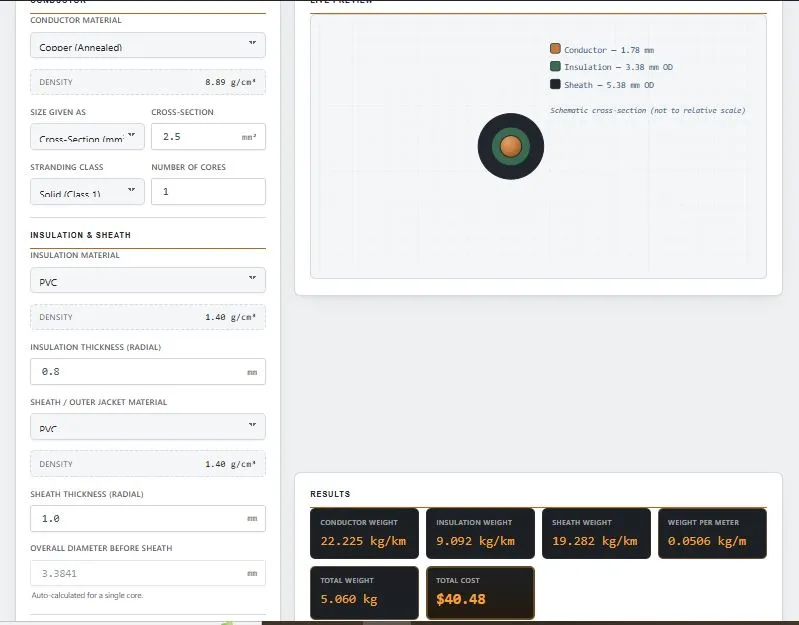
Table of Contents
How the Wire and Cable Weight Calculator Works
This calculator uses the standard layer-based method used across the cable industry — it treats the conductor, insulation, and outer sheath as separate concentric rings and calculates each one's weight individually before adding them together.
1. Conductor Weight — The conductor's cross-sectional area (entered directly in mm², or calculated from a diameter) is multiplied by the material's density and a stranding factor, then by the number of cores.
| Conductor Material | Density (g/cm³) |
|---|---|
| Copper (Annealed) | 8.89 |
| Tinned Copper | 8.89 |
| Aluminum | 2.70 |
| Aluminum Alloy | 2.70 |
| Copper-Clad Aluminum | 3.00 |
2. Insulation Weight — The insulation forms a ring around each conductor. Its area is the outer insulated diameter squared minus the conductor diameter squared, multiplied by π/4, then by the insulation material's density and the number of cores.
3. Sheath Weight — The outer sheath wraps around the entire cable assembly (not each core individually), so its ring area is calculated once, using the overall diameter before and after the sheath.
4. Total Weight & Cost — All three layer weights are added, any manufacturing/wastage allowance is applied, and the result is converted to your selected length, quantity, and currency.
You can also enter a custom density for any conductor, insulation, or sheath material not listed.
Why Use This Wire and Cable Weight Calculator
Calculating cable weight by hand means digging up density figures for the conductor, the insulation, and the sheath separately, converting diameters to areas, and adding manufacturing allowance on top — a multi-step process where one wrong unit conversion throws off the whole result.
This calculator handles all three layers at once. Enter the conductor size, insulation and sheath specs, and it returns each layer's weight individually (in kg/km) alongside the combined total — so you can see exactly where the weight is coming from, not just a single final number.
It also converts straight into a purchase estimate: pick your currency, enter a price per kg or per lb, and the total cost for your exact length and number of drums appears instantly, with live unit switching so you never have to redo the math.
Conductor and Insulation Materials Explained
The conductor material affects both weight and conductivity, while the insulation and sheath choice usually comes down to where the cable will actually be installed.
Copper (Annealed) (8.89 g/cm³) is the default for most wiring — house wiring, control panels, motor leads — because it conducts better than any commonly used alternative and is easy to terminate.
Tinned copper carries the same density but has a thin tin coating, mostly used in marine cabling and anywhere moisture exposure would otherwise corrode bare copper over time.
Aluminum (2.70 g/cm³) weighs roughly a third of copper, which is why it shows up in long-distance power transmission and large-gauge feeder cables where weight and cost per meter matter more than raw conductivity.
Copper-clad aluminum (CCA) (3.00 g/cm³) is a middle ground — an aluminum core with a copper skin — common in lower-cost data and speaker cabling.
On the insulation side, PVC (1.40 g/cm³) is the industry default for general-purpose wiring due to its low cost and decent flexibility. XLPE and LDPE/HDPE (0.92–0.95 g/cm³) are lighter and handle higher temperatures, so they turn up in power cables and outdoor-rated wiring. EPR/rubber and LSZH (1.50 g/cm³) are chosen for flexibility and low-smoke safety requirements respectively — LSZH specifically for enclosed spaces like tunnels and ships. Polyurethane and nylon show up in cables that need abrasion resistance, while FEP (Teflon) is reserved for high-temperature or chemical-resistant applications.
Working with a material not listed? Use the "Custom Material" option for the conductor, insulation, or sheath, and enter the exact density from your supplier's datasheet.
For additional conductor and cable material references, see EngineeringToolbox's metal density chart.
Who This Calculator Is Built For
Cable manufacturers and traders use it to cross-check a quoted kg/km figure against their own datasheet before pricing a bulk order, catching mismatches before they turn into a costly mistake.
Electrical contractors and site engineers rely on it to estimate how much a drum of cable will actually weigh — useful for planning transport, crane capacity, or simply confirming a supplier's delivery note.
Panel builders and OEM buyers use it to compare the true landed cost of copper versus aluminum conductors for the same job, since the weight difference directly changes the price per meter.
It's also useful for electrical engineering students and hobbyists who want to understand how a cable's construction — conductor, insulation, and sheath — actually adds up to its final listed weight, rather than just accepting a datasheet number at face value.
Tips for Getting Accurate Results
A couple of habits separate a rough guess from a number you can actually order against.
If your datasheet gives conductor size as a diameter rather than cross-section, use the "Diameter" mode instead of converting it to mm² by hand — the calculator handles that conversion internally, so there's no rounding error carried forward.
For multi-core cables, don't skip the "Overall Diameter Before Sheath" field — it can't be reliably auto-calculated because bunching and filler geometry varies between manufacturers, so pull that figure straight from the cable's datasheet rather than estimating it.
If you're ordering rather than just checking a spec, add a manufacturing or wastage allowance. This is typically small for factory-wound drums but should be increased if there's expected handling loss or cutting waste at your end.
For an odd-ball insulation or sheath compound not on the list, use the custom density option and take the figure from the supplier's technical datasheet rather than a generic average.
Frequently Asked Questions
How is wire and cable weight calculated?
Each layer — conductor, insulation, and sheath — is treated as a ring with its own cross-sectional area. That area is multiplied by the material's density to get kg/km, and the three layers are added together for the total weight.
What conductor materials does this calculator support?
Copper, tinned copper, aluminum, aluminum alloy, and copper-clad aluminum (CCA) are built in, plus a custom density option for any other conductor material.
Can I enter conductor size as a diameter instead of mm²?
Yes. Switch "Size Given As" to "Diameter" and enter the value in mm — the calculator converts it to cross-sectional area internally before running the weight calculation.
What does the stranding factor do?
It accounts for the small extra length and air gaps in stranded or flexible conductors compared to a solid core of the same cross-section, slightly adjusting the calculated weight to match real-world stranded wire.
Why do I have to enter the "Diameter Before Sheath" manually for multi-core cables?
Because how multiple insulated cores pack together — with fillers, binders, or specific lay geometry — varies by manufacturer and can't be reliably estimated by a single formula. For a single core, this value is calculated automatically.
Does the calculator handle cables with no insulation or no sheath?
Yes. Selecting "None" for either layer removes it from the calculation entirely, useful for bare conductors or unsheathed multi-core assemblies.
What's the difference between the per-layer weights and the total weight?
Conductor, insulation, and sheath weights are shown separately in kg/km so you can see where the weight comes from. Total weight applies your entered length, quantity, and any wastage allowance, converted to kg or lb.
Can I get the cost in my local currency?
Yes, over 20 currencies are available, including USD, EUR, GBP, INR, and PKR, with a custom currency symbol option if yours isn't listed.
Wire and Cable Weight Calculator — Quick Summary
This wire and cable weight calculator gives instant, layer-by-layer weight and cost results for any conductor, insulation, and sheath combination — no manual density lookups, no unit conversion errors. Whether you're checking a single wire or pricing a full drum, this wire and cable weight calculator handles the math and currency conversion in one step, saving time on every quote or site estimate.
Disclaimer
This wire and cable weight calculator is provided by BytePriva as a free reference tool to help estimate weight and cost using standard density values and layer-based geometric formulas. Results are intended for general planning, quoting, and educational purposes only.
Actual cable weight can vary due to manufacturing tolerances, filler and binder materials, core lay-up geometry, and alloy composition. For procurement, safety-critical, or high-value orders, always confirm the final figures against certified manufacturer datasheets or test certificates before purchasing or installation.
BytePriva makes no warranty regarding the accuracy of results generated by this tool and is not liable for any loss, cost, or damage arising from decisions made using these estimates. Use of this calculator is entirely at the user's own discretion.