A metal scrap value calculator works out what your scrap is actually worth in your pocket — not just weight multiplied by price, but the real, final number after impurity, moisture, weighing tolerance, dealer commission, and transport are accounted for. Enter your gross weight, your rate, and whichever deductions apply to your load, and the calculator instantly shows an itemized breakdown ending in one clear figure: the net payable amount.
Most online scrap calculators stop at "weight × rate." That's not what you get paid at the yard. This tool is built to match how a real transaction actually settles — gross weight in, deductions applied honestly, net payment out — so you know roughly what to expect before the metal ever leaves your hands.
Scrap details
Deductions & fees (enter only what applies — leave 0 if none)
Live value breakdown
- Net payable—
- Weight / quality loss—
- Commission—
- Transport—
- Other—
Results
Deductions exceed the scrap value — the net payable amount is negative.
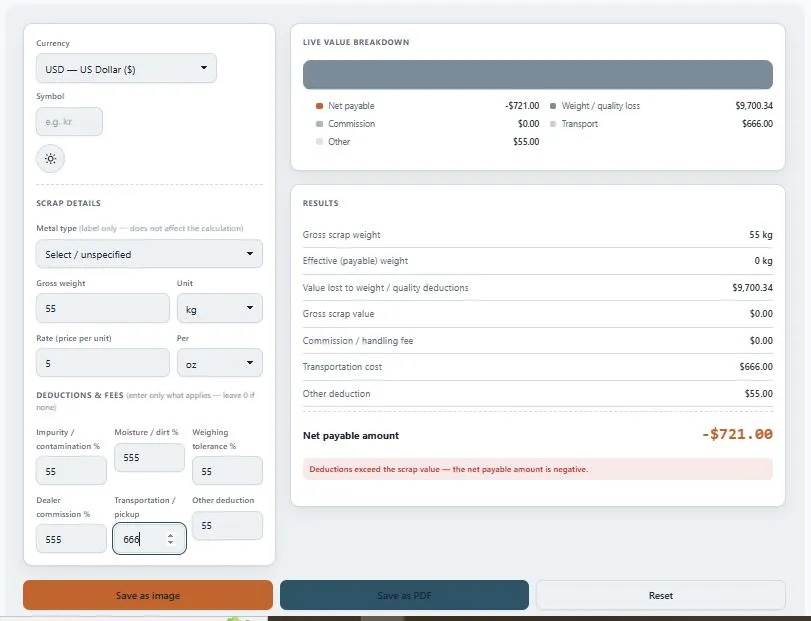
Table of Contents
How the Metal Scrap Value Calculator Works
The calculator runs on five inputs you control, and nothing is assumed or hidden behind the scenes.
Step 1 — Gross weight. Enter your scrap weight in kilograms, grams, pounds, ounces, metric tons, US short tons, or UK long tons.
Step 2 — Rate. Enter the price you're being offered, and choose which unit that price is quoted per (it doesn't have to match your weight unit — the calculator converts automatically).
Step 3 — Weight and quality deductions. Scrap yards rarely pay on the full gross weight. Three deductions apply here, each entered as a percentage: impurity/contamination (non-metal material or mixed metals reducing usable weight), moisture/dirt (water weight or debris that shouldn't be paid for), and weighing tolerance (the small shrinkage or scale-tolerance margin many yards apply). These are applied in sequence to your gross weight, giving you an effective (payable) weight.
Step 4 — Value. Effective weight is multiplied by your rate to get the gross scrap value.
Step 5 — Fees. A dealer commission percentage, a flat transportation/pickup cost, and any other deduction are subtracted from the gross value.
What's left is your net payable amount — the number that matters. If your fees happen to exceed the scrap's value, the calculator shows that honestly as a negative number with a warning, rather than hiding it.
Why Use This Metal Scrap Value Calculator
Scrap pricing conversations move fast, and it's easy to lose track of how much a "small" deduction actually costs you. This metal scrap value calculator gives you a few concrete advantages:
- A real net figure, not a guess. You see the exact amount left after every deduction, not just a raw weight-times-rate estimate.
- Works in your currency. Choose from 25+ currencies including USD, EUR, GBP, INR, and PKR, or set a custom symbol if yours isn't listed.
- Handles mixed units. Weight and rate don't need to be in the same unit — quote in pounds, weigh in kilograms, and the math still holds.
- A visual breakdown. A live bar chart shows how your value splits between net payout, weight loss, commission, transport, and other fees, so you can see at a glance where the money is going.
- Save your results. Export the breakdown as a clean image or a one-page PDF to keep for your records or share with the other party before a deal is finalized.
- Works on any device. No horizontal scrolling, no cramped buttons — usable on a phone screen at the scrap yard, not just at a desk.
Metal Types & Scrap Grading Guide
The calculator lets you label your entry by metal type — copper, brass, aluminum, stainless steel, steel/iron, lead, zinc, and more — purely for your own reference on the results and export. It does not use a fixed price list, because scrap prices for the same metal can vary significantly by grade, region, and day. A clean, bare No. 1 copper wire and a mixed, coated copper cable are not the same material, and no calculator should pretend otherwise by quoting one number for "copper."
If you want to understand how different grades of the same metal are actually classified in the industry — what separates a No. 1 from a No. 2 grade, or what counts as contamination — the Recycled Materials Association's Scrap Specifications Circular is the standard reference used across the scrap trade for defining these categories. It's a useful starting point before you negotiate a rate, since your buyer's grading is what ultimately decides which percentage deductions apply.
Weight Unit Conversion Reference
| Unit | Equals (in kg) |
|---|---|
| 1 Kilogram (kg) | 1 kg |
| 1 Gram (g) | 0.001 kg |
| 1 Metric Ton (t) | 1,000 kg |
| 1 Pound (lb) | 0.45359237 kg |
| 1 Ounce (oz) | 0.02834952 kg |
| 1 US Short Ton | 907.18474 kg |
| 1 UK Long Ton | 1,016.0469 kg |
These are the exact conversion factors used inside the calculator, so weight entered in any unit converts precisely — no rounding shortcuts.
Who This Calculator Is Built For
- Individuals and households clearing out old wiring, pipes, appliances, or car parts who want a realistic idea of payout before visiting a yard
- Small scrap collectors and dealers who need to quote or double-check a price quickly, without opening a spreadsheet
- Recycling and demolition businesses estimating the value of a mixed metal load, including transport and handling costs
- Procurement or operations staff who need to sanity-check a supplier's or buyer's quoted price against a transparent breakdown
Tips for Getting Accurate Results
Here's how to get the most accurate number out of this metal scrap value calculator:
- Weigh before you deduct. Enter the actual gross weight from a scale, not an estimate — every downstream number depends on it.
- Ask your buyer for their deduction percentages up front. Impurity, moisture, and tolerance figures vary by yard; using your buyer's actual numbers gives you a far more accurate result than a generic guess.
- Match your rate unit to how it was quoted. If you were quoted "$3 per pound," select pounds as the rate unit even if you weighed in kilograms — the calculator handles the conversion, but only if the unit is set correctly.
- Don't skip small percentages. A 2–3% moisture or tolerance deduction looks minor on paper but adds up on larger loads — include it rather than rounding it to zero.
- Re-check after negotiating. If a buyer revises their rate or commission mid-conversation, update the fields immediately; the net payable amount updates live as you type.
Frequently Asked Questions
Does this calculator use fixed scrap prices for each metal?
No. There is no built-in price list. You enter the rate you were quoted or the market rate you're working with, and the calculator does the math from there. Scrap prices change too often and vary too much by grade and region for a fixed list to be reliable.
What's the difference between gross weight and effective weight?
Gross weight is what your scale shows. Effective weight is what's left after impurity, moisture, and weighing-tolerance deductions are applied — it's the weight you're actually paid on.
Can I use different units for weight and rate?
Yes. Weigh in kilograms and quote in pounds, or any other combination — the calculator converts between kilograms, grams, metric tons, pounds, ounces, US short tons, and UK long tons automatically.
What happens if my deductions and fees are more than the scrap is worth?
The calculator will show a negative net payable amount along with a clear warning, rather than hiding the shortfall. That's a real possibility with heavily contaminated or low-value loads plus high transport costs, and you should see it plainly.
Is my currency supported?
The calculator includes 25+ major currencies. If yours isn't listed, select "Custom" and enter your own currency symbol.
Can I save or share my calculation?
Yes. Use "Save as Image" for a clean picture of your breakdown, or "Save as PDF" for a one-page printable summary with no extra page clutter.
Does the "metal type" field change the calculation?
No. It's a label only, shown on your results and exports for your own reference. It has no effect on the numbers.
Is this calculator free to use?
Yes, this metal scrap value calculator is free with no sign-up required, and it runs entirely in your browser.
Quick Summary
A metal scrap value calculator gives you the real number that matters at a scrap sale: not gross weight times rate, but the net payable amount after impurity, moisture, weighing tolerance, dealer commission, and transport are subtracted. This calculator lets you enter your own weight, your own rate, and your own deductions in any of 25+ currencies, shows a live visual breakdown of where your money goes, and lets you export the result as an image or a clean one-page PDF — all without assuming a fixed price for any metal.
Disclaimer
This metal scrap value calculator is provided by BytePriva for general estimation purposes only. It does not use live market prices and does not represent an offer, quote, or guarantee of payment from any buyer, dealer, or recycling facility. All figures depend entirely on the weight, rate, and deduction values you enter, and actual payouts may differ based on a buyer's own grading, testing, and terms. BytePriva makes no warranty as to the accuracy of any result and accepts no liability for decisions made based on this tool. Always confirm final pricing and deductions directly with your buyer before completing a transaction.