This channel weight calculator works out the exact weight of a C-channel or C-beam from its section dimensions, length, and material density, then converts that into a total material cost. Enter the channel's overall depth, flange width, flange thickness, and web thickness, choose the material — mild/carbon steel, stainless steel 304 or 316, galvanized steel, aluminum, or a copper alloy — and the calculator computes the true cross-sectional area rather than assuming a fixed profile.
Enter the channel length and the number of pieces you need, add a wastage percentage for cutting scrap, and the tool returns the cross-sectional area, weight per piece, total weight, and the material you actually need to procure. From there, choose how your supplier prices the steel — per kg, per metric ton, per meter, or per piece — and the calculator adds labor, cutting/fabrication, and shipping costs to give a complete total in any of 25+ world currencies.
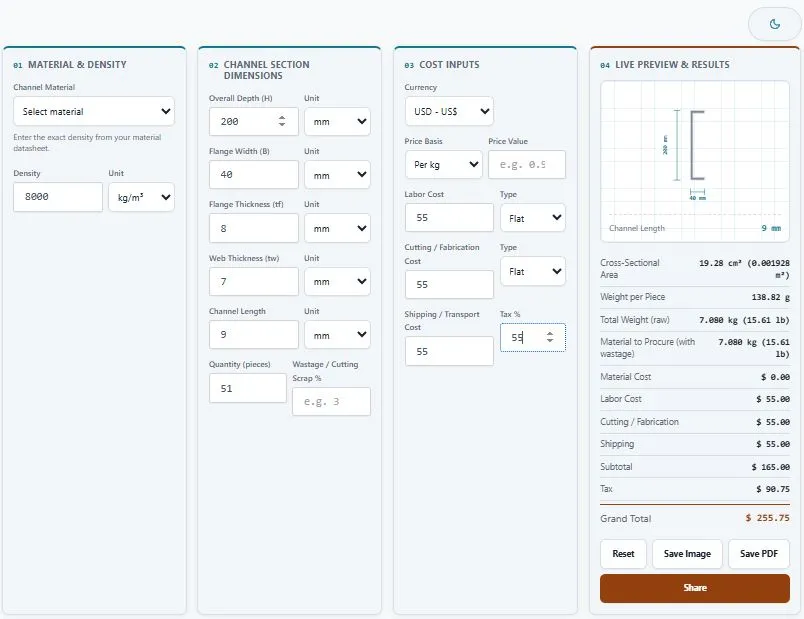
Table of Contents
How the Channel Weight Calculator Works
The calculator is built on the standard cross-sectional area method used across structural steel engineering:
Cross-Sectional Area = 2 × (Flange Width × Flange Thickness) + (Depth − 2 × Flange Thickness) × Web Thickness
Weight = Cross-Sectional Area × Length × Density
The tool converts every dimension into meters and every density into kilograms per cubic meter behind the scenes.
This means it doesn't matter whether you enter your section dimensions in millimeters, centimeters, meters, or inches — the math stays accurate down to a fraction of a kilogram. The calculator also checks that your flange thickness is physically possible for the given depth, and that your web thickness doesn't exceed the flange width, since a C-channel's flanges only extend from one side of the web; if either check fails, it shows a warning instead of returning an incorrect weight.
Reference Density Table
The table below shows typical densities for common channel materials. These are industry reference values only — always confirm the exact density from your mill certificate, since alloy composition and grade can shift the number slightly.
| Material | Density (kg/m³) |
|---|---|
| Mild / Carbon Steel | ~7850 |
| Stainless Steel 304 | ~8000 |
| Stainless Steel 316 | ~8000 |
| Galvanized Steel | ~7850 |
| Aluminum | ~2700 |
| Copper Alloy (Bronze/Brass) | ~8900 |
Worked Example
Take a mild steel C-channel with an overall depth of 100 mm, flange width of 50 mm, flange thickness of 5 mm, web thickness of 5 mm, and a density of 7850 kg/m³:
Cross-Sectional Area = 2 × (0.05 m × 0.005 m) + (0.1 m − 0.01 m) × 0.005 m = 0.0005 + 0.00045 = 0.00095 m²
Weight per meter = 0.00095 m² × 7850 kg/m³ = 7.46 kg/m
For a 6-meter channel, that's 7.46 kg/m × 6 m = 44.73 kg per piece. If you're ordering 10 pieces with 3% wastage for cutting scrap, the material to procure works out to 44.73 kg × 10 × 1.03 = 460.7 kg — and that figure (or the equivalent length or piece count, depending on how your supplier prices) feeds directly into the final cost breakdown.
Why Use This Channel Weight Calculator
Working out C-channel weight by hand means calculating the cross-sectional area from four separate dimensions, converting units, looking up density, and only then getting to cost — and a single unit mix-up (say, entering flange thickness in centimeters instead of millimeters) can throw the final weight off by a factor of ten. This tool removes that risk by handling multiple length and thickness units internally, so the same accurate result comes out regardless of which units your section drawing or mill certificate uses.
It also catches mistakes that manual calculations often miss: an impossible cross-section, where the flange thickness is too large for the given depth, or where the web thickness exceeds the flange width. Instead of silently returning a wrong or negative weight, the calculator flags the input as invalid so you can correct it before it feeds into a quote or a material estimate.
Beyond weight, the calculator solves a real pricing problem — structural steel isn't always quoted the same way. Some suppliers price per kilogram, others per metric ton, per running meter, or per piece. Instead of forcing one pricing model, this tool lets you pick whichever basis matches your actual quote, then adds labor, cutting/fabrication, and shipping on top, so you get one final number instead of several partial figures to add up yourself.
The live cross-section preview updates as you type, redrawing the actual C-shaped profile to scale with your flange width, depth, and thickness values — so you can visually confirm your inputs look like the channel you're picturing before committing to an order.
Materials & Densities Guide for This Channel Weight Calculator
C-channels aren't limited to one material — the same open-sided section shape gets rolled or fabricated from different metals depending on the application's strength, corrosion, and weight requirements.
Mild / Carbon Steel is the standard structural material, used in framing, purlins, machine bases, and general fabrication where strength-to-cost ratio matters most.
Stainless Steel 304 offers strong general corrosion resistance and is common in food-grade equipment, architectural trim, and light structural applications that don't face aggressive chloride exposure.
Stainless Steel 316 adds molybdenum for better resistance to chlorides and marine environments, making it the preferred stainless grade for coastal structures and chemical processing equipment.
Galvanized Steel is standard structural steel coated in zinc for corrosion protection, widely used in outdoor framing, agricultural structures, and cable trays exposed to weather.
Aluminum channels are far lighter than steel for the same volume, chosen where reducing weight matters — transportable equipment, trailer framing, and architectural applications.
Copper Alloy (Bronze/Brass) channels are less common structurally but appear in architectural, decorative, and specialized corrosion-resistant applications.
For the official general requirements governing rolled structural steel shapes, including channels, the ASTM A6/A6M specification is the standard most manufacturers and engineers reference.
Who This Channel Weight Calculator Is Built For
Fabricators and steel workshops estimating raw material for a job can use the quantity and wastage fields to work out exactly how much channel to order for cutting and welding operations, beyond just the finished-part weight.
Structural engineers and detailers checking channel weight for framing, purlins, or secondary member design can quickly verify a section's weight per meter without cross-referencing a physical shapes table.
Procurement and purchasing teams buying structural steel can match the price basis — per kg, per metric ton, per meter, or per piece — to however their supplier actually quotes, instead of converting prices manually before every order.
Machine builders and equipment fabricators using channel for frames, bases, or cable trays can get accurate weight figures for handling, mounting, and load-bearing planning.
International buyers and suppliers benefit from the built-in currency selector, which covers 25+ world currencies plus a custom option, so the total cost is shown in the currency that's actually relevant to the quote.
Tips for Getting Accurate Results From This Channel Weight Calculator
Use the exact density from your mill certificate, not the reference value shown in this guide. The reference values (like mild steel's ~7850 kg/m³) are close approximations — actual density can shift slightly based on alloy composition and grade, which matters more on large orders where small percentage differences add up.
Remember this uses a simplified area formula. The calculator computes cross-sectional area from depth, flange width, flange thickness, and web thickness using the standard rectangular estimation method — it doesn't account for fillet radius (the small curved area where the web meets the flange). Official section tables like IS 808 or ASTM A6 typically show slightly higher published weights per meter than this rectangular formula, because they include that fillet material. For quick estimation and quoting this is accurate enough, but for certified structural design work, always cross-check against official rolled-section tables.
Double-check your unit selection before reading the result. Since flange thickness and web thickness are often specified in millimeters on a section drawing while channel length is given in meters or feet, it's worth glancing at each unit dropdown before trusting the output.
Watch for the geometry warnings. If flange thickness is too large relative to depth, or web thickness is too large relative to flange width, the calculator flags it instead of returning a number — this usually means a unit was entered wrong on one of the four section fields.
Set a realistic wastage percentage rather than leaving it at zero. Cutting channel to length for a project almost always produces offcut scrap; if you don't account for it, your "material to procure" figure will undershoot what you actually need to order.
FAQs
How do I calculate the weight of a C-channel?
Calculate the cross-sectional area by adding the two flange areas and the web area, then multiply that area by the channel's length and material density. This calculator does that automatically — enter the depth, flange width, flange thickness, and web thickness, select the material, and it returns the weight instantly.
What is the density of steel used in C-channels?
Mild/carbon steel is approximately 7850 kg/m³, and stainless steel 304 or 316 is approximately 8000 kg/m³. Aluminum is around 2700 kg/m³, and copper alloys around 8900 kg/m³. Always confirm the exact figure from your mill certificate, since alloy grade can shift density slightly.
Why does the calculator show a geometry warning?
The calculator checks that two flange thicknesses fit within the overall depth with room left for the web, and that the web thickness doesn't exceed the flange width — since a C-channel's flanges only extend from one side. If either check fails, it shows a warning instead of returning an incorrect or negative weight, which usually points to a unit mismatch between fields.
Does this calculator account for cutting wastage or scrap?
Yes. The Wastage/Cutting Scrap % field increases the total weight, length, and piece count figures to show how much material you actually need to procure, separate from the finished-channel weight.
Can this calculator handle different steel pricing methods, like per ton or per meter?
Yes, this channel weight calculator supports four pricing methods — per kg, per metric ton, per meter, and per piece — so you can match whichever basis your supplier actually quotes, and it calculates material cost accordingly.
What units can I use for channel dimensions?
Depth and flange width support millimeters, centimeters, meters, and inches. Flange thickness and web thickness support millimeters, centimeters, and inches. Channel length additionally supports feet. You can mix units across fields and the calculator converts everything internally.
Can I use this for bulk orders with multiple pieces?
Yes. Enter the number of pieces in the Quantity field, and the calculator scales the total weight and any per-piece costs (labor, cutting/fabrication) accordingly, while flat costs like shipping stay fixed per order.
Can I save or share my calculation results?
Yes. The tool includes a Save as Image button for a clean summary image, a Save as PDF button for a one-page printable result, and a Share button to send the summary directly via WhatsApp.
Quick Summary
This channel weight calculator gives you the cross-sectional area and weight of a C-channel from depth, flange width, flange thickness, web thickness, length, and material density, then converts that into a full cost breakdown — material, labor, cutting/fabrication, and shipping — in your chosen currency. Select your channel material, enter your section dimensions in any unit, add a wastage percentage for cutting scrap, choose how your supplier prices the steel, and this channel weight calculator shows weight per piece, total order weight, and the grand total cost, with a live cross-section preview and the option to save the result as an image or PDF.
Disclaimer
This channel weight calculator by BytePriva is provided as a free estimation tool to help with planning, quoting, and material ordering. The formulas and density values used are based on a standard structural steel area-estimation method and general industry reference densities; they are intended for guidance only and do not account for fillet radius, rolling tolerance, or standard-specific section properties found in official rolled-section tables such as IS 808 or ASTM A6/A6M.
Actual channel weight and total pricing may vary depending on the exact grade, manufacturing standard, supplier pricing, and regional cost factors at the time of your order. BytePriva makes no warranty, express or implied, regarding the accuracy of results for any structural, load-bearing, or safety-critical application, and accepts no liability for decisions made based solely on this calculator's output.
For structural design, load-bearing calculations, or formal procurement, always confirm figures against official section tables and consult a qualified structural engineer before finalizing a design or placing an order.