An acrylic sheet weight calculator works out exactly how much a sheet of acrylic (Perspex) actually weighs — and what it costs — based on its real dimensions, thickness, and density, instead of a rough per-sheet estimate. Choose a rectangular or circular sheet, enter its size and thickness, pick a material density or type your own, and get the net weight, the material you'll need to purchase after cutting waste, and the total cost instantly.
Most weight calculators stop at a single number. This one shows the difference between the finished piece's weight and the material you actually have to buy once waste is accounted for, adds real fabrication costs like edge finishing, and lets you price by weight or by area — whichever way your supplier quotes.
Shape & size
Material
Waste & overhead (leave 0 if not applicable)
Pricing
Live sheet preview
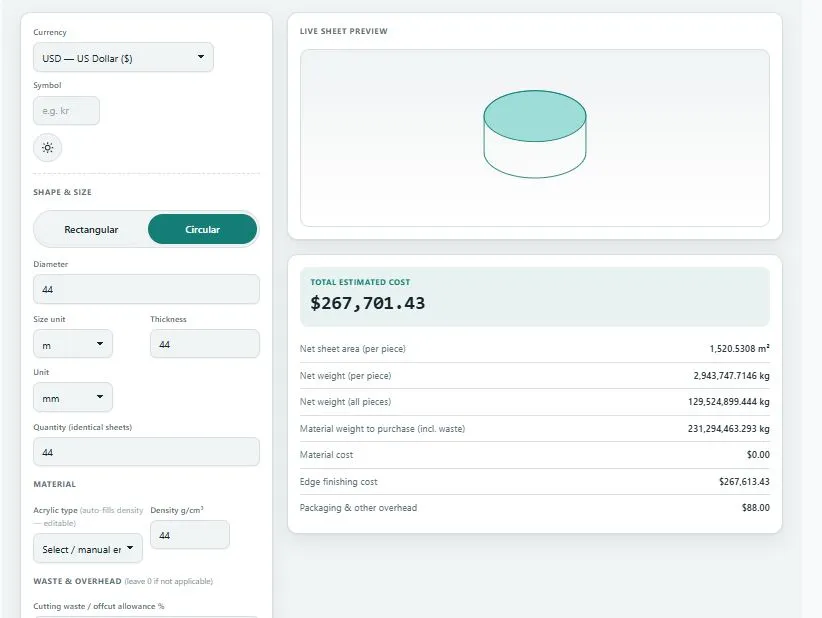
Table of Contents
How the Acrylic Sheet Weight Calculator Works
The calculator works through four stages, using your exact dimensions throughout.
Step 1 — Area and volume. For a rectangular sheet, area comes from length × width. For a circular sheet, it's calculated from the diameter using the actual circle area formula. Either way, multiplying by thickness gives the sheet's real volume.
Step 2 — Weight. Volume is multiplied by the density you enter — either typed directly or auto-filled from a cast or extruded acrylic reference, and always editable — to get the actual weight of one sheet, then multiplied by quantity for the total.
Step 3 — Purchase weight. Cutting a shape from stock material always creates some offcut or kerf loss. Entering a waste percentage shows you the material weight you'll actually need to buy, separately from the finished piece's net weight.
Step 4 — Cost. Material cost is calculated by weight or by area, whichever pricing mode you choose. Edge finishing cost is calculated from the sheet's actual perimeter — length and width for a rectangle, or π × diameter for a circle — multiplied by your edge finishing rate. Packaging and any other overhead are added on top for the total estimated cost.
Why Use This Acrylic Sheet Weight Calculator
A single "weight per sheet" number hides most of what actually affects an acrylic order. This acrylic sheet weight calculator breaks it apart:
- Two real shapes. Rectangular and circular sheets each use their own correct area formula, not one shape approximated as the other.
- Net weight vs. purchase weight. See the finished piece's actual weight separately from the material you need to buy once cutting waste is factored in.
- Edge finishing costed properly. Perimeter is calculated from your real dimensions, not estimated, so edge finishing cost reflects the actual shape you're cutting.
- Price by weight or by area. Many suppliers quote per kilogram, others per square meter — this calculator works either way.
- A live 3D-style preview. The sheet is drawn to scale as you type, so you can see its proportions, not just read a set of numbers.
- No sign-up, works instantly. Every result updates in your browser as you change any input.
Acrylic Density Reference
For detailed material property data across cast and extruded acrylic grades from multiple manufacturers, MatWeb's materials database is a widely used, neutral engineering reference for plastics properties including density.
Table:
| Acrylic Type | Density (g/cm³) |
|---|---|
| Cast Acrylic (PMMA) | 1.19 |
| Extruded Acrylic (PMMA) | 1.18 |
These are the same values used in the calculator's material dropdown — selecting either one auto-fills the density field, which stays fully editable if your supplier's spec sheet gives a different figure.
Who This Calculator Is Built For
- Sign makers and fabricators estimating weight and cost before cutting an acrylic panel or disc
- Buyers and estimators comparing supplier quotes given per kilogram versus per square meter
- Display, retail fixture, and furniture makers who need edge finishing cost included in a project estimate
- Hobbyists and small workshops planning a cut list and wanting a realistic material cost before ordering
Tips for Getting Accurate Results
Here's how to get the most accurate number out of this acrylic sheet weight calculator:
- Confirm cast vs. extruded before relying on the auto-filled density. The two have slightly different densities, and mixing them up introduces a small but avoidable error.
- Enter a waste percentage that matches your actual cutting process. Laser and CNC cutting typically waste less material than hand-cutting or nesting irregular shapes — check with your fabricator if unsure.
- Use the circular shape for discs and round cut-outs, not the rectangular one. The area formula is different, and using the wrong shape will overstate or understate both weight and cost.
- Match the pricing mode to how you were quoted. If your supplier quotes per square meter, use "Price per area" rather than converting it to a per-kilogram rate yourself.
- Leave edge finishing at 0 if you're not polishing or flame-finishing the edges. It only adds cost when there's actually a finishing process being priced.
Frequently Asked Questions
Does this calculator assume a fixed density for acrylic?
No. Selecting cast or extruded acrylic auto-fills a typical density into an editable field, and you can type your own value if your supplier's spec sheet gives a different figure.
What's the difference between net weight and purchase weight?
Net weight is the actual finished piece's weight. Purchase weight adds your entered waste/offcut percentage, showing how much material you'll actually need to buy to end up with that finished piece.
Can I calculate a circular or disc-shaped piece?
Yes. Switch the shape toggle to "Circular" and enter the diameter — the calculator uses the actual circle area formula rather than approximating it as a rectangle.
How is edge finishing cost calculated?
From the sheet's real perimeter — length and width for a rectangle, or π × diameter for a circle — multiplied by your entered edge finishing rate per meter.
Can I price by area instead of by weight?
Yes. Toggle "Price per area" and enter a rate per square meter or square foot, useful when a supplier quotes that way instead of per kilogram.
Does quantity affect the whole calculation?
Yes. Entering more than one identical sheet multiplies the weight, purchase weight, and all related costs accordingly.
What does the live preview show?
A scaled 3D-style diagram of the sheet — a box for rectangular sheets or a cylinder for circular ones — that updates as you change the dimensions or thickness.
Is this calculator free to use?
Yes, this acrylic sheet weight calculator is free with no sign-up required, and it runs entirely in your browser.
Quick Summary
An acrylic sheet weight calculator turns real dimensions, thickness, and density into an actual weight and cost, instead of a rough per-sheet estimate. This calculator supports rectangular and circular sheets, separates net weight from the material you'll need to purchase after cutting waste, adds real fabrication costs like edge finishing, and lets you price by weight or by area — with a live scaled preview showing the sheet as you build it.
Disclaimer
This acrylic/Perspex sheet weight calculator is provided by BytePriva for general estimation purposes only. It uses standard geometric and density-based formulas, but actual sheet weight and cost can vary by manufacturer, batch, and cutting method. BytePriva makes no warranty as to the accuracy of any result and accepts no liability for ordering, fabrication, or budgeting decisions based on this tool. Always confirm final weight, material, and pricing with your supplier before placing an order.