Use this powder coating coverage calculator to find how much powder you need and what it will cost, based on your exact specifications. Enter the powder's specific gravity, the surface area to be coated, desired dry film thickness, number of coats, and your transfer efficiency, and the tool returns theoretical coverage, actual coverage, powder required per part, total powder needed, and total cost in your chosen currency.
Powder & Coating Spec
Typical starting value only — specific gravity varies by formulation and color. Always confirm the exact figure on your powder's technical data sheet (TDS).
Typically 25–95% depending on gun setup, part grounding, geometry and reclaim system. Measure yours as (powder deposited ÷ powder applied) × 100 for accuracy — don't guess.
Covers masking loss, color-change purge, and parts needing a re-coat — separate from transfer efficiency.
Live Preview
Results
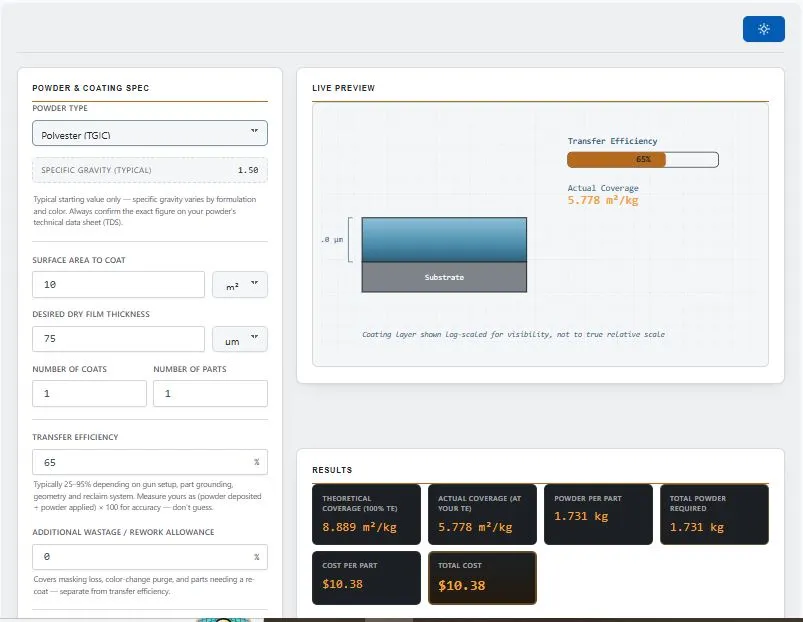
Table of Contents
How the Powder Coating Coverage Calculator Works
This calculator uses the powder coating industry's standard coverage formula, which relates a powder's specific gravity and film thickness to the area one kilogram can cover.
1. Theoretical Coverage — Calculated as 1000 divided by (specific gravity × thickness in microns), giving the maximum possible coverage in m²/kg at 100% transfer efficiency.
2. Actual Coverage — Theoretical coverage multiplied by your entered transfer efficiency percentage, since only a portion of sprayed powder actually adheres to the part — the rest is overspray.
3. Powder per Part — Based on actual coverage, your surface area, number of coats, and any additional wastage allowance for masking loss, purge loss, or rework.
4. Total Powder and Cost — Powder per part multiplied by the number of parts, then multiplied by your entered price per kg or per lb in your selected currency.
You can select a common powder type for a typical starting specific gravity, or enter a custom specific gravity — either way, the calculation always uses whatever value is in that field, so accuracy depends on entering the figure from your powder's technical data sheet.
Why Use This Powder Coating Coverage Calculator
Estimating powder needs by hand means looking up the specific gravity, converting thickness units, applying a transfer efficiency percentage, and accounting for extra coats and wastage separately — miss one step and the final cost estimate can be off by a wide margin.
This calculator runs all of those steps together. Enter your powder's specific gravity, the area to be coated, your target thickness, and your actual transfer efficiency, and it returns both the theoretical coverage (the industry benchmark figure) and the actual coverage you'll really get — side by side, so you can see exactly how much your real-world efficiency is costing you in extra powder.
It also scales straight to a purchase estimate: enter a price per kg or per lb in your currency, and the total cost for your full job — across multiple coats and multiple parts — appears instantly.
Powder Types and Specific Gravity Explained
Specific gravity is what actually drives the coverage number — a heavier powder covers less area per kilogram at the same thickness, regardless of what type it is. Here's what's built into the calculator as a starting reference, though the exact figure always comes from your powder's own datasheet.
Epoxy powders (typically around 1.6 specific gravity) are common for interior applications — appliances, shelving, pipe coatings — valued for hardness and chemical resistance, though they tend to chalk under UV exposure.
Epoxy-polyester hybrids (also around 1.6) combine epoxy's toughness with better outdoor stability than pure epoxy, making them a common general-purpose indoor/light-outdoor choice.
Polyester (TGIC) powders (typically around 1.5) are the standard for outdoor architectural and automotive parts thanks to strong UV and weather resistance, though TGIC itself has raised some handling concerns in certain markets.
Polyester (Primid / TGIC-free) (also around 1.5) offers similar outdoor performance to TGIC polyester without the same curing agent, and has become the more common outdoor choice in many regions.
Polyurethane powders (typically around 1.4) are known for a smoother, higher-gloss finish and are often used where appearance matters as much as durability, such as consumer goods and furniture.
None of these numbers should be taken as exact — specific gravity varies by manufacturer, color, and filler content even within the same category. Select "Custom Powder" and enter the exact figure from your technical data sheet whenever precision matters.
For more detail on how transfer efficiency is measured, see SpecialChem's guide to powder coating testing methods.
Who This Calculator Is Built For
Powder coating shop owners and estimators use it to quote a job accurately before committing to a price, factoring in their actual transfer efficiency instead of relying on the optimistic theoretical number alone.
Coating line operators and quality technicians use it to double-check whether a batch's expected powder consumption lines up with what's actually being used — a quick way to spot a transfer efficiency problem before it eats into margins.
Procurement and purchasing staff use it to estimate how much powder to order for a run of parts, based on the real coverage they're getting rather than the manufacturer's best-case figure.
It's also useful for coating students and new operators learning the relationship between film thickness, specific gravity, and transfer efficiency, since seeing the theoretical and actual coverage numbers side by side makes the effect of efficiency losses concrete rather than abstract.
Tips for Getting Accurate Results
The biggest source of error in a coverage estimate is almost always the transfer efficiency number, not the formula itself — so measure it rather than guess. Weigh a part before and after coating, weigh the powder applied, and divide deposited weight by applied weight to get your real figure instead of assuming a round number.
Don't skip the specific gravity check either. The presets in this calculator are typical starting points, and two powders in the same category — even the same color from different batches — can have a noticeably different specific gravity. Pull the exact number from your powder's technical data sheet whenever the estimate needs to be accurate rather than approximate.
If your process involves masking, color changes, or a known rework rate, use the wastage allowance field to capture that separately from transfer efficiency rather than folding it into an inflated efficiency number.
Frequently Asked Questions
How is powder coating coverage calculated?
Theoretical coverage is 1000 divided by (specific gravity × thickness in microns), giving m²/kg at 100% transfer efficiency. Actual coverage multiplies that by your entered transfer efficiency percentage, since some sprayed powder is always lost as overspray.
What's the difference between theoretical and actual coverage?
Theoretical coverage is the industry benchmark figure assuming every particle of sprayed powder sticks to the part. Actual coverage reflects your real transfer efficiency, so it's always lower and is what you should budget powder against.
What powder types does this calculator support?
Epoxy, epoxy-polyester hybrid, polyester (TGIC), polyester (Primid/TGIC-free), and polyurethane are built in as typical starting references, plus a custom specific gravity option for any other powder.
Should I trust the preset specific gravity value?
Only as a rough starting point. Specific gravity varies by manufacturer, color, and formulation, so for an accurate result, select "Custom Powder" and enter the figure from your powder's technical data sheet.
Can I enter thickness in mils instead of microns?
Yes, use the unit dropdown next to the thickness field to switch between microns (µm) and mils — the calculator converts internally either way.
What does the wastage allowance field account for?
It's a separate percentage for losses not related to spray transfer, such as masking material loss, color-change purge, or a known rate of parts needing a re-coat.
Does the calculator handle multiple coats and multiple parts?
Yes. Set the number of coats to scale powder per part, and the number of parts to scale up to a full job total, both reflected in the total powder and total cost figures.
Can I see the cost in my own currency?
Yes, over 20 currencies are available in the dropdown, plus a custom currency symbol field if yours isn't listed, and pricing can be entered per kg or per lb.
Powder Coating Coverage Calculator — Quick Summary
This powder coating coverage calculator turns your specific gravity, thickness, and transfer efficiency into a real powder and cost estimate — no manual formula, no guesswork. Whether you're quoting a single part or a full production run, this powder coating coverage calculator gives you theoretical and actual coverage side by side, so you know exactly what your process efficiency is costing you.
Disclaimer
This powder coating coverage calculator is provided by BytePriva as a free reference tool to help estimate powder consumption and cost using the standard industry coverage formula. Results are intended for general planning, quoting, and educational purposes only.
Actual powder usage can vary due to differences in specific gravity between batches and colors, real-world transfer efficiency, part geometry, and equipment condition. For production planning or purchasing decisions, always confirm specific gravity against your powder manufacturer's technical data sheet and measure your actual transfer efficiency rather than relying on an assumed figure.
BytePriva makes no warranty regarding the accuracy of results generated by this tool and is not liable for any loss, cost, or damage arising from decisions made using these estimates. Use of this calculator is entirely at the user's own discretion.