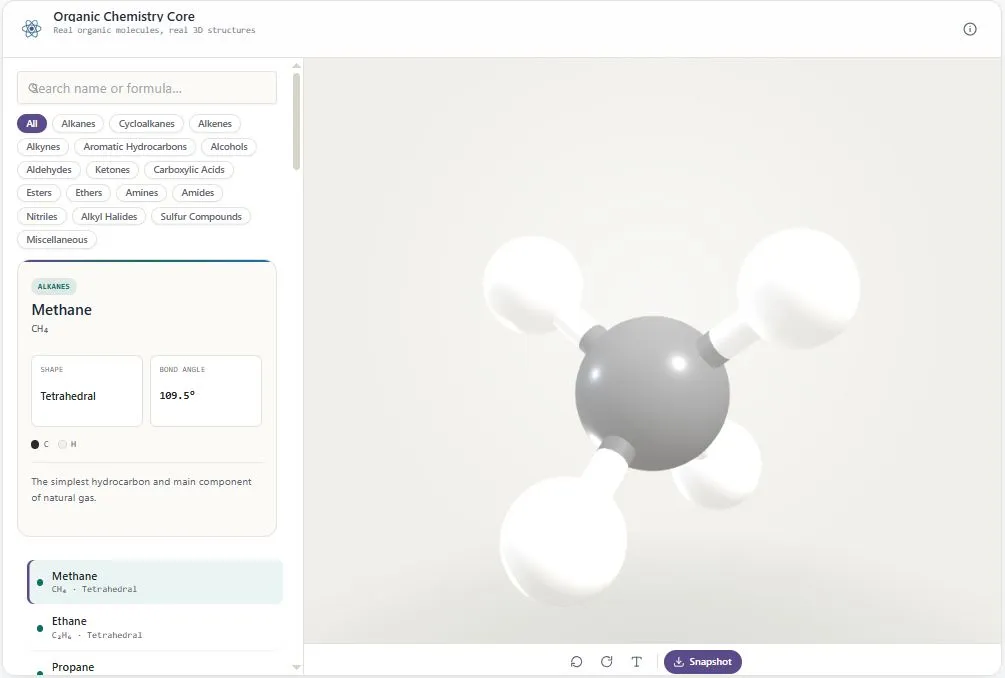
This organic chemistry 3D viewer lets you search, rotate, and inspect real organic compounds in interactive 3D — from simple alkanes to alcohols, esters, amines, and aromatic rings — organized by functional group so you can browse a whole family of related organic molecules at once. Most organic chemistry references show flat, 2D skeletal structures, which makes it hard to actually picture things like tetrahedral sp³ carbons, planar sp² double bonds, or ring puckering. This tool shows the real 3D structure instead: pick a compound, and see its true geometry rendered accurately, with bond angles and hybridization reflected in the actual model rather than a simplified drawing. Filter by functional group — alkanes, alkenes, carboxylic acids, and more — search by name, toggle atom labels, and rotate freely from any angle. It runs entirely in your browser, loads instantly, and needs no sign-up or installation.
Organic Chemistry Core
Real organic molecules, real 3D structures
Loading viewer…
About this tool
Disclaimer: This tool is strictly for educational visualization. It does not replace professional lab safety guidelines. Always consult certified instructors before handling real chemicals. bytepriva.com assumes no liability for real-world experimentation.
Note: This is a browser-based 3D visualization. Rendering can vary slightly across devices, browsers, and graphics hardware, so treat the on-screen model as a teaching aid rather than a lab-verified reference — please have a qualified chemistry educator confirm structural details before relying on them.
Table of Contents
How This Organic Chemistry 3D Viewer Works
To use this organic chemistry 3D viewer, follow these four steps:
- Search or browse by functional group. Type a molecule's name or formula into the search box, or filter by family — Alkanes, Alkenes, Alcohols, Esters, Amines, and more — to browse related compounds together.
- Select a molecule. Click any result to load its accurate 3D structure, along with its bond angle and a short description of its role or use.
- Rotate and explore. Drag to rotate the model from any angle, scroll or pinch to zoom, and toggle atom labels to identify each element directly on the structure.
- Reset, auto-rotate, or save. Use the toolbar below the model to reset the camera, turn on auto-rotate for a hands-free view, or download a snapshot of the current angle.
Everything runs 100% in your browser — no installation, no plugins, and no sign-up required.
Why Use This Organic Chemistry 3D Viewer
Most organic chemistry resources show compounds as flat, 2D skeletal drawings — useful for quick notation, but they don't convey what a molecule actually looks like in space. This organic chemistry 3D viewer renders real compounds with their true geometry: tetrahedral sp³ carbons, planar sp² double bonds, and the actual ring shapes of cyclic structures, all built from coordinates that reflect real bond angles rather than simplified textbook diagrams.
Organic chemistry is built around functional groups — the specific atoms or bonds that give a molecule its characteristic reactivity. This tool organizes all 70 compounds by exactly those families, so instead of studying one isolated structure, you can compare every alcohol, ester, or amine side by side and start recognizing the shape patterns that define each group.
It's also built for speed: no account, no installation, and nothing to wait for. Search or filter by functional group, rotate any molecular structure freely, toggle atom labels to check each element, and download a snapshot when you need one for notes or an assignment — all directly in your browser.
Who This Organic Chemistry 3D Viewer Is Built For
- High school and college organic chemistry students — see real 3D structures instead of just memorizing flat skeletal drawings from a textbook.
- Students preparing for exams — quickly search any compound to review its structure, functional group, and bond angle before a test or lab practical.
- Chemistry teachers and tutors — pull up a real, rotatable 3D model during a lesson to show hybridization or ring shape instead of relying on flat diagrams.
- Visual learners — some concepts, like why cyclohexane puckers into a chair shape, click faster when you can rotate the structure yourself.
- Anyone curious about organic molecules — no chemistry background required to search a compound and see what it actually looks like in 3D.
Tips for Getting the Most Out of This Tool
- Use the functional group filters to compare compounds — click a family like "Alcohols" or "Carboxylic Acids" to see every related molecule together, which makes it easier to spot the shared structural pattern.
- Turn on atom labels for unfamiliar elements — the label toggle in the toolbar identifies each atom directly on the model, useful for compounds containing nitrogen, sulfur, or halogens.
- Some rings are shown simplified for clarity — a few cyclic structures are flattened to make them easier to read at a glance; where that affects an exact angle, the description or bond-angle label notes it honestly.
- Rotation quality depends on your device — auto-rotate and dragging are smoothest on a modern browser with hardware acceleration enabled; older devices may render more slowly.
- Use snapshot for notes or assignments — the snapshot button captures the model at its current angle, handy for pasting into study notes or a lab report.
Frequently Asked Questions
Is this organic chemistry 3D viewer free to use?
Yes. There's no sign-up, no installation, and no limit on how many molecules you can view — it's completely free.
What functional groups are covered?
The tool covers 17 families, including alkanes, alkenes, alkynes, aromatic hydrocarbons, alcohols, aldehydes, ketones, carboxylic acids, esters, ethers, amines, amides, nitriles, alkyl halides, cycloalkanes, and sulfur compounds.
Are the 3D structures accurate, or simplified?
Structures are built to reflect real geometry and bond angles. A small number of ring compounds are shown flattened for visual clarity, and in those cases the description or angle label notes it directly rather than presenting it as a precise, unaltered structure.
Can I search for a molecule by its formula instead of its name?
Yes. The search box matches both molecule names and chemical formulas, so you can type either one.
Why do some carbons look different from others (like a double bond vs. a single bond)?
The 3D model reflects real hybridization — sp³ carbons are tetrahedral, sp² carbons (found in double bonds and aromatic rings) are flat and planar, and sp carbons (in triple bonds) are linear. Rotating the model makes these differences easy to see.
Does this tool work on mobile and tablets?
Yes. You can drag to rotate and pinch to zoom on touch devices, and the molecule list is accessible from a slide-up panel on smaller screens.
Can I save an image of the model?
Yes. The Snapshot button in the toolbar downloads an image of the model at its current angle, useful for notes or assignments.
Do I need any chemistry software or plugins to use this?
No. It runs entirely in your web browser using standard web technology — no downloads or plugins required.
Quick Summary
This free organic chemistry 3D viewer lets you search, rotate, and inspect real organic compounds in interactive 3D, organized by functional group — alkanes, alcohols, esters, amines, and more. Each structure reflects true hybridization and bond angles rather than a simplified 2D drawing, so you can actually see why an sp³ carbon is tetrahedral or why a ring puckers. Filter by family, toggle atom labels, and use auto-rotate or snapshot to study any molecular structure from every angle. It works entirely in your browser — no sign-up, no installation, completely free.
Disclaimer
This organic chemistry 3D viewer is provided for educational and informational purposes only. It is a visualization aid meant to help illustrate organic molecular structure and is not a substitute for a chemistry textbook, laboratory manual, certified course material, or guidance from a qualified chemistry instructor.
While structures and bond angles are based on published reference data and checked for accuracy, rendering can vary slightly across browsers, devices, and graphics hardware, and no automated tool can be guaranteed error-free. This tool must not be used as the sole basis for laboratory work, chemical handling, safety decisions, academic submissions, or any professional, medical, or industrial application. Always verify critical information independently with a qualified professional or authoritative source before relying on it.
This tool is provided "as is," free of charge, with no warranty of any kind, express or implied, including but not limited to accuracy, completeness, or fitness for a particular purpose. bytepriva.com and its owners accept no liability for any loss, damage, injury, or other consequence arising directly or indirectly from the use, misuse, or inability to use this tool, to the fullest extent permitted by law.