Gauge vs thickness is one of the most common mix-ups in sheet metal. A gauge number looks like a thickness, but it is only a label from a chart, and different charts give different thicknesses for the same number. This guide shows the difference with real published numbers, explains how one common gauge chart is built, and gives you a simple way to order sheet metal without surprises.
Short answer
A gauge number is not a thickness. Which thickness it means depends on the material and the gauge chart behind it. For example, in a 1931 US Bureau of Standards circular, gauge 14 is 0.0766 in (1.95 mm) on the steel chart and 0.0641 in (1.63 mm) on the Brown & Sharpe chart. The safe habit is to always write the thickness in mm or inches next to the gauge number.
Last reviewed: October 2026. The published tables used here are from an older document, and suppliers today may use other charts, so always confirm with your supplier.
Same Gauge Number, Different Thickness
The U.S. Bureau of Standards (the agency that is now NIST) published a circular called Standard Thicknesses, Weights, and Tolerances of Sheet Metal (Customary Practice) in 1931. It lists several different gauges, among them the United States standard gage for iron and steel, the galvanized sheet gage, the tin-plate gage, the Birmingham wire gage, the American wire gage (also called Brown & Sharpe) and the American zinc gage. Its tables show how far apart two of them can be. You can read it on the NIST publications site.
| Gauge | US standard gage, steel (in) | Same in mm | Brown & Sharpe (in) | Same in mm | Steel chart is thicker by |
|---|---|---|---|---|---|
| 10 | 0.1379 | 3.50 | 0.1019 | 2.59 | 0.91 mm (35%) |
| 14 | 0.0766 | 1.95 | 0.0641 | 1.63 | 0.32 mm (20%) |
| 16 | 0.0613 | 1.56 | 0.0508 | 1.29 | 0.27 mm (21%) |
| 18 | 0.0490 | 1.24 | 0.0403 | 1.02 | 0.22 mm (22%) |
| 20 | 0.0368 | 0.93 | 0.0320 | 0.81 | 0.12 mm (15%) |
Look at gauge 14. If someone reads a Brown & Sharpe chart when the sheet is steel, they would think the sheet is 1.63 mm thick when the steel chart says 1.95 mm, which is about 16% too thin. For the same sheet area, steel at 1.95 mm weighs about 15.3 kg per square meter, and at 1.63 mm about 12.8 kg per square meter (calculated with a steel density of 7,850 kg/m³). A wrong chart can lead to a wrong weight, a wrong price and a wrong fit.
Why There Is No Single Gauge Chart
The same circular describes the data it presents as customary practice and says it does not promulgate them as standards. It also recommends something simple and practical: it is always advisable to specify, in addition to the gage or stock size number, the equivalent decimal thickness. That one sentence is the heart of this whole guide.
In plain words, a gauge number is shorthand that depends on a chart, and the chart depends on the material and the system in use. The thickness in mm or inches does not depend on any chart.
How the Brown & Sharpe Chart Is Built
Some gauge systems are lists of values, but the Brown & Sharpe chart (also called American wire gage) follows a formula. The thickness in inches is 0.005 × 92 raised to the power of (36 − gauge) ÷ 39. I checked this formula against the five Brown & Sharpe values in the NIST table above, and it reproduces each one to four decimal places.
Thickness (mm) = thickness (in) × 25.4
| Gauge | Thickness (in) | Thickness (mm) |
|---|---|---|
| 8 | 0.1285 | 3.26 |
| 10 | 0.1019 | 2.59 |
| 12 | 0.0808 | 2.05 |
| 14 | 0.0641 | 1.63 |
| 16 | 0.0508 | 1.29 |
| 18 | 0.0403 | 1.02 |
| 20 | 0.0320 | 0.81 |
| 22 | 0.0253 | 0.64 |
| 24 | 0.0201 | 0.51 |
| 26 | 0.0159 | 0.40 |
| 28 | 0.0126 | 0.32 |
| 30 | 0.0100 | 0.25 |
Here is a neat pattern in this chart. Each step up in gauge number makes the sheet about 11% thinner, and six steps up make it about half as thick. For example, gauge 10 is 2.59 mm and gauge 16 is 1.29 mm. That pattern only holds for charts built on this formula.
A Safe Way to Order: Say It Three Ways
Whenever you buy, quote or draw a sheet, write all three of these together:
| What to write | Example (made up) |
|---|---|
| 1. The material and grade | Mild steel sheet |
| 2. The gauge number, if you use one | 14 gauge |
| 3. The thickness in mm or inches | 1.9 mm (0.075 in) |
- Ask which chart the supplier uses for that material.
- Ask for the thickness in mm or inches and for the tolerance.
- Measure a sample with calipers or a micrometer when the fit matters. If the sheet is coated or galvanized, ask whether the stated thickness includes the coating.
- Use the thickness, not the gauge, in calculations such as weight, bend allowance and cost.
Common Mistakes
- Using one chart for every metal. A steel gauge number and an aluminum gauge number are not the same thickness.
- Assuming a higher gauge means thicker. For these charts, a higher gauge number means a thinner sheet.
- Copying a gauge from an old drawing without checking the thickness it meant.
- Forgetting tolerance. A sheet sold as a certain gauge can measure a little above or below the chart value.
Questions People Ask About Gauge vs Thickness
Is gauge the same as thickness?
No. A gauge number is a label that points to a thickness on a chart, and the chart depends on the material and the system. Always state the thickness in mm or inches too.
Does 14 gauge always mean the same thickness?
No. In the NIST circular, gauge 14 is 0.0766 in on the steel chart and 0.0641 in on the Brown & Sharpe chart. Check which chart your supplier uses.
Why does a bigger gauge number mean thinner metal?
That is how these charts are set up. In the Brown & Sharpe chart, each higher number gives a thinner sheet, and six steps up give about half the thickness.
What should I write on a drawing or order?
The thickness in mm or inches, with the material. If you also want to write the gauge, put it beside the thickness, as the NIST circular advises.
Can I convert gauge to thickness with a formula?
For Brown & Sharpe, yes: thickness in inches is 0.005 × 92 to the power of (36 − gauge) ÷ 39. Other charts are lists of values, so use the table that matches your material and supplier.
Are the NIST values still used today?
The circular is from 1931 and describes customary practice, not a current standard. Today's suppliers may use different charts for steel, so confirm the thickness with your supplier before you order.
Summary
Gauge vs thickness comes down to one rule: a gauge number is only a label from a chart, and different charts give different thicknesses. Write the thickness in mm or inches along with the material, and use the thickness for every calculation.
This guide is for general information only. The published tables quoted here come from an older document, and the gauge chart your supplier uses may be different. Please confirm the exact thickness and tolerance with your supplier or an approved specification before you order, cut or design around a sheet. Links to other websites are provided for reference only, and BytePriva is not responsible for their content. Read our full disclaimer.
Sources and Further Reading
- Standard Thicknesses, Weights, and Tolerances of Sheet Metal (Customary Practice), U.S. Department of Commerce, Bureau of Standards, 1931. Gauge tables and the advice to state the decimal thickness.
Convert a Gauge Number to Thickness
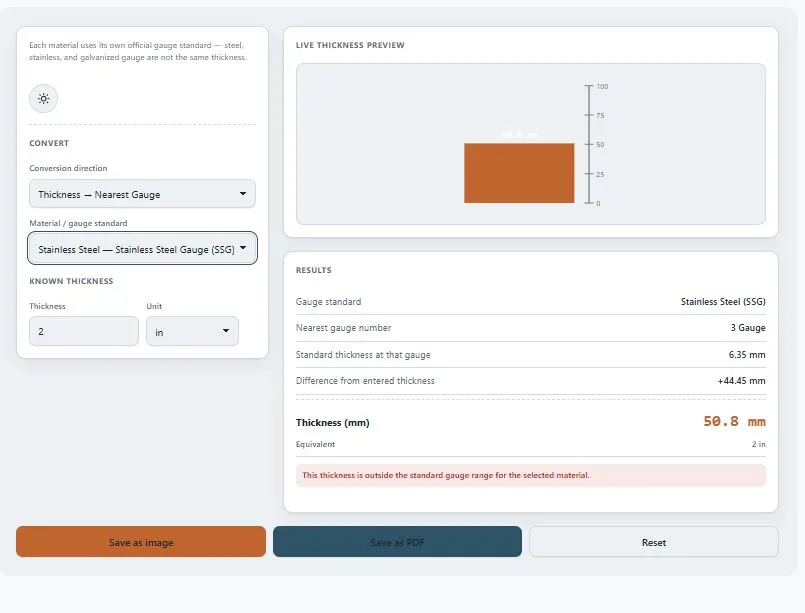
If you would like a ready converter, you can try BytePriva's Metal Sheet Gauge to Thickness Converter. Its page lets you choose the material (standard steel, galvanized steel, stainless steel, or aluminum, brass and copper), convert a gauge to a thickness or a thickness to the nearest gauge, and see both mm and inches. Its page also notes that the same gauge number gives different thicknesses for different materials.
As with any chart or tool, confirm the final thickness and tolerance with your supplier before you order.
Tool link: https://bytepriva.com/metal-sheet-gauge-to-thickness-converter/