Powder coating coverage per kg is the one number every finisher needs before ordering powder. At a film thickness of 60 µm, one kilogram of powder with a specific gravity between 1.2 and 1.8 can theoretically cover about 9 to 14 square metres. In real life it covers less, because some of the powder never lands on the part.
This guide gives you the simple formula, a ready-made chart and three worked examples. You will also see the mistakes that quietly waste powder. The formula and unit conversions come from industry sources listed at the end, and every example is worked out step by step.
Last updated: October 2026
Quick answer
Theoretical coverage (m²/kg) = 1000 ÷ (specific gravity × film thickness in µm). Actual coverage = theoretical coverage × transfer efficiency.
Example: a powder with a specific gravity of 1.5, sprayed at 60 µm, covers 11.1 m²/kg in theory and about 7.2 m²/kg if 65% of the powder lands on the part.
In this guide
- What coverage per kg actually means
- The formula (metric and imperial)
- Specific gravity: where to find it
- Coverage chart (m² per kg)
- Transfer efficiency
- Three worked examples
- Cost per m², not price per kg
- Seven mistakes that waste powder
- FAQs
What Does Powder Coating Coverage per kg Actually Mean?
Think of coverage as one simple question: how much surface can one kilogram of powder coat at the film thickness you want?
The answer comes in two versions.
- Theoretical coverage is the best case. Every gram that leaves the gun ends up in the cured film.
- Actual coverage is the real case. It takes overspray and other losses into account.
Data sheets almost always print the theoretical number. If you order powder from that number alone, you can easily run short before the job is finished.
The Powder Coating Institute's magazine treats it as two separate steps as well. First you work out theoretical coverage from specific gravity and film thickness. Then you correct it for transfer efficiency.
The Powder Coating Coverage Formula (Metric and Imperial)
Theoretical coverage (m²/kg) = 1000 ÷ (specific gravity × film thickness in µm)
Actual coverage (m²/kg) = theoretical coverage × transfer efficiency
Powder needed (kg) = surface area (m²) ÷ actual coverage
Where does the 1000 come from?
One kilogram of powder with a specific gravity of 1.0 takes up one litre, which is 0.001 m³. Spread that volume into a film only 1 µm thick (0.000001 m) and it covers 0.001 ÷ 0.000001 = 1,000 m².
Real powders are heavier than water, and real films are much thicker than 1 µm. So you divide by both numbers. That is all the formula is.
The imperial version
In feet, pounds and mils the same idea reads: coverage (ft²/lb) = 192.3 ÷ (specific gravity × film thickness in mils) × transfer efficiency.
Several trade articles use 192.3, while the Powder Coating Institute's magazine prints 192.4. The difference is only rounding. You can read the full set of calculations in this calculations article in Powder Coated Tough, the official magazine of the Powder Coating Institute.
Two conversions are worth remembering. One mil equals 25.4 µm, and one m²/kg equals about 4.88 ft²/lb.
Here is a quick sanity check. Take a powder with a specific gravity of 1.0 at 1 mil. The metric formula gives 1000 ÷ 25.4 = 39.4 m²/kg. The imperial formula gives 192.3 ft²/lb, and 192.3 ÷ 4.88 = 39.4 m²/kg. Same answer.
Specific Gravity: Where to Find It and Why It Matters
Specific gravity (SG) is simply the powder's density compared with water. It is one of the three numbers that set powder coating coverage per kg. A heavier powder, with a higher SG, covers less area at the same film thickness.
The exact figure is on your powder's technical data sheet (TDS). If you have the sheet, use it instead of a "typical" value. Pigments and fillers change density, so different colours can have different specific gravities.
The data sheets cited in this guide list values from about 1.2 to 1.8. Powder makers measure the number in the lab with a standard method for coating powders, ISO 8130-2, which uses a gas pycnometer.
Check the film thickness behind the coverage number
Data sheets quote theoretical coverage on different bases. The Columbia Coatings HF Red sheet gives 151 ft² at 1 mil. TIGER Series 58, listed with the International EPD System, gives 10.4 to 13.8 m²/kg at 60 µm. Some sheets do not state the thickness at all.
So when you compare two powders, make sure both coverage numbers use the same film thickness. The table below shows that the formula in this guide matches two real data sheets.
| Powder | Specific gravity | Basis | Data sheet says | Formula gives |
|---|---|---|---|---|
| Columbia Coatings HF Red (TGIC) | 1.28 | 1 mil | 151 ft² | 150 ft²/lb |
| TIGER Series 58 (polyester) | 1.2 to 1.6 | 60 µm | 10.4 to 13.8 m²/kg | 10.4 to 13.9 m²/kg |
Powder Coating Coverage Chart (Theoretical m² per kg)
This chart shows theoretical powder coating coverage per kg at 100% transfer efficiency. Multiply the number by your own transfer efficiency to get the real figure.
| Specific gravity | 40 µm (1.6 mil) | 50 µm (2.0 mil) | 60 µm (2.4 mil) | 70 µm (2.8 mil) | 80 µm (3.1 mil) | 100 µm (3.9 mil) |
|---|---|---|---|---|---|---|
| 1.2 | 20.8 | 16.7 | 13.9 | 11.9 | 10.4 | 8.3 |
| 1.4 | 17.9 | 14.3 | 11.9 | 10.2 | 8.9 | 7.1 |
| 1.5 | 16.7 | 13.3 | 11.1 | 9.5 | 8.3 | 6.7 |
| 1.6 | 15.6 | 12.5 | 10.4 | 8.9 | 7.8 | 6.2 |
| 1.8 | 13.9 | 11.1 | 9.3 | 7.9 | 6.9 | 5.6 |
How to read it: a powder with an SG of 1.5 sprayed at 70 µm covers 9.5 m²/kg in theory. At 65% transfer efficiency that drops to about 6.2 m²/kg.
Transfer Efficiency: Why Real Coverage Is Lower
Transfer efficiency (TE) is what separates the data sheet number from real powder coating coverage per kg. It is the share of the powder leaving the gun that actually ends up on the part. The Powder Coating Institute's magazine gives the simple formula: powder deposited on the part ÷ powder that left the gun × 100.
You can measure it in your own shop. Weigh a part before and after coating to find the powder deposited. Then catch the powder from the gun in a bag for 15 to 30 seconds, weigh it, and work out how much the gun delivers per minute.
Two details matter here:
- Reclaim changes the picture. First-pass transfer efficiency counts only fresh powder. If you collect overspray and feed it back, TE tends to drop somewhat as the reclaimed powder builds up.
- System efficiency is stricter. It compares the powder that reached parts with all the powder you put into the system, so it also counts powder lost on hangers and racks, in filters and in disposed batches.
What numbers should you expect? In its cost example, Products Finishing uses 50% as a fair average transfer efficiency. Another of its examples assumes about 95% material utilization when overspray is collected for reuse. Your own measurement beats any of these.
Three Worked Examples
Example 1: A simple metric job
Here is powder coating coverage per kg worked out for a real job. You need to coat 10 m² of steel parts. The powder has an SG of 1.5. The data sheet recommends 60 µm, your transfer efficiency is 65%, and the powder costs $8 per kg.
- Theoretical coverage: 1000 ÷ (1.5 × 60) = 11.11 m²/kg
- Actual coverage: 11.11 × 0.65 = 7.22 m²/kg
- Powder needed: 10 ÷ 7.22 = 1.38 kg
- Powder cost: 1.38 kg × $8 = about $11.08
There is also a shortcut that skips the middle steps: powder (kg) = area × thickness (µm) × SG ÷ (1000 × TE). Here that is 10 × 60 × 1.5 ÷ (1000 × 0.65) = 1.38 kg.
Example 2: What film thickness and transfer efficiency do together
Same 10 m² job and the same powder (SG 1.5). Only thickness and transfer efficiency change, and with them the powder coating coverage per kg.
| Film thickness | Transfer efficiency | Actual coverage | Powder needed |
|---|---|---|---|
| 50 µm | 50% | 6.67 m²/kg | 1.50 kg |
| 60 µm | 65% | 7.22 m²/kg | 1.38 kg |
| 80 µm | 65% | 5.42 m²/kg | 1.85 kg |
| 80 µm | 80% | 6.67 m²/kg | 1.50 kg |
Going from 60 µm to 80 µm at the same efficiency adds a third more powder (1.38 kg to 1.85 kg). Raising transfer efficiency from 65% to 80% brings the 80 µm job back down to 1.50 kg. Both levers matter.
Example 3: The same maths in feet and pounds
A 100 ft² part, a powder with an SG of 1.5, a film of 2.5 mils and a transfer efficiency of 50%.
- Theoretical coverage: 192.3 ÷ (1.5 × 2.5) = 51.3 ft²/lb
- Actual coverage: 51.28 × 0.50 = 25.6 ft²/lb (about 5.25 m²/kg)
- Powder needed: 100 ÷ 25.64 = 3.9 lb
Doing this by hand for every quote gets old fast. The Powder Coating Coverage Calculator on BytePriva uses the same coverage formula shown above.
Compare Powders by Cost per m², Not Price per kg
A cheaper powder per kg is not always the cheaper powder per part. Powder coating coverage per kg changes with specific gravity, so the honest comparison is cost per applied square metre: price per kg ÷ actual coverage.
Take two hypothetical powders, both sprayed at 60 µm with 65% transfer efficiency.
| Powder A | Powder B | |
|---|---|---|
| Price per kg | $6.00 | $7.00 |
| Specific gravity | 1.7 | 1.3 |
| Actual coverage | 6.37 m²/kg | 8.33 m²/kg |
| Cost per m² | $0.94 | $0.84 |
Powder B costs more per kg but about 11% less per square metre. One warning: this comparison is only fair if both powders hide the metal at the same film thickness. A lighter powder sometimes needs more film to cover the substrate fully, and that can cancel the advantage.
Seven Mistakes That Quietly Waste Powder
Here are seven habits that can throw off your powder coating coverage per kg estimate.
- Using one "typical" SG for every colour. Pull the number from the data sheet of the exact powder you are spraying.
- Treating the data sheet number as real coverage. It assumes every particle lands on the part.
- Ignoring the thickness basis. 151 ft² at 1 mil and 11 m²/kg at 60 µm are not directly comparable.
- Guessing transfer efficiency. Measure it with the before-and-after weighing method.
- Spraying thicker than the data sheet recommends. It uses more powder, and industry guidance warns that properties can drop when the film goes beyond the specified thickness. Heavy "fire hosing" also lowers transfer efficiency.
- Forgetting second coats, masking and colour changes. Count every coat in your area, and add a wastage allowance for purge and re-coats.
- Mixing units. Keep mils with pounds or µm with kilograms, and convert with 1 mil = 25.4 µm.
FAQs About Powder Coating Coverage per kg
How many square metres does 1 kg of powder coating cover?
At a 60 µm film, a powder with a specific gravity between 1.2 and 1.8 has a theoretical coverage of roughly 9 to 14 m² per kg. After overspray and other losses the real figure is lower. At 65% transfer efficiency it works out to about 6 to 9 m² per kg.
What is the formula for powder coating coverage per kg?
Theoretical coverage in m²/kg = 1000 ÷ (specific gravity × film thickness in µm). Multiply by transfer efficiency (as a decimal) to get actual coverage.
How much powder do I need for a part?
Powder in kg = area in m² × film thickness in µm × specific gravity ÷ (1000 × transfer efficiency). Add an allowance for masking, colour changes and re-coats.
What is a good transfer efficiency?
It depends on your gun setup, part shape, grounding and whether you reclaim overspray. There is no single right number. Products Finishing uses 50% as a fair average in one cost example and about 95% utilization with reclaimed overspray in another. The reliable answer is to measure your own: powder deposited divided by powder sprayed.
Why does my powder cover less than the data sheet says?
The data sheet figure is theoretical. It assumes all the powder lands on the part, at one stated film thickness. Real jobs lose powder to overspray, racks and filters, and many shops spray thicker than the data sheet basis.
How do I convert ft²/lb to m²/kg?
Divide by 4.88. For example, 50 ft²/lb is about 10.2 m²/kg. To convert film thickness, multiply mils by 25.4 to get µm.
Summary
Powder coating coverage per kg comes down to three numbers: specific gravity, film thickness and transfer efficiency. Get the specific gravity from the data sheet, follow the recommended film thickness, measure your own transfer efficiency, and the formula does the rest.
This guide is for general information and planning. The formulas are standard industry methods, but real powder use depends on your powder batch, equipment, part shape and technique, so treat the results as close estimates. Before you buy powder or quote a job, check the specific gravity and recommended film thickness on your powder's technical data sheet, and follow its safety data sheet for handling. Links to other websites are provided for reference only, and BytePriva is not responsible for their content. Read our full disclaimer.
Sources and Further Reading
- Powder Coated Tough (Powder Coating Institute): Technology Interchange, If You Can't Measure It. Coverage formula, transfer efficiency and system efficiency.
- Powder Coating Institute. Industry association and publisher of Powder Coated Tough.
- Powder Coated Tough: Formulators Forum, Impacts of Specific Gravity on Powder Coating Formulations. How pigments, fillers and density affect coverage.
- ISO 8130-2:2021. Coating powders, determination of density by gas comparison pycnometer.
- NIST Guide to the SI, Appendix B.8. Unit conversion factors, including the mil.
- International EPD System: TIGER Series 58 Powder Coatings. Theoretical coverage at 60 µm and specific gravity range.
- Columbia Coatings: HF Red technical data sheet. Example of specific gravity and coverage on a data sheet.
- Products Finishing: Calculating the Average Cost of Powder, How to Measure Powder Value, Coverage of Powder and How to Lower Your Powder Coating Operation Costs. Cost per part, transfer efficiency examples and film thickness guidance.
Work Out Your Own Powder Needs
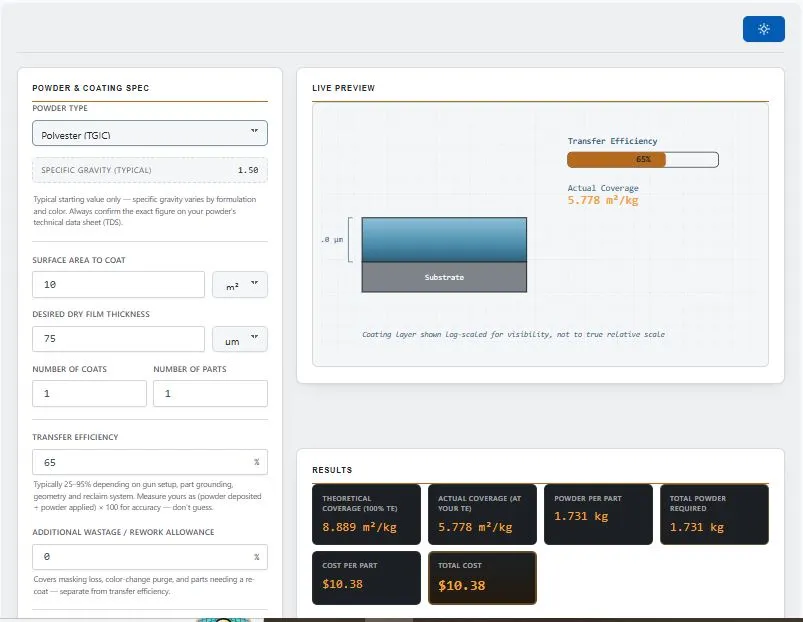
Want to skip the manual maths? BytePriva's Powder Coating Coverage Calculator is free and needs no signup. You enter the specific gravity (or pick a powder type for a typical starting value), the surface area, film thickness, number of coats and parts, transfer efficiency, an extra wastage allowance and your powder price. It gives you theoretical and actual coverage, powder per part, total powder and cost, and you can copy, share, download or print the result.
Tool link: https://bytepriva.com/powder-coating-coverage-calculator/