Picture two rubber sheets, both 1 m × 1 m and 10 mm thick. One is a general-purpose compound that weighs around 11 kg. The other is FKM, the fluoroelastomer family often sold under the Viton brand name, and it comes in closer to 19 kg. Nothing about the size tells you which is which, and a quote that just says “rubber sheet” won’t either.
That gap is where shipping estimates slip, lifting plans come up short and price-per-kg comparisons go sideways. The fix is small: find the density of the rubber you actually have, then do one multiplication. Below you’ll find the formula, a rubber sheet weight chart by thickness, density values for the common materials, and worked examples you can copy.
By the BytePriva Team · Last updated 2 November 2026 · Figures cross-checked against several published supplier and engineering references.
Quick answer
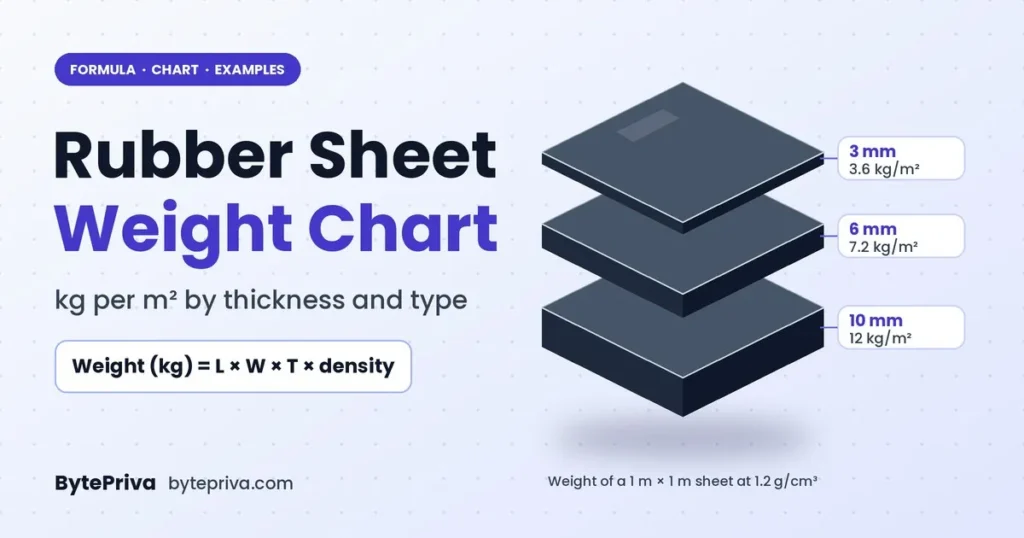
Rubber sheet weight (kg) = length (m) × width (m) × thickness (mm) × density (g/cm³).
Most common sheet compounds (EPDM, nitrile, neoprene, silicone, SBR) sit at roughly 1.0 to 1.5 g/cm³, so one square metre weighs about 1.0 to 1.5 kg for every millimetre of thickness. Example: a 1 m × 1 m × 5 mm sheet at 1.2 g/cm³ weighs 6 kg.
One note before the numbers: every density in this guide is a typical value meant for estimating. Real compounds vary, so treat the figures as a starting point and see the disclaimer at the end.
The rubber sheet weight formula
Weight is volume times density. The metric version is the easiest one to remember:
Weight (kg) = Length (m) × Width (m) × Thickness (mm) × Density (g/cm³)
It works because one square metre of sheet that’s 1 mm thick holds exactly one litre of rubber (1,000 cm³). At a density of 1.2 g/cm³, that litre weighs 1.2 kg, so every millimetre of thickness adds 1.2 kg per square metre. If your density is given in kg/m³, divide it by 1,000 first: 1,200 kg/m³ is 1.2 g/cm³.
Imperial version (pounds)
Weight (lb) = Length (ft) × Width (ft) × Thickness (in) × Density (g/cm³) × 5.2
The 5.2 comes from water, which weighs about 62.4 lb per cubic foot. One square foot that’s one inch thick is one-twelfth of a cubic foot, so material with the density of water weighs 62.4 ÷ 12 = 5.2 lb. Multiply by your rubber’s density and you have the answer. To convert a metric result, multiply kilograms by 2.2046. A 2.47 kg offcut, for instance, is about 5.45 lb.
Density or specific gravity?
Datasheets use both terms. For everyday weight estimates they’re interchangeable, because specific gravity simply compares a material to water, and water is about 1 g/cm³. A listed specific gravity of 1.24 means you can use 1.24 g/cm³ in the formulas on this page.
Rubber density chart by material (g/cm³ and kg/m³)
This is where most weight estimates go wrong. Published densities for rubber often describe the raw polymer, but a finished sheet is a compound: the polymer plus fillers such as carbon black or mineral powders, oils and curing agents. Those additions usually make the sheet denser than the polymer on its own. EPDM is a good example. The polymer is only about 0.86 g/cm³, yet finished EPDM can be compounded anywhere from roughly 0.9 to above 2.0 g/cm³, which is why two “EPDM sheets” can weigh quite differently.
| Rubber type | Raw polymer (g/cm³) | Typical finished sheet (g/cm³) | Planning value (g/cm³) |
|---|---|---|---|
| Natural rubber (NR) | 0.92–0.93 | 0.95–1.2 | 1.1 |
| SBR | 0.92–0.97 | 1.0–1.3 | 1.2 |
| EPDM | 0.86–0.87 | 1.1–1.5 | 1.2 |
| Nitrile (NBR, Buna-N) | 0.96–1.02 | 1.0–1.3 | 1.2 |
| Neoprene (CR) | 1.15–1.25 | 1.2–1.4 | 1.3 |
| Silicone (VMQ) | 0.95–0.98 | 1.1–1.6 | 1.2 |
| Fluoroelastomer (FKM) | 1.80–1.85 | 1.8–2.0 | 1.9 |
Multiply g/cm³ by 1,000 to get kg/m³, so a planning value of 1.2 is 1,200 kg/m³. “Planning value” is the number to use when you don’t have a datasheet yet. Swap in the supplier’s figure as soon as you can.
The finished-sheet ranges are practical estimates drawn from several published supplier and engineering references. They are not guarantees, and your compound may fall outside them.
Rubber sheet weight chart by thickness (kg per m²)
The chart shows the weight of a 1 m × 1 m sheet in kilograms, which is also the weight per square metre. Pick the column closest to your density, then scale up for your actual area.
| Thickness | 1.1 g/cm³ | 1.2 g/cm³ | 1.3 g/cm³ | 1.5 g/cm³ | 1.9 g/cm³ |
|---|---|---|---|---|---|
| 1 mm | 1.1 | 1.2 | 1.3 | 1.5 | 1.9 |
| 2 mm | 2.2 | 2.4 | 2.6 | 3 | 3.8 |
| 3 mm | 3.3 | 3.6 | 3.9 | 4.5 | 5.7 |
| 4 mm | 4.4 | 4.8 | 5.2 | 6 | 7.6 |
| 5 mm | 5.5 | 6 | 6.5 | 7.5 | 9.5 |
| 6 mm | 6.6 | 7.2 | 7.8 | 9 | 11.4 |
| 8 mm | 8.8 | 9.6 | 10.4 | 12 | 15.2 |
| 10 mm | 11 | 12 | 13 | 15 | 19 |
| 12 mm | 13.2 | 14.4 | 15.6 | 18 | 22.8 |
| 15 mm | 16.5 | 18 | 19.5 | 22.5 | 28.5 |
| 20 mm | 22 | 24 | 26 | 30 | 38 |
| 25 mm | 27.5 | 30 | 32.5 | 37.5 | 47.5 |
Which column should you use? Natural rubber is about 1.1. EPDM, nitrile, SBR and silicone are about 1.2. Neoprene is about 1.3. Heavily filled compounds can reach 1.5, and FKM is about 1.9.
For pounds per square foot, multiply kg/m² by 0.2048. If your sheet is sold in inches, convert precisely: 1/16 in is 1.59 mm, 1/8 in is 3.18 mm, 3/16 in is 4.76 mm, 1/4 in is 6.35 mm, 3/8 in is 9.53 mm and 1/2 in is 12.7 mm. Rounding these to whole millimetres looks harmless but adds up fast on a big sheet.
How much area does 1 kg of rubber sheet cover?
Buying by the kilogram? Flip the formula around:
Area per kg (m²) = 1 ÷ (Thickness in mm × Density in g/cm³)
| Thickness | kg per m² (at 1.2 g/cm³) | Area covered by 1 kg (m²) |
|---|---|---|
| 1 mm | 1.2 | 0.833 |
| 2 mm | 2.4 | 0.417 |
| 3 mm | 3.6 | 0.278 |
| 5 mm | 6 | 0.167 |
| 6 mm | 7.2 | 0.139 |
| 10 mm | 12 | 0.083 |
| 12 mm | 14.4 | 0.069 |
If you need to know how many pieces make a kilogram, work out the weight of one piece and divide 1 kg by it. A 300 mm × 300 mm × 3 mm piece at 1.2 g/cm³ weighs about 0.32 kg, so you get roughly three pieces per kilogram.
Worked examples
Example 1: A cut-to-size EPDM sheet
Size 2 m × 1.2 m, thickness 6 mm, density 1.2 g/cm³.
Area = 2 × 1.2 = 2.4 m².
Weight = 2.4 × 6 × 1.2 = 17.28 kg.
Example 2: A roll of rubber sheet
Roll 10 m long × 1.2 m wide × 3 mm thick, density 1.2 g/cm³.
Area = 12 m².
Weight = 12 × 3 × 1.2 = 43.2 kg, which is about 4.32 kg per running metre.
Example 3: Neoprene sheet in feet and inches
Size 4 ft × 8 ft, thickness 1/4 in (0.25), density 1.3 g/cm³.
Weight = 4 × 8 × 0.25 × 1.3 × 5.2 = 54.08 lb, or about 24.5 kg.
Example 4: Weight of a rubber gasket
For a flat ring gasket measured in mm, with density in g/cm³:
Weight (g) = [π ÷ 4 × (OD² − ID²) × Thickness ÷ 1,000] × Density
Take OD 100 mm, ID 60 mm, thickness 3 mm, density 1.2 g/cm³.
Ring area = π ÷ 4 × (10,000 − 3,600) = 5,026.5 mm².
Volume = 5,026.5 × 3 = 15,080 mm³ = 15.08 cm³.
Weight = 15.08 × 1.2 = 18.1 g each, so 100 gaskets weigh about 1.81 kg. If the gasket has bolt holes, subtract their volume too.
Turning weight into material cost
Material cost per square metre = kg per m² × price per kg. A 5 mm sheet at 1.2 g/cm³ is 6 kg/m². If the supplier charges 3.50 per kg, the material comes to 21.00 per m², before cutting waste and freight. Because price is per kilogram, a denser compound costs more per square metre even when the per-kg price is identical.
How to find the real density of your sheet
A planning value gets you close. If the number matters, for freight, load limits or a firm quote, confirm the real density with one of these:
- Read the datasheet or label. Look for “density”, “specific gravity”, “SG” or “relative density”.
- Weigh a sample. Cut a regular piece, measure length, width and thickness with calipers, weigh it, then divide: Density (g/cm³) = Mass (g) ÷ Volume (cm³). A 100 mm × 100 mm × 5 mm piece is 50 cm³. If it weighs 62 g, the density is 1.24 g/cm³.
- Use water displacement for odd shapes. Submerge the piece fully in a graduated container, wipe away any clinging air bubbles, and divide its mass by the volume of water it displaces.
- Ask for a tested value. Laboratories measure rubber density with standardised methods. ISO 2781:2018 covers two test methods for vulcanised and thermoplastic rubber, and ISO notes that density matters both for controlling compound quality and for working out how much rubber is needed to make a given volume of material.
Why calculated and real weight can differ
- Compound recipe. Fillers, oils and plasticisers change density. Two sheets of the same rubber type from different makers can differ noticeably.
- Reinforcement. Fabric or steel inserts add weight that the plain rubber formula doesn’t capture.
- Sponge and foam rubber. Cellular rubber is far lighter than solid sheet. Don’t use the solid-rubber densities above for it; use the manufacturer’s figure.
- Thickness tolerance. A nominal 10 mm sheet may measure slightly more or less, and weight scales directly with thickness.
- Hardness. Shore A hardness doesn’t set weight by itself, although harder compounds often carry more filler. Treat it as a hint, not a rule.
Common mistakes to avoid
- Mixing millimetres and centimetres in the same calculation.
- Using the raw polymer density for a finished, filled sheet.
- Rounding inch sizes to whole millimetres.
- Applying solid-rubber densities to sponge or reinforced sheet.
Rubber sheet weight FAQ
How much does a rubber sheet weigh per square metre?
It depends on thickness and density, but most common sheet compounds weigh about 1.0 to 1.5 kg per square metre for every millimetre of thickness. A 5 mm sheet at 1.2 g/cm³ weighs about 6 kg per square metre.
What is the density of rubber in kg/m³?
Finished rubber sheet is usually around 1,000 to 1,500 kg/m³ (1.0 to 1.5 g/cm³). Raw polymers can be lighter, for example EPDM at roughly 860 kg/m³, while fluoroelastomer (FKM) compounds are much denser at about 1,800 to 2,000 kg/m³.
How do I calculate the weight of a neoprene rubber sheet?
Multiply length (m) × width (m) × thickness (mm) × density (g/cm³). Neoprene sheet is typically around 1.2 to 1.4 g/cm³, so using 1.3 gives about 13 kg for a 1 m × 1 m × 10 mm sheet. Use the supplier’s datasheet value when you have it.
Is EPDM lighter than neoprene?
As a raw polymer, yes: EPDM is about 0.86 g/cm³ and neoprene about 1.23 g/cm³. Finished sheets overlap, though, because fillers raise the density of both. EPDM sheet is often 1.1 to 1.5 g/cm³ and neoprene 1.2 to 1.4 g/cm³, so check the datasheet before assuming.
How many square metres are in 1 kg of rubber sheet?
Use area per kg = 1 ÷ (thickness in mm × density in g/cm³). For a 3 mm sheet at 1.2 g/cm³, 1 kg covers about 0.28 m². For 10 mm, it covers about 0.083 m².
Does rubber sink or float in water?
It depends on the compound. Some raw rubbers, such as natural rubber at about 0.92 g/cm³, are lighter than water. Most finished sheets contain fillers that push the density above 1 g/cm³, so they sink.
How do I convert rubber sheet weight to pounds?
Multiply kilograms by 2.2046. For example, 2.47 kg is about 5.45 lb. You can also work in feet and inches directly: length (ft) × width (ft) × thickness (in) × density (g/cm³) × 5.2 gives pounds.
How do I calculate the weight of a rubber gasket?
For a ring gasket in mm, find the area as π ÷ 4 × (OD² − ID²), multiply by thickness to get volume in mm³, divide by 1,000 to get cm³, then multiply by density in g/cm³ to get grams. Subtract the volume of any bolt holes.
Prefer not to do the maths by hand?
If you’d rather skip the arithmetic, BytePriva has a free Rubber Sheet Weight Calculator. It runs in your browser with no signup: enter the size, thickness and density, and it gives you the weight.
Disclaimer: This article is for general information and estimating only. The densities and weights shown are typical values and are not guaranteed for any specific product, compound or manufacturer. Always confirm the density, thickness tolerance and weight with your supplier’s datasheet or a certified test result before making purchasing, shipping, structural, safety or compliance decisions. This content is not professional engineering advice, and BytePriva is not liable for decisions made on the basis of it. Neoprene, Viton and other product names are trademarks of their respective owners; they are used here only to identify material types, and BytePriva is not affiliated with or endorsed by those owners.