The Hex Bar Weight Calculator helps you calculate hex bar weight, dimensions, volume, and material cost using the size, material density, quantity, and cost details you provide.
Hex Bar Specification
Distance between two opposite parallel flat sides (the wrench size).
Total axial length of each bar.
Material & Density
ρ = 7.85 g/cm³
Overhead & Wastage
Bar Preview
Cost Breakdown
- Base metal cost
- $0.00
- Wastage allowance (0%)
- $0.00
- Setup & labor
- $0.00
- Cutting & machining
- $0.00
- Freight & shipping
- $0.00
- Tax / VAT (0%)
- $0.00
Formula Reference
- Side length
- s = d ÷ √3
- Across corners
- D = (2 ÷ √3) × d
- Cross-section area
- A = (√3 ÷ 2) × d²
- Weight
- Weight = Area × Length × Density
Estimates are for reference only. Actual bar weight can vary with mill tolerance, alloy composition and surface finish. Always confirm against a certified mill test report before ordering or invoicing.
The Hex Bar Weight Calculator is designed to estimate the weight and related measurements of a regular hexagonal bar based on the Flat-to-Flat size, length, material density, and quantity entered by the user. It calculates cross-sectional area, volume, unit weight, total weight, across-corners dimension, linear weight, surface area, and material-related costs based on the values you provide.
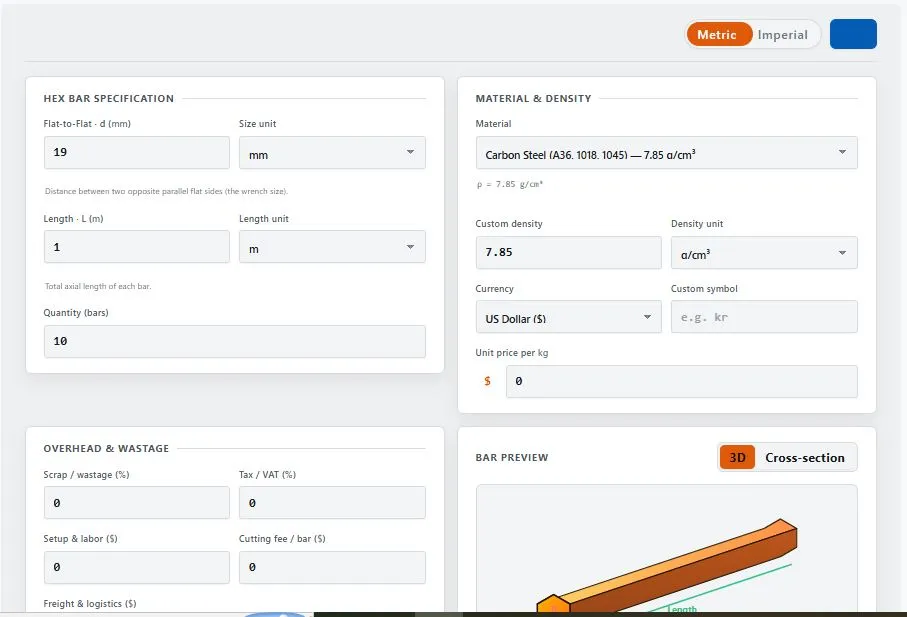
Table of Contents
How Does the Hex Bar Weight Calculator Work?
The Hex Bar Weight Calculator uses the Flat-to-Flat dimension of a regular hexagonal bar, along with its length and material density, to estimate the bar's weight. The calculator determines the hexagonal cross-sectional area and volume, then uses the selected or custom material density to calculate the unit weight and total weight based on the quantity entered. It can also estimate related measurements and costs using the values provided by the user.
Hex Bar Weight Calculation Formula
For a regular hexagonal bar, the calculator uses the Flat-to-Flat dimension to determine the cross-sectional area. The main formulas used are:
Cross-Sectional Area: A = (√3 / 2) × d²
Across Corners: D = (2 / √3) × d
Volume: V = A × L
Weight: W = V × ρ
Here, d is the Flat-to-Flat dimension, D is the Across-Corners dimension, L is the bar length, and ρ (rho) represents the selected or custom material density. The calculator applies the appropriate unit conversions when switching between metric and imperial units.
What Can You Calculate with the Hex Bar Weight Calculator?
The Hex Bar Weight Calculator provides several useful results based on the dimensions, material, quantity, and cost information you enter. Depending on your inputs, you can calculate the unit weight of one hex bar, total weight for multiple bars, cross-sectional area, volume, across-corners dimension, linear weight, surface area, and estimated total cost. The calculator also supports different materials, custom density values, metric and imperial units, and optional cost factors such as wastage, labor, cutting, freight, and tax.
Supported Materials for Hex Bar Weight Calculation
The Hex Bar Weight Calculator supports a wide range of material options, including carbon steel, stainless steel grades, aluminum, brass, bronze, copper, titanium, tool steel, lead, nickel alloys, cast iron, and custom density. Selecting the appropriate material allows the calculator to use its corresponding density for the weight and cost calculations. If your material is not listed, you can enter a custom density value when available.
Metric and Imperial Units
The Hex Bar Weight Calculator supports both metric and imperial unit systems, making it convenient for users working with different measurement standards. You can switch between the available unit systems while entering the hex bar dimensions and other relevant values. The calculator handles the necessary unit conversions to present the calculated results in the selected system.
Material Density and Custom Density
Material density plays an important role in calculating the weight of a hex bar. The Hex Bar Weight Calculator uses the density associated with the selected material to estimate the bar's weight. If you are working with a material that is not available in the list, you can use the custom density option and enter the density value for your specific material. This gives you more flexibility when calculating weights for different alloys and materials.
Understanding the Weight and Cost Results
The Hex Bar Weight Calculator shows the estimated weight of a single bar as well as the total weight based on the quantity you enter. It also provides additional measurements such as cross-sectional area, volume, linear weight, and surface area. If you enter the relevant cost details, the calculator can also estimate the total cost by taking factors such as material cost, wastage, labor, cutting fees, freight, and tax into account.
How to Use the Hex Bar Weight Calculator
Using the Hex Bar Weight Calculator is simple. Start by entering the Flat-to-Flat size and bar length, then select the material you are working with. Enter the quantity if you want to calculate the total weight for multiple bars. You can switch between metric and imperial units and use the custom density option when needed. For cost estimates, enter the applicable material cost and any additional cost details available in the calculator. The results will update based on the information you provide.
Important Notes About Hex Bar Weight Calculations
The results provided by the Hex Bar Weight Calculator are estimates based on the dimensions, material density, quantity, and other values entered by the user. Actual hex bar weight may vary slightly due to material composition, manufacturing tolerances, dimensional variations, and surface conditions. For purchasing, shipping, fabrication, or other applications where exact weight is required, verify the material specification and actual dimensions with the manufacturer or supplier.
Frequently Asked Questions About Hex Bar Weight
What is the difference between Across Flats and Across Corners on a hex bar?
Across Flats is the distance between two opposite parallel flat faces of a regular hexagonal bar. Across Corners is the distance between two opposite corners. The Hex Bar Weight Calculator uses the Flat-to-Flat dimension as the main size input and calculates the Across-Corners dimension from it.
What formula is used to calculate hex bar weight?
For a regular hexagonal bar, the cross-sectional area is calculated using A = (√3 / 2) × d², where d is the Flat-to-Flat dimension. The volume is then calculated from the cross-sectional area and length, and the estimated weight is determined using the selected or custom material density.
Can I calculate the weight of different materials with this calculator?
Yes. The calculator provides a range of material options with corresponding density values. You can select the material that matches your hex bar or use the custom density option when you need to enter a different density value.
Can I use metric and imperial units?
Yes. The calculator supports metric and imperial unit systems. You can switch between the available unit systems while entering your dimensions and other values, and the calculator converts the relevant measurements for the selected system.
Is the calculated hex bar weight the exact real-world weight?
The calculator provides a theoretical estimate based on the dimensions and material density you enter. Actual weight may vary slightly because of material composition, manufacturing tolerances, dimensional variations, surface condition, and other production factors. For applications requiring exact weight, verify the actual dimensions and material specifications with the manufacturer or supplier.
Where Can a Hex Bar Weight Calculator Be Useful?
A Hex Bar Weight Calculator can be useful for a variety of practical tasks involving hexagonal metal bars. It can help with estimating material weight for purchasing, shipping, fabrication, inventory planning, and general project calculations. The cost features can also be useful when you want to estimate material expenses by entering your own pricing and additional cost values.
Disclaimer
The Hex Bar Weight Calculator is provided for general informational and estimation purposes only. All results are calculated from the dimensions, material density, quantity, and other information entered by the user and should not be considered a substitute for verified measurements, manufacturer specifications, or professional advice.
BytePriva does not guarantee that every calculated result will exactly match the actual weight, dimensions, material properties, market price, or final cost of a physical hex bar. Users are responsible for verifying all relevant measurements, material specifications, prices, and other information before making purchasing, shipping, fabrication, engineering, or financial decisions. BytePriva and its owners, operators, and contributors are not responsible for any loss, damage, cost, or claim arising from the use of or reliance on the calculator or its results. By using this tool, you acknowledge and agree to use the results at your own discretion and responsibility.