The square bar weight calculator estimates the weight of a square bar from its side size, length, material and quantity, and turns it into a total cost. Use Metric or Imperial units, choose a material such as steel, stainless steel, aluminum, brass, copper or titanium, pick sharp or rounded corners, and enter your price per kg. You get the unit weight, total weight, cross-section area, volume and total cost at once.
Bar Specification
ρ = 7,850 kg/m³
Bar Preview
Formula Reference
- Sharp corners
- Area = A²
- Rounded corners
- Area = A² − (4 − π) r²
- Weight
- Weight = Area × Length × Density
Estimates are for reference only. Actual bar weight can vary with mill tolerance, alloy composition and surface finish. Always confirm against a certified mill test report before ordering or invoicing.
Related Tools
Quick answer
A 20 mm mild steel square bar weighs 3.14 kg per meter (about 2.11 lb per foot), so a 6 m length weighs about 18.84 kg. The formula is side (mm) × side (mm) × 7.85 ÷ 1000 = kg per meter.
Table of Contents
How to Use the Square Bar Weight Calculator
- Pick your units. Choose Metric (mm, m, kg) or Imperial (in, ft, lb).
- Choose the material. Select steel, stainless steel, aluminum, brass, copper or titanium. The density fills in automatically. If your supplier gave an exact density, use Custom density instead.
- Enter the side and the length. Use the length of one side of the square, not the diagonal.
- Choose the corner profile. Pick sharp corners, or rounded (fillet) corners if your bar has them.
- Add quantity and price per kg. You will see the unit weight, total weight, cross-section area, volume and total cost.
- Share or save the result. Send it on WhatsApp, copy the summary, or save it as an image or PDF.
Quick Reference: Square Bar Weight Chart (Mild Steel)
These values use steel at 7,850 kg/m³. Weight per meter is simply side² × density.
| Size | Weight per Meter | Weight per Foot | 6 m Bar |
|---|---|---|---|
| 6 × 6 mm | 0.283 kg | 0.086 kg | 1.70 kg |
| 8 × 8 mm | 0.502 kg | 0.153 kg | 3.01 kg |
| 10 × 10 mm | 0.785 kg | 0.239 kg | 4.71 kg |
| 12 × 12 mm | 1.130 kg | 0.345 kg | 6.78 kg |
| 15 × 15 mm | 1.766 kg | 0.538 kg | 10.60 kg |
| 16 × 16 mm | 2.010 kg | 0.613 kg | 12.06 kg |
| 20 × 20 mm | 3.140 kg | 0.957 kg | 18.84 kg |
| 25 × 25 mm | 4.906 kg | 1.495 kg | 29.44 kg |
| 30 × 30 mm | 7.065 kg | 2.153 kg | 42.39 kg |
| 32 × 32 mm | 8.038 kg | 2.450 kg | 48.23 kg |
| 40 × 40 mm | 12.560 kg | 3.828 kg | 75.36 kg |
| 50 × 50 mm | 19.625 kg | 5.982 kg | 117.75 kg |
| 60 × 60 mm | 28.260 kg | 8.614 kg | 169.56 kg |
| 75 × 75 mm | 44.156 kg | 13.459 kg | 264.94 kg |
| 80 × 80 mm | 50.240 kg | 15.313 kg | 301.44 kg |
| 100 × 100 mm | 78.500 kg | 23.927 kg | 471.00 kg |
Doubling the side makes the bar four times heavier, because weight depends on the side squared.
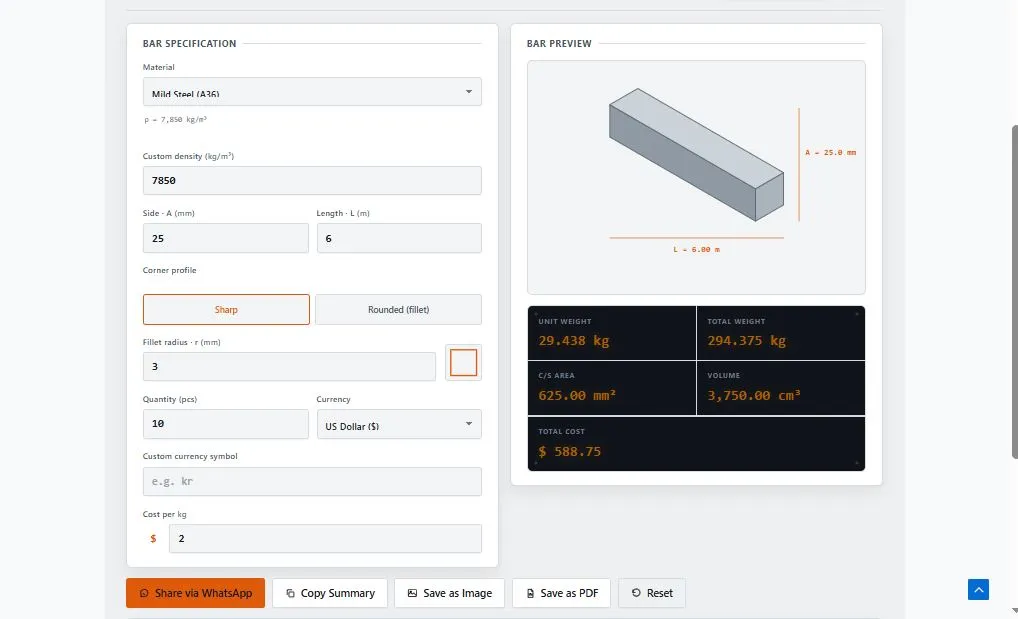
Worked Example: 10 Bars of 25 mm × 6 m
Enter mild steel (A36, 7,850 kg/m³), 25 mm side, 6 m length, 10 pieces and $2 per kg:
- Cross-section area = 25 × 25 = 625 mm²
- Volume per bar = 3,750 cm³
- Unit weight = 29.438 kg
- Total weight = 294.375 kg
- Total cost = $588.75
Square Bar Weight Formula (Metric and Imperial)
Weight is volume multiplied by density. For a square bar, the volume is the side squared multiplied by the length.
- Any metal (metric): kg per meter = side (mm) × side (mm) × density (kg/m³) ÷ 1,000,000
- Mild steel shortcut (metric): kg per meter = side² × 7.85 ÷ 1000
- Mild steel (imperial): lb per foot ≈ side (in)² × 3.4
- Total weight: weight per meter × length × number of bars
Example (20 mm steel bar): 20 × 20 = 400, then 400 × 7.85 ÷ 1000 = 3.14 kg per meter.
Want every size from 6 mm to 50 mm with worked examples? Read our full guide: Square Bar Weight per Meter: Chart, Formula and Examples.
Do Rounded Corners Change the Weight?
Yes, slightly. With rounded corners the area is A² − (4 − π) × r². For the same 25 mm bar with a 3 mm fillet radius, the area drops from 625 mm² to about 617.3 mm², and a 6 m bar weighs about 29.07 kg instead of 29.44 kg, roughly 1.2% less. The effect is small, but it matters on large orders.
Same Bar, Different Material
A 25 mm × 6 m bar has a volume of 0.00375 m³. Typical reference densities give:
| Material | Density (kg/m³) | Weight per Bar |
|---|---|---|
| Steel | 7,850 | 29.44 kg |
| Stainless steel | 8,000 | 30.00 kg |
| Aluminum | 2,700 | 10.13 kg |
| Brass | 8,500 | 31.88 kg |
| Copper | 8,960 | 33.60 kg |
| Titanium | 4,500 | 16.88 kg |
Alloys vary, so use Custom density when your supplier gives an exact figure. For more values, see the EngineeringToolbox metals and alloys density table.
Common Mistakes When Calculating Square Bar Weight
- Entering the diagonal instead of the side. Always measure across one flat side.
- Mixing millimeters and inches. Set Metric or Imperial first, then type your numbers.
- Using steel density for every metal. Aluminum weighs roughly a third of steel for the same size, while brass and copper weigh more.
- Treating the result as mill weight. It is a theoretical estimate. Tolerances and corner radius change real weight slightly.
Frequently Asked Questions
How do you calculate the weight of a square bar?
Multiply the side by itself, then by the length and the material density. For mild steel in millimeters, kg per meter = side² × 7.85 ÷ 1000. Multiply by the length in meters for the total.
What is the weight of a 20 mm square bar per meter?
A 20 mm mild steel square bar weighs 3.14 kg per meter. A 6 m length weighs about 18.84 kg.
What is the formula for square bar weight in pounds?
For steel, weight in lb per foot is roughly side in inches squared × 3.4. For example, a 1 inch square steel bar weighs about 3.4 lb per foot.
Do rounded corners change the weight?
Slightly. A 25 mm bar with a 3 mm corner radius has about 617.3 mm² of area instead of 625 mm², which makes a 6 m bar about 1.2% lighter (29.07 kg instead of 29.44 kg).
How much lighter is an aluminum square bar than steel?
For the same size, aluminum (about 2,700 kg/m³) weighs about 34% of mild steel (7,850 kg/m³). A 25 mm × 6 m aluminum bar is about 10.13 kg, compared with 29.44 kg for steel.
How accurate is a square bar weight calculator?
It gives a theoretical weight based on the size, length and density you enter. Real bars can differ because of mill tolerances, alloy and corner radius. Always confirm with a mill test report or your supplier before ordering or invoicing.
How do I find the total weight of several square bars?
Multiply the weight of one bar by the quantity. For example, ten 25 mm × 6 m steel bars weigh about 294.4 kg in total.
Is a square bar heavier than a round bar?
Yes. If the side of the square equals the diameter of the round bar, the square bar is about 27% heavier because it has more cross-section area.
Quick Summary
Enter the side, length, material, corner style, quantity and price per kg, and this square bar weight calculator returns the weight per bar, total weight and total cost. For a 20 mm mild steel bar, the answer is 3.14 kg per meter.
Important Notes & Disclaimer
The results provided by this Square Bar Weight Calculator are theoretical estimates based on the dimensions, length, quantity, and material density selected or entered by the user. Actual square bar weight may vary depending on the material grade, composition, manufacturing tolerances, and measured dimensions.
For applications where precise weight is important, users should verify the material specifications and actual dimensions with the relevant manufacturer or supplier before making purchasing, shipping, fabrication, or engineering decisions.
BytePriva provides this calculator as a general-purpose estimation tool and does not guarantee that calculated results will exactly match the weight of a specific physical product.