Sheet metal weight calculator: use this free tool to get an instant, accurate weight and cost estimate for rectangular sheets and circular discs — steel, galvanized, stainless steel, and aluminum. Enter the dimensions, pick a gauge or enter a custom thickness, and the tool applies the correct material density automatically. No signup, no data upload — everything runs directly in your browser.
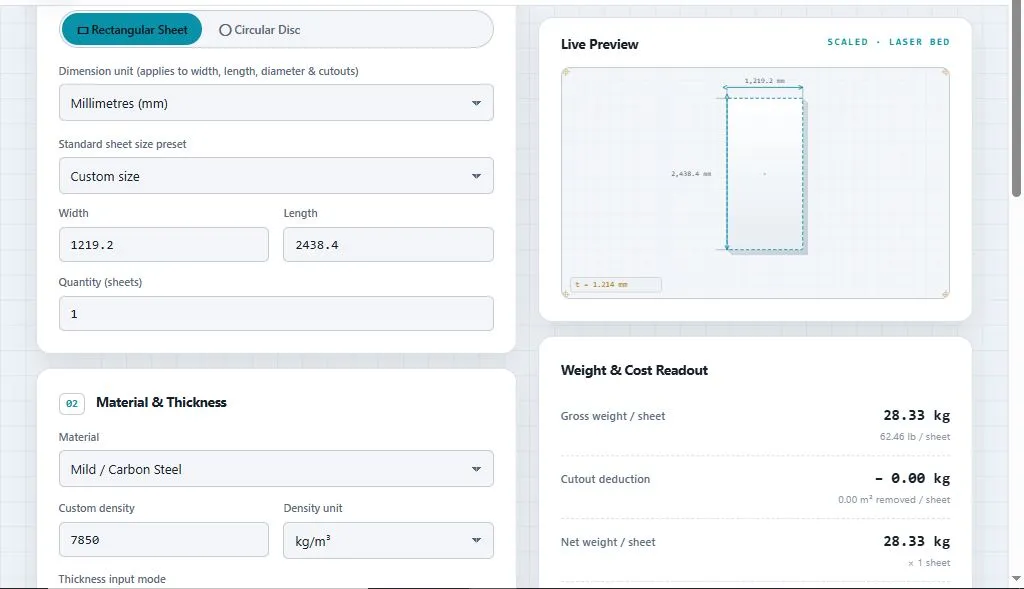
Table of Contents
How to Calculate Sheet Metal Weight
This sheet metal weight calculator gives you an instant, accurate weight and cost estimate for rectangular sheets and circular discs — steel, galvanized, stainless steel, and aluminum. Enter the dimensions, pick a gauge or enter a custom thickness, and the tool applies the correct material density automatically. No signup, no data upload — everything runs directly in your browser.
Why Use a Sheet Metal Weight Calculator
Manually calculating sheet metal weight means looking up gauge charts, converting units, and multiplying by hand — a process that's easy to get wrong under time pressure. This sheet metal weight calculator removes that risk by applying the correct density and gauge conversion automatically, giving fabricators, buyers, and hobbyists an instant, reliable number every time. Whether you're pricing a single sheet or a full production run, this sheet metal weight calculator gives you accurate, instant numbers without spreadsheets or manual lookups.
Sheet Metal Weight Formula
Sheet metal weight is calculated using the standard volume-times-density formula:
Weight (kg) = Length (mm) × Width (mm) × Thickness (mm) × Density (g/cm³) ÷ 1,000,000
For circular discs, the area is calculated first using π × (Diameter ÷ 2)², then multiplied by thickness and density. If a cutout or hole needs to be removed from the sheet, its weight is calculated the same way and subtracted from the gross weight before the scrap margin is applied.
Gauge to Thickness Conversion (Manufacturers' Standard Gage, Steel)
| Gauge | Thickness (mm) | Thickness (in) |
| 7 ga | 4.55 mm | 0.1793 in |
| 8 ga | 4.18 mm | 0.1644 in |
| 9 ga | 3.80 mm | 0.1495 in |
| 10 ga | 3.42 mm | 0.1345 in |
| 11 ga | 3.175 mm | 0.1250 in |
| 12 ga | 2.66 mm | 0.1046 in |
| 14 ga | 1.90 mm | 0.0747 in |
| 16 ga | 1.52 mm | 0.0598 in |
| 18 ga | 1.21 mm | 0.0478 in |
| 20 ga | 0.912 mm | 0.0359 in |
| 22 ga | 0.759 mm | 0.0299 in |
| 24 ga | 0.607 mm | 0.0239 in |
| 26 ga | 0.455 mm | 0.0179 in |
| 28 ga | 0.379 mm | 0.0149 in |
For more background on gauge numbering, see the Wikipedia entry on sheet metal gauge.
How do you calculate the weight of a sheet metal?
Multiply the sheet's length, width, and thickness together to get its volume, then multiply that volume by the material's density. For a rectangular steel sheet 1000mm × 500mm × 2mm, the weight is 1000 × 500 × 2 × 7.85 ÷ 1,000,000 = 7.85 kg. This is exactly the method this sheet metal weight calculator uses internally.
Does gauge number mean the same thickness for every metal?
No. Gauge-to-thickness conversion differs by material and by gauge standard. A 16-gauge steel sheet is not the same thickness as a 16-gauge aluminum sheet, because steel and aluminum use different gauge charts. Always confirm which gauge standard applies to your material before ordering.
How much does a standard 4x8 ft steel sheet weigh?
Using this sheet metal weight calculator, A 4 ft × 8 ft (1219mm × 2438mm) mild steel sheet at 16-gauge (1.52mm thick) weighs approximately 35.2 kg (77.6 lb). Thicker gauges and denser materials like stainless steel will weigh proportionally more.
What density should I use for stainless steel vs. aluminum?
Use 8.00 g/cm³ for 304-grade stainless steel and 2.70 g/cm³ for aluminum. Stainless steel is roughly three times denser than aluminum, so an identically sized sheet in stainless will weigh about three times as much.
How is scrap margin factored into the cost calculation?
Scrap margin adds a percentage buffer on top of the calculated material weight to account for cutting waste, offcuts, and process loss. For example, a 5% scrap margin on a 10kg sheet adds 0.5kg to the billed weight before the final cost is calculated.
What's the difference between sheet metal and plate metal?
Sheet metal is generally thinner and is commonly used for fabrication, enclosures, panels, ductwork, and other formed parts. Plate metal is thicker and is typically used for structural, industrial, and heavy-duty applications. The exact thickness range can vary by industry and standard, so always confirm the material specification before calculating weight.
How accurate is an online sheet metal weight calculator?
A sheet metal weight calculator can provide accurate results when the dimensions, thickness, material density, and quantity are entered correctly. The calculated result is an estimate based on the selected material density and dimensions. Actual weight may vary slightly because of manufacturing tolerances, coatings, surface finishes, and material composition.
Do I need to account for kerf or laser cutting waste separately?
Yes. If a sheet is being laser cut, plasma cut, or otherwise processed, kerf and cutting waste can affect the amount of material required. The calculator's weight result represents the material based on the dimensions entered. For purchasing and production estimates, account separately for kerf, nesting efficiency, scrap, and cutting waste when necessary.
Disclaimer
This calculator is provided as a free estimation tool. While every effort has been made to ensure accuracy, calculations may occasionally contain errors due to rounding, input variations, or edge cases. This tool should be used for general planning and reference purposes only — not as a substitute for professional verification. Users are responsible for independently confirming all weights, costs, and material specifications with their supplier before making purchasing or production decisions. BytePriva accepts no liability for decisions made based solely on this tool's output.