A tap drill size chart tells you which drill bit to use before you cut an internal thread. Choose a hole that is too small and the tap strains or breaks. Choose one that is too large and the thread comes out shallow and weak. This free tap drill calculator gives you the drill for metric, UNC, UNF and custom threads, shows the formula with your own numbers, and tells you how much thread each drill really produces.
Below you will find the formula, four complete charts (metric tap drill size coarse and fine, UNC and UNF), worked examples, and straight answers to the questions people ask most about thread drill size.
Quick answer: For metric threads, tap drill ≈ major diameter − pitch. An M6×1 uses a 5.0 mm drill, an M8×1.25 uses 6.8 mm and an M10×1.5 uses 8.5 mm. For inch threads, tap drill ≈ major diameter − 1 ÷ TPI. A 1/4-20 uses a #7 drill (0.2010 in). The general formula is Drill = D − 0.01299 × % × P, where % is the thread engagement.
| Drill set | Size | Diameter | Thread % |
|---|
| Thread | Pitch (mm) | Tap drill | mm | in | Thread % |
|---|
Related Tools
Table of Contents
What Is a Tap Drill Size?
A tap drill is the drill bit used to make the hole that a tap will then thread. According to Wikipedia's list of drill and tap sizes, the right hole is slightly larger than the minor diameter of the mating screw but smaller than its pitch and major diameters. Many thread sizes have several workable drills, because different hole sizes produce threads with anywhere from 50% to 100% of the full thread depth, and depths of about 60% to 75% are usually the target.
That range is why charts rarely disagree by much, and why a small difference between two charts is normal rather than a mistake. It also explains the calculator's Thread engagement setting: it lets you choose the percentage and see the exact drill that results.
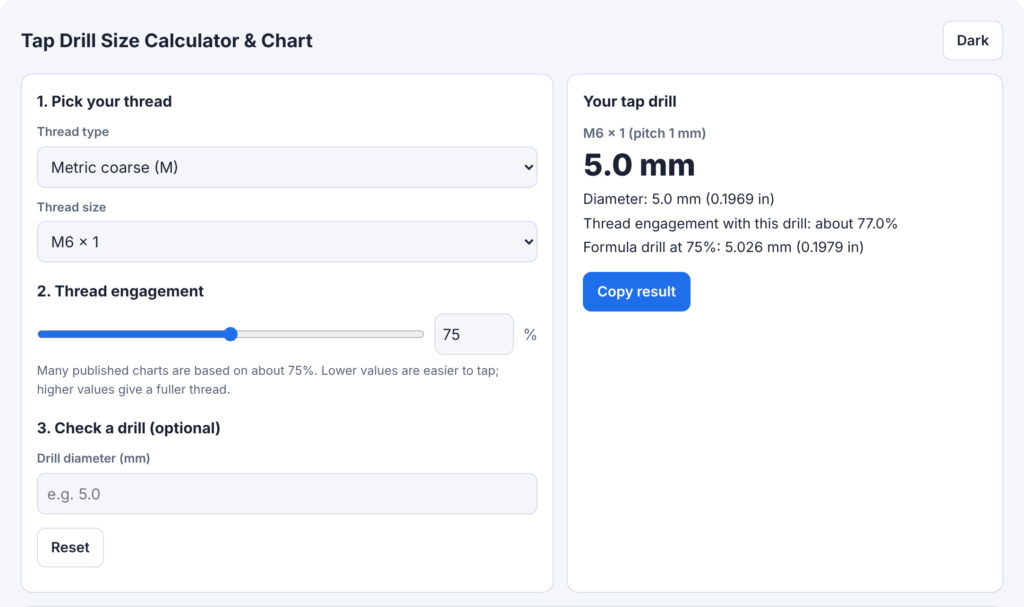
What You Get in This Tap Drill Calculator
- Six thread types: metric coarse, metric fine, UNC, UNF, and custom metric or custom inch threads.
- Instant result in mm and inches, with the standard chart drill, the thread percentage it produces, and the formula drill for your chosen engagement.
- Thread engagement slider from 50% to 100%.
- Check a drill: type in a drill you already own and see the thread percentage it would give.
- Nearest standard drills from the metric (0.1 mm), fractional (1/64 in) and number/letter sets, each with its own thread percentage.
- Searchable chart for all four thread series. Tap a row to load it into the calculator.
- Step-by-step working that substitutes your numbers into the formula.
- Copy buttons for the result and for the chart (Excel or Google Sheets).
- Light and dark themes and a layout that adapts to phones, tablets and desktops.
How to Use the Tap Drill Calculator
- Pick a thread type. For example metric coarse or UNC.
- Pick the thread size. The list shows each size with its pitch or TPI, such as M6 × 1 or 1/4-20. For anything else, choose a custom type and enter the major diameter and the pitch (metric) or threads per inch (inch).
- Leave engagement at 75% or move the slider. Lower values reduce tapping load, higher values give a fuller thread.
- Read the result. The large number is the standard chart drill. Under it you will see its diameter in both units, the thread percentage it produces, and the exact formula drill.
- Optional: check a drill. Enter any drill diameter in the unit shown to see its thread percentage.
- Copy the result or scroll to the chart.
The drill is always shown in both mm and inches, so you can match it to whichever drill set you own.
Tap Drill Size Formula
The calculator uses one formula for every thread:
- Pitch P = the pitch in mm (metric) or 1 ÷ TPI (inch)
- Tap drill = D − 0.01299 × % × P
- Thread % = (D − drill) ÷ (0.01299 × P)
D is the major (nominal) diameter and % is the thread engagement, entered as a number such as 75.
Example 1: M6×1 at 75%. Drill = 6 − 0.01299 × 75 × 1 = 5.026 mm. The standard chart drill is 5.0 mm, which gives (6 − 5) ÷ (0.01299 × 1) = about 77% thread.
Example 2: 1/4-20 at 75%. P = 1 ÷ 20 = 0.05 in. Drill = 0.25 − 0.01299 × 75 × 0.05 = 0.2013 in. The nearest number drill, #7, measures 0.2010 in and gives about 75.4%.
There is also a fast mental rule that works for both systems: major diameter minus pitch. Wikipedia describes the same shortcut for metric threads and notes that it also works for inch threads once TPI is converted to a pitch. It lands near a standard drill rather than exactly on one.
| Thread | Major − pitch | Standard chart drill |
|---|---|---|
| M6 × 1 | 6 − 1 = 5.0 mm | 5.0 mm |
| M8 × 1.25 | 8 − 1.25 = 6.75 mm | 6.8 mm |
| M10 × 1.5 | 10 − 1.5 = 8.5 mm | 8.5 mm |
| 1/4-20 | 0.250 − 0.050 = 0.200 in | #7 (0.2010 in) |
| 3/8-16 | 0.375 − 0.0625 = 0.3125 in | 5/16 in (0.3125 in) |
| 1/2-13 | 0.500 − 0.0769 = 0.4231 in | 27/64 in (0.4219 in) |
How Thread Percentage Works
Thread percentage describes how much of the full thread depth your hole leaves for the tap to cut. A smaller drill leaves more material, so you get a higher percentage and a stronger thread, but the tap works harder. A larger drill does the opposite. The table shows how the drill changes with the percentage for two common threads.
| Thread engagement | M10 × 1.5 drill (mm) | 1/4-20 drill (in) |
|---|---|---|
| 60% | 8.831 | 0.2110 |
| 70% | 8.636 | 0.2045 |
| 75% | 8.539 | 0.2013 |
| 80% | 8.441 | 0.1980 |
| 100% | 8.051 | 0.1850 |
A 100% thread is a theoretical limit that most shops avoid, because the extra tapping load rarely buys a meaningful gain in strength. Many machinists pick a lower value for harder materials and follow the tap manufacturer's recommendation for their specific job.
Percentages depend on the formula basis. This calculator and the charts below use the 0.01299 form, so another source may show a slightly different percentage for the same drill.
Metric Tap Drill Size Chart (Coarse)
These are commonly published tap drill sizes for ISO metric coarse threads. Most sit close to major minus pitch, which is why the percentage column is mostly 77%.
| Thread | Pitch (mm) | Tap drill (mm) | Drill (in) | Thread % |
|---|---|---|---|---|
| M1 × 0.25 | 0.25 | 0.75 | 0.0295 | 77% |
| M1.2 × 0.25 | 0.25 | 0.95 | 0.0374 | 77% |
| M1.4 × 0.3 | 0.3 | 1.1 | 0.0433 | 77% |
| M1.6 × 0.35 | 0.35 | 1.25 | 0.0492 | 77% |
| M2 × 0.4 | 0.4 | 1.6 | 0.0630 | 77% |
| M2.5 × 0.45 | 0.45 | 2.05 | 0.0807 | 77% |
| M3 × 0.5 | 0.5 | 2.5 | 0.0984 | 77% |
| M3.5 × 0.6 | 0.6 | 2.9 | 0.1142 | 77% |
| M4 × 0.7 | 0.7 | 3.3 | 0.1299 | 77% |
| M5 × 0.8 | 0.8 | 4.2 | 0.1654 | 77% |
| M6 × 1 | 1 | 5.0 | 0.1969 | 77% |
| M7 × 1 | 1 | 6.0 | 0.2362 | 77% |
| M8 × 1.25 | 1.25 | 6.8 | 0.2677 | 74% |
| M10 × 1.5 | 1.5 | 8.5 | 0.3346 | 77% |
| M12 × 1.75 | 1.75 | 10.2 | 0.4016 | 79% |
| M14 × 2 | 2 | 12.0 | 0.4724 | 77% |
| M16 × 2 | 2 | 14.0 | 0.5512 | 77% |
| M18 × 2.5 | 2.5 | 15.5 | 0.6102 | 77% |
| M20 × 2.5 | 2.5 | 17.5 | 0.6890 | 77% |
| M22 × 2.5 | 2.5 | 19.5 | 0.7677 | 77% |
| M24 × 3 | 3 | 21.0 | 0.8268 | 77% |
| M27 × 3 | 3 | 24.0 | 0.9449 | 77% |
| M30 × 3.5 | 3.5 | 26.5 | 1.0433 | 77% |
| M33 × 3.5 | 3.5 | 29.5 | 1.1614 | 77% |
| M36 × 4 | 4 | 32.0 | 1.2598 | 77% |
Metric Fine Thread Tap Drill Sizes
Fine threads have a smaller pitch, so the drill is closer to the major diameter.
| Thread | Pitch (mm) | Tap drill (mm) | Drill (in) | Thread % |
|---|---|---|---|---|
| M4 × 0.5 | 0.5 | 3.5 | 0.1378 | 77% |
| M5 × 0.5 | 0.5 | 4.5 | 0.1772 | 77% |
| M8 × 1 | 1 | 7.0 | 0.2756 | 77% |
| M10 × 1 | 1 | 9.0 | 0.3543 | 77% |
| M10 × 1.25 | 1.25 | 8.8 | 0.3465 | 74% |
| M12 × 1 | 1 | 11.0 | 0.4331 | 77% |
| M12 × 1.25 | 1.25 | 10.8 | 0.4252 | 74% |
| M12 × 1.5 | 1.5 | 10.5 | 0.4134 | 77% |
| M14 × 1.5 | 1.5 | 12.5 | 0.4921 | 77% |
| M16 × 1 | 1 | 15.0 | 0.5906 | 77% |
| M16 × 1.5 | 1.5 | 14.5 | 0.5709 | 77% |
| M18 × 1.5 | 1.5 | 16.5 | 0.6496 | 77% |
| M20 × 1 | 1 | 19.0 | 0.7480 | 77% |
| M20 × 1.5 | 1.5 | 18.5 | 0.7283 | 77% |
| M22 × 1.5 | 1.5 | 20.5 | 0.8071 | 77% |
| M24 × 1.5 | 1.5 | 22.5 | 0.8858 | 77% |
| M24 × 2 | 2 | 22.0 | 0.8661 | 77% |
| M30 × 1.5 | 1.5 | 28.5 | 1.1220 | 77% |
| M30 × 2 | 2 | 28.0 | 1.1024 | 77% |
UNC Tap Drill Size Chart (Inch Coarse)
Inch sizes are drilled with number, letter or fractional drills. Their decimals are listed so you can match them to a metric set.
| Thread | TPI | Tap drill | Drill (in) | Drill (mm) | Thread % |
|---|---|---|---|---|---|
| #1-64 | 64 | #53 | 0.0595 | 1.511 | 67% |
| #2-56 | 56 | #50 | 0.0700 | 1.778 | 69% |
| #3-48 | 48 | #47 | 0.0785 | 1.994 | 76% |
| #4-40 | 40 | #43 | 0.0890 | 2.261 | 71% |
| #5-40 | 40 | #38 | 0.1015 | 2.578 | 72% |
| #6-32 | 32 | #36 | 0.1065 | 2.705 | 78% |
| #8-32 | 32 | #29 | 0.1360 | 3.454 | 69% |
| #10-24 | 24 | #25 | 0.1495 | 3.797 | 75% |
| #12-24 | 24 | #16 | 0.1770 | 4.496 | 72% |
| 1/4-20 | 20 | #7 | 0.2010 | 5.105 | 75% |
| 5/16-18 | 18 | F | 0.2570 | 6.528 | 77% |
| 3/8-16 | 16 | 5/16 | 0.3125 | 7.938 | 77% |
| 7/16-14 | 14 | U | 0.3680 | 9.347 | 75% |
| 1/2-13 | 13 | 27/64 | 0.4219 | 10.716 | 78% |
| 9/16-12 | 12 | 31/64 | 0.4844 | 12.303 | 72% |
| 5/8-11 | 11 | 17/32 | 0.5312 | 13.494 | 79% |
| 3/4-10 | 10 | 21/32 | 0.6562 | 16.669 | 72% |
| 7/8-9 | 9 | 49/64 | 0.7656 | 19.447 | 76% |
| 1-8 | 8 | 7/8 | 0.8750 | 22.225 | 77% |
UNF Tap Drill Size Chart (Inch Fine)
| Thread | TPI | Tap drill | Drill (in) | Drill (mm) | Thread % |
|---|---|---|---|---|---|
| #0-80 | 80 | 3/64 | 0.0469 | 1.191 | 81% |
| #1-72 | 72 | #53 | 0.0595 | 1.511 | 75% |
| #2-64 | 64 | #50 | 0.0700 | 1.778 | 79% |
| #3-56 | 56 | #45 | 0.0820 | 2.083 | 73% |
| #4-48 | 48 | #42 | 0.0935 | 2.375 | 68% |
| #5-44 | 44 | #37 | 0.1040 | 2.642 | 71% |
| #6-40 | 40 | #33 | 0.1130 | 2.870 | 77% |
| #8-36 | 36 | #29 | 0.1360 | 3.454 | 78% |
| #10-32 | 32 | #21 | 0.1590 | 4.039 | 76% |
| #12-28 | 28 | #14 | 0.1820 | 4.623 | 73% |
| 1/4-28 | 28 | #3 | 0.2130 | 5.410 | 80% |
| 5/16-24 | 24 | I | 0.2720 | 6.909 | 75% |
| 3/8-24 | 24 | Q | 0.3320 | 8.433 | 79% |
| 7/16-20 | 20 | 25/64 | 0.3906 | 9.922 | 72% |
| 1/2-20 | 20 | 29/64 | 0.4531 | 11.509 | 72% |
| 9/16-18 | 18 | 33/64 | 0.5156 | 13.097 | 65% |
| 5/8-18 | 18 | 37/64 | 0.5781 | 14.684 | 65% |
| 3/4-16 | 16 | 11/16 | 0.6875 | 17.462 | 77% |
| 7/8-14 | 14 | 13/16 | 0.8125 | 20.637 | 67% |
| 1-12 | 12 | 59/64 | 0.9219 | 23.416 | 72% |
The percentage column shows the thread each listed drill actually produces. Where a value looks low, such as 65%, the calculator's nearest-drill table lets you compare a neighbouring size.
What If You Do Not Own the Exact Drill?
Drill sets differ by region, so the calculator lists the nearest size in three sets with the thread each one gives. For a 1/4-20 at 75%, the formula drill is 0.2013 in. The nearest options and their results are:
| Drill set | Size | Diameter | Thread % |
|---|---|---|---|
| Number / letter | #7 | 0.2010 in (5.105 mm) | 75.4% |
| Metric (0.1 mm) | 5.1 mm | 0.2008 in | 75.8% |
| Fractional | 13/64 in | 0.2031 in (5.159 mm) | 72.2% |
All three are workable choices. The fractional drill is slightly larger, so it gives a lower percentage and a lighter tapping load. The same comparison appears automatically for any thread you select.
Common Tap Drill Mistakes
- Using the clearance drill instead of the tap drill. The clearance drill lets a bolt pass freely. The tap drill makes the hole you thread.
- Mixing units. A metric drill in an inch thread, or the reverse, is a common slip. The calculator shows both units to help.
- Forgetting that charts are for cutting taps. Thread-forming (roll) taps do not cut material away, so they normally need a different, usually larger, hole. Follow the tap maker's chart for those.
- Treating the chart as the only valid answer. Most threads accept more than one drill, as the percentage column shows.
- Drilling too shallow in a blind hole. Drill deeper than the thread depth so the tap does not bottom out.
- Ignoring drill runout and wear. A wobbling or worn drill makes an oversize hole, which lowers the actual thread percentage.
Frequently Asked Questions
What size drill do I use for an M6 tap?
Use a 5.0 mm drill for a standard M6×1 coarse thread. It gives about 77% thread engagement. For an M6 fine thread with a 0.75 mm pitch, the major-minus-pitch rule gives about 5.25 mm, so confirm with the calculator.
How do you calculate tap drill size?
For a quick estimate, subtract the pitch from the major diameter. For metric threads the pitch is given in mm. For inch threads, divide 1 by the TPI. For a chosen thread percentage, use Drill = D − 0.01299 × % × P.
What is the tap drill size for 1/4-20?
A #7 drill, which measures 0.2010 in (5.105 mm), is the standard choice and gives about 75% thread. A 13/64 in drill is a common alternative at about 72%.
What drill size is needed for M8, M10 and M12?
The standard coarse sizes are 6.8 mm for M8×1.25, 8.5 mm for M10×1.5 and 10.2 mm for M12×1.75.
What does 75% thread mean?
It means the drilled hole leaves 75% of the theoretical full thread depth for the tap to cut. Many published charts are built around roughly this value, and thread depths of about 60% to 75% are usually considered a good balance between strength and tapping effort.
Can I use a slightly bigger drill than the chart says?
Yes, within reason. A larger drill lowers the thread percentage, which makes tapping easier but gives less thread engagement. Use the check-a-drill field to see the exact percentage before you commit.
Why do different charts show different tap drill sizes?
Charts target slightly different thread percentages, round to different drill sets, and use different formula bases. A one-step difference between two reputable charts is common. Compare the thread percentage rather than the drill name.
Is the tap drill size the same for thread-forming taps?
No. Forming taps displace material instead of cutting it, so they usually need a different hole size than cutting taps. This calculator and chart are for cutting taps. Use the tap manufacturer's data for forming taps.
What is the difference between a tap drill and a clearance drill?
The tap drill makes the hole that will be threaded. The clearance drill makes a larger hole that a bolt passes through without engaging a thread.
Does the material I am tapping change the drill size?
It can influence your choice. Many machinists use a lower thread percentage in harder materials to reduce tap load, but the right value depends on the material, the tap and the application. Check the tap maker's recommendation.
Quick Summary
A tap drill is the hole size you drill before tapping. For metric threads, major minus pitch gets you close, so M6×1 uses 5.0 mm. For inch threads, major minus 1 ÷ TPI does the same, so 1/4-20 uses a #7 drill. For anything else, use Drill = D − 0.01299 × % × P and check the thread percentage. This tap drill size chart and calculator do the maths, show the working, and compare neighbouring drills.
Disclaimer
This calculator, chart and article are provided for general information and planning only. Drill sizes come from commonly published values and the formula shown above. They have not been checked against your tap, material, machine, drawing or standard, and thread percentages can differ between sources. Always follow your tap manufacturer's recommendation, your drawing or specification, and test on scrap before drilling and tapping a finished part. For safety-critical or load-bearing joints, follow the applicable standard and consult a qualified engineer. The tool and content are provided as is, without warranty of any kind, and you use them at your own risk.