A metal sheet gauge to thickness converter turns a gauge number into an actual thickness in mm or inches — and gets it right for the material you're actually working with, since steel, galvanized steel, stainless steel, and aluminum all use different gauge standards for the exact same number. Select your material, enter the gauge, and get the real thickness instantly, or work backwards by entering a known thickness to find the nearest matching gauge.
Most gauge charts online only cover one material and expect you to know which system applies. This converter keeps steel, galvanized, and stainless separate using their own official standard tables, and calculates aluminum, brass, and copper directly from the Brown & Sharpe formula — so even non-standard decimal gauges convert accurately, not just the common whole numbers.
Convert
Gauge number
Known thickness
Live thickness preview
Results
This thickness is outside the standard gauge range for the selected material.
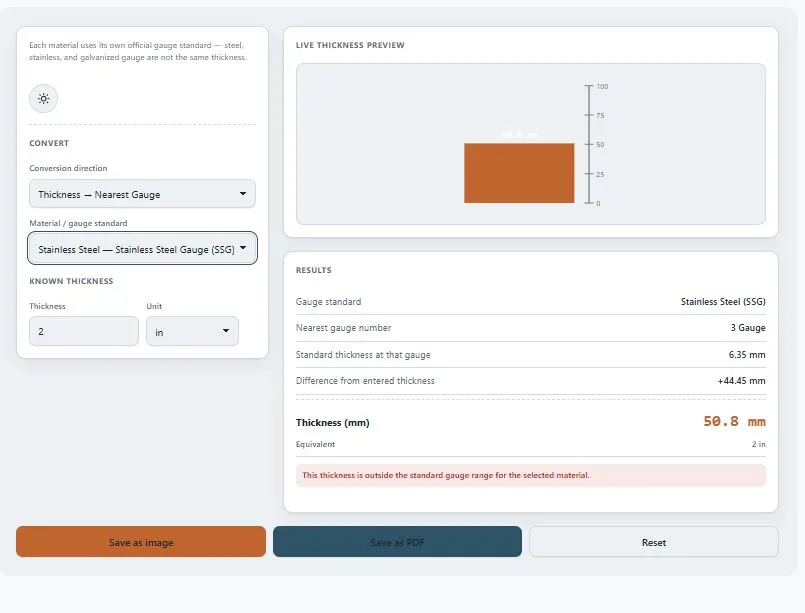
Table of Contents
How the Metal Sheet Gauge to Thickness Converter Works
The converter works differently depending on the material you select, because "gauge" isn't one universal measurement — it's defined separately for each material family.
Standard steel, galvanized steel, and stainless steel each follow their own official gauge standard table (Manufacturers' Standard Gauge, galvanized MSG, and Stainless Steel Gauge). These tables aren't based on a single formula — each gauge number corresponds to a specific, standardized thickness, so the converter looks up the exact value for the gauge and material you select.
Aluminum, brass, and copper use the Brown & Sharpe (B&S) gauge system instead, which follows a real mathematical formula: thickness = 0.005 × 92^((36 − gauge) / 39) inches. Because this is a genuine formula rather than a fixed table, the converter can calculate accurate thickness for any gauge number, including decimals, not just the commonly listed whole sizes.
Working in reverse — thickness to gauge — uses the same logic. For steel, galvanized, and stainless, the converter searches the standard table for the closest matching gauge and shows you how far your entered thickness is from that standard value. For aluminum, brass, and copper, it inverts the B&S formula directly, giving you an exact gauge number rather than a nearest match.
Gauge to Thickness Reference Chart
These are the exact standard values used inside the converter — steel, galvanized, and stainless from their official gauge tables, aluminum calculated directly from the Brown & Sharpe formula. For the original historical U.S. standard behind these gauge numbers, the National Institute of Standards and Technology's Circular on Sheet Metal Gauges documents the official thicknesses, weights, and tolerances still referenced across the industry today.
Table:
| Gauge | Standard Steel (mm) | Galvanized (mm) | Stainless (mm) | Aluminum / B&S (mm) |
|---|---|---|---|---|
| 3 | 6.07 | — | 6.35 | 5.83 |
| 6 | 4.94 | — | 5.16 | 4.11 |
| 8 | 4.18 | 4.27 | 4.37 | 3.26 |
| 10 | 3.42 | 3.51 | 3.57 | 2.59 |
| 12 | 2.66 | 2.75 | 2.78 | 2.05 |
| 14 | 1.90 | 1.99 | 1.98 | 1.63 |
| 16 | 1.52 | 1.61 | 1.59 | 1.29 |
| 18 | 1.21 | 1.31 | 1.27 | 1.02 |
| 20 | 0.91 | 1.01 | 0.95 | 0.81 |
| 22 | 0.76 | 0.85 | 0.79 | 0.64 |
| 24 | 0.61 | 0.70 | 0.64 | 0.51 |
| 26 | 0.45 | 0.55 | 0.48 | 0.40 |
| 28 | 0.38 | 0.47 | 0.40 | 0.32 |
| 30 | 0.30 | 0.40 | 0.32 | 0.25 |
This is a shortened reference — the calculator itself supports every gauge from 3 to 30 for steel, galvanized, and stainless, and any decimal gauge value for aluminum, brass, and copper.
Why Use This Metal Sheet Gauge to Thickness Converter
Gauge numbers are one of the most common sources of ordering and fabrication mistakes, mainly because the same number means different things depending on the material. This metal sheet gauge to thickness converter is built around that fact:
- Correct table for the correct material. Steel, galvanized steel, and stainless steel each use their own standard gauge table, not one chart stretched across all three.
- Real formula for non-ferrous metals. Aluminum, brass, and copper are calculated from the actual Brown & Sharpe formula, so even uncommon decimal gauges convert accurately.
- Works both directions. Convert a gauge to a thickness, or enter a known thickness and find the nearest standard gauge, with the difference shown so you know how close it actually is.
- A live visual reference. The sheet thickness is drawn to scale next to a ruler that updates as you type, so you can see the size, not just read a number.
- No sign-up, works instantly. Every conversion happens in your browser as you type — no submitting a form or waiting for a result.
Who This Calculator Is Built For
- Sheet metal fabricators and machine shops converting a customer's gauge specification into an actual thickness before cutting or ordering material
- Buyers and estimators comparing suppliers who quote in gauge numbers for different materials, where the same gauge means different thicknesses
- HVAC, automotive, and metal fabrication students learning why gauge isn't a universal measurement and how it's actually defined per material
- Engineers and designers who have a measured thickness and need to identify the nearest standard gauge for specification or ordering purposes
Tips for Getting Accurate Results
Here's how to get the most accurate number out of this metal sheet gauge to thickness converter:
- Always confirm the material before reading the gauge. The same gauge number gives a different thickness for steel, galvanized steel, stainless steel, and aluminum — selecting the wrong material is the most common source of error.
- Use the reverse direction when you have a caliper reading. If you've measured a sheet's actual thickness, switch to "Thickness → Nearest Gauge" instead of guessing which gauge it might be.
- Watch the difference value in reverse mode. A small difference means your measured thickness closely matches a standard gauge; a larger difference may mean the sheet is a non-standard or custom thickness.
- Use decimal gauges for aluminum, brass, and copper when needed. Since the Brown & Sharpe system is a real formula, you're not limited to the commonly listed whole gauge numbers.
- Double-check galvanized sheet only goes down to 8 gauge. Thinner galvanized gauges below 8 aren't part of the standard table, since galvanized sheet isn't typically produced that thick.
Frequently Asked Questions
Is gauge the same thickness for every material?
No. The same gauge number means a different thickness depending on the material — steel, galvanized steel, stainless steel, and aluminum each follow their own standard. This converter keeps them separate rather than using one chart for all materials.
How is aluminum thickness calculated?
Aluminum, brass, and copper use the Brown & Sharpe (B&S) gauge system, which is a real mathematical formula rather than a fixed table. This means the converter can calculate any gauge value, including decimals, not just the commonly listed whole numbers.
Can I convert a thickness back into a gauge number?
Yes. Switch the direction to "Thickness → Nearest Gauge," enter your known thickness, and the converter finds the closest matching gauge for your selected material.
How accurate is the reverse (thickness to gauge) conversion?
For aluminum, brass, and copper, it's exact, since the B&S formula is inverted directly. For steel, galvanized, and stainless, it finds the nearest standard gauge and shows you the difference between your entered thickness and that standard value.
Why doesn't galvanized steel show gauges below 8?
Galvanized sheet isn't standardly produced below 8 gauge, so those thicknesses simply aren't part of the official galvanized gauge table.
Does the calculator show both mm and inches?
Yes. Every result shows the thickness in both millimeters and inches at the same time.
What does the live ruler diagram show?
A scaled side-profile of the sheet next to a ruler, so you can see the thickness visually, not just as a number. It updates automatically as you change the gauge or thickness.
Is this calculator free to use?
Yes, this metal sheet gauge to thickness converter is free with no sign-up required, and it runs entirely in your browser.
Quick Summary
A metal sheet gauge to thickness converter turns a gauge number into a real, material-specific thickness, since the same gauge number means different thicknesses for steel, galvanized steel, stainless steel, and aluminum. This converter uses the official standard tables for steel, galvanized, and stainless, calculates aluminum, brass, and copper directly from the Brown & Sharpe formula, and works in both directions — gauge to thickness, or thickness to nearest gauge — with results shown live on a scaled ruler diagram.
Disclaimer
This metal sheet gauge to thickness converter is provided by BytePriva for general reference purposes only. It is based on published standard gauge tables and the Brown & Sharpe formula, but actual sheet thickness can vary slightly by manufacturer and production tolerance. BytePriva makes no warranty as to the accuracy of any result and accepts no liability for ordering, fabrication, or design decisions based on this tool. Always verify critical thickness requirements against the supplier's material specification or an approved engineering standard.