A bolt torque chart calculator works out the actual tightening torque a fastener needs — not a generic chart value, but a real number based on your bolt's size, thread pitch, clamp load, and friction condition. Enter your bolt's diameter and pitch, the clamp load you need (or calculate it from the bolt's strength class), and either a simple K-factor or detailed thread and bearing friction values, and it instantly gives you the torque to apply, shown live on a gauge.
Generic torque charts assume one fixed friction value for every bolt, which is exactly where most over-tightening and under-tightening mistakes come from. This calculator lets you set your own K-factor, or go further and use the detailed thread-and-bearing-friction method (the same approach used in mechanical engineering references like Shigley's) for both metric and imperial bolts.
Bolt & thread
Clamp load (preload)
Friction & torque method
Live torque gauge
Results
Friction is too high relative to the thread pitch for this joint to be tightened by turning — check your input values.
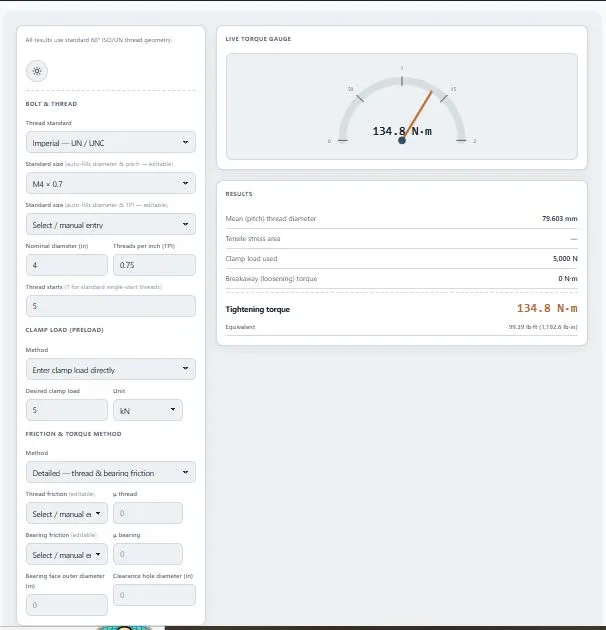
Table of Contents
How the Bolt Torque Chart Calculator Works
The calculator works through four stages, using standard 60° ISO/UN thread geometry throughout.
Step 1 — Thread geometry. From your bolt's nominal diameter and pitch (or threads per inch for imperial sizes), the calculator derives the mean (pitch) thread diameter — the actual diameter the thread engages at, which is smaller than the nominal diameter and is what the torque formula depends on.
Step 2 — Clamp load. You can enter the clamp load (preload) directly, or calculate it from the bolt's strength: selecting a property class or SAE grade fills in a typical proof stress, the calculator works out the tensile stress area from the thread geometry, and multiplies stress area by proof stress by your target percentage of proof load to get the clamp load.
Step 3 — Friction. Choose a simple K-factor (a single combined friction number, quick and commonly used for general work), or the detailed method, which separates thread friction from bearing-face friction and accounts for the actual thread angle and lead — the same approach used in mechanical engineering references such as Shigley's Mechanical Engineering Design.
Step 4 — Torque. The calculator combines thread geometry, clamp load, and friction into the tightening torque, shown instantly on the live gauge. In detailed mode, it also calculates the breakaway (loosening) torque using the same friction values.
Why Use This Bolt Torque Chart Calculator
Printed torque charts give you one number per bolt size, based on one assumed friction condition. This bolt torque chart calculator is built to go further:
- Two friction methods. Use a quick K-factor for general work, or switch to detailed thread-and-bearing friction when you need engineering-level accuracy.
- Clamp load from bolt strength. Don't have a target clamp load? Calculate it directly from the bolt's property class or SAE grade and a target percentage of proof load.
- Metric and imperial, properly separated. ISO metric and UN/UNC sizes each use their own correct pitch and stress-area formulas — not one system approximated onto the other.
- Standard size shortcuts. Common metric and imperial sizes auto-fill diameter and pitch, still fully editable if your bolt is non-standard.
- Breakaway torque included. When using detailed friction, you also get the loosening torque, not just the tightening figure.
- A live gauge you can watch. The needle moves as you type, so you can see how changing friction or clamp load actually affects the torque before you commit to a number.
Friction & Strength Reference Guide
The K-factor and friction dropdowns auto-fill typical reference values for common bolt finishes — zinc plated, cadmium plated, waxed, lubricated, and dry stainless steel — and the property class / SAE grade dropdowns auto-fill typical proof stress values for common bolt strength grades. All of these are starting points: actual friction depends heavily on surface condition, lubrication, and how many times a fastener has been reused, so every field stays fully editable.
For a detailed, publicly available reference on fastener torque, friction, and strength calculations, NASA's Fastener Design Manual (Reference Publication 1228) is a thorough, freely accessible engineering resource covering torque formulas, materials, and design criteria in depth.
Who This Calculator Is Built For
- Mechanics and technicians who need an accurate torque spec for a specific bolt and clamp load, not just a generic chart number
- Design and mechanical engineers checking tightening torque against a target preload during bolted-joint design
- Maintenance and assembly teams working with different platings or lubrication conditions, where a fixed chart value doesn't apply
- Students and instructors learning how thread geometry, friction, and clamp load combine to produce a torque value, using the same method taught in mechanical design courses
K-Factor, Friction & Proof Stress Reference
Table 1 — K-factor by condition:
| Condition | Typical K-Factor |
|---|---|
| Non-plated, dry (black finish) | 0.20 |
| Zinc plated | 0.20 |
| Cadmium plated | 0.16 |
| Zinc plated, lubricated | 0.17 |
| Waxed / heavily lubricated | 0.13 |
| Stainless steel (dry) | 0.30 |
Table 2 — Detailed friction coefficients:
| Condition | Thread Friction (μ) | Bearing Friction (μc) |
|---|---|---|
| Dry / as-machined | 0.15 | 0.15 |
| Lightly oiled | 0.12 | 0.12 |
| Lubricated | 0.10 | 0.10 |
| Zinc plated | 0.14 | — |
| Cadmium plated | 0.11 | — |
| PTFE coated | 0.08 | — |
| Hardened plain washer | — | 0.14 |
Table 3 — Bolt strength (proof stress):
| Class / Grade | Proof Stress |
|---|---|
| ISO 4.6 | 225 MPa |
| ISO 4.8 | 310 MPa |
| ISO 5.8 | 380 MPa |
| ISO 8.8 | 580 MPa |
| ISO 9.8 | 650 MPa |
| ISO 10.9 | 830 MPa |
| ISO 12.9 | 970 MPa |
| SAE Grade 2 | 55 ksi |
| SAE Grade 5 | 85 ksi |
| SAE Grade 8 | 120 ksi |
These are the same values used in the calculator's dropdowns — selecting any option auto-fills the matching field, which you can then override if your exact material, finish, or spec sheet gives a different figure.
Tips for Getting Accurate Results
Here's how to get the most accurate number out of this bolt torque chart calculator:
- Switch thread standard before entering dimensions. Changing between metric and imperial clears the diameter and pitch fields on purpose, since the same number means something different in mm versus inches.
- Use the detailed friction method when precision matters. The K-factor method is fast, but combining thread and bearing friction separately gives a more accurate result, especially when the bolt head and thread finishes differ.
- Only switch to "Calculate from bolt strength" if you actually want a target-percentage-based clamp load. Otherwise, entering your clamp load directly is more accurate if you already know it.
- Enter bearing face outer diameter and clearance hole diameter for detailed mode. These two values are what the calculator uses to compute the bearing friction torque contribution — without them, that part of the torque is not counted.
- Check the breakaway torque alongside the tightening torque. If you're troubleshooting a joint that's hard to loosen or comes loose too easily, the detailed method's breakaway figure is often more informative than the tightening torque alone.
Frequently Asked Questions
Does this calculator use one fixed friction value like a printed torque chart?
No. You choose either a K-factor or detailed thread-and-bearing friction values, both editable, so the result reflects your actual bolt condition rather than one generic assumption.
Can I calculate clamp load instead of entering it directly?
Yes. Switch the method to "Calculate from bolt strength," select a property class or SAE grade, and set a target percentage of proof load — the calculator works out the clamp load from the bolt's actual stress area.
Does it support both metric and imperial bolts?
Yes. Metric (ISO) and Imperial (UN/UNC) each use their own correct pitch and stress-area formulas, and standard sizes can be selected from a dropdown that auto-fills diameter and pitch.
What is the breakaway torque, and when do I see it?
It's the torque needed to loosen the joint, calculated from the same friction values as the tightening torque. It only appears when you use the detailed friction method, since it needs the separated thread and bearing friction inputs.
Are the K-factor and friction values fixed?
No. Selecting a condition auto-fills a typical reference number into an editable field, which you can adjust to match your actual bolt finish or documentation.
What happens if I switch between metric and imperial mid-calculation?
The diameter, pitch, and related dimension fields are cleared automatically, since the same number means something different in millimeters versus inches. This avoids an accidental unit mix-up in the result.
Does it show the torque in more than one unit?
Yes. The tightening torque is shown in N·m, with the equivalent in lb·ft and lb·in displayed alongside it.
Is this calculator free to use?
Yes, this bolt torque chart calculator is free with no sign-up required, and it runs entirely in your browser.
Quick Summary
A bolt torque chart calculator gives you a real tightening torque based on your bolt's actual size, clamp load, and friction condition, instead of a single generic chart value. This calculator supports metric and imperial bolts, lets you enter clamp load directly or derive it from the bolt's strength class, offers both a quick K-factor method and a detailed thread-and-bearing friction method, and shows the tightening torque — along with breakaway torque in detailed mode — live on a gauge as you adjust any input.
Disclaimer
This bolt torque chart calculator is provided by BytePriva for general estimation purposes only. It uses standard mechanical engineering formulas for thread geometry and friction, but actual torque requirements can be affected by factors not captured here, such as fastener condition, reuse, coating variation, and joint stiffness. BytePriva makes no warranty as to the accuracy of any result and accepts no liability for decisions, assembly outcomes, or joint failures based on this tool. For critical, safety-related, or structural applications, always verify torque values against the manufacturer's specification or an approved engineering standard.