This plywood weight calculator works out the exact weight of a plywood sheet from its length, width, thickness, and material density, then converts that into a total material cost. Choose the actual plywood type — softwood, hardwood, marine grade, poplar/combi core, MDF core, or film-faced/shuttering plywood — and enter its density from your supplier's datasheet, or use the reference range shown for that type.
Enter the quantity of sheets you need and a wastage percentage for cutting scrap, and the calculator returns the weight per sheet, the total weight for the full order, the area per sheet, and the total area once wastage is accounted for. From there, choose how your supplier prices the material — per sheet, per square meter, per square foot, or per kg — and the tool adds labor, cutting/edge banding, packaging, shipping, and tax to give a complete, real total cost in any of 25+ world currencies.
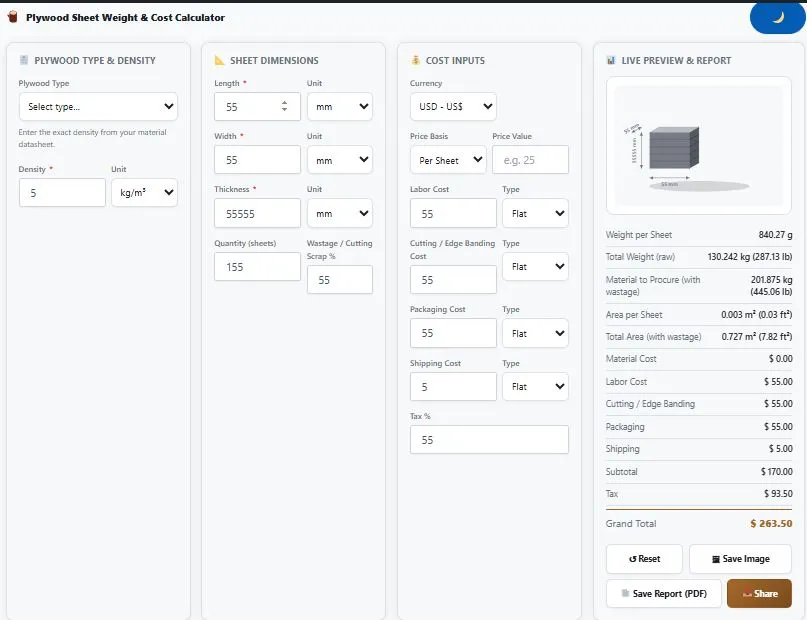
Table of Contents
How the Plywood Weight Calculator Works
The calculator is built on the standard volume-density formula used across the plywood and engineered wood industry:
Weight = Length × Width × Thickness × Density
The tool converts every dimension into meters and every density into kilograms per cubic meter behind the scenes.
This means it doesn't matter whether you enter your measurements in millimeters, centimeters, meters, inches, or feet — the math stays accurate down to a fraction of a gram. Once the weight per sheet is known, it's multiplied by the number of sheets you're ordering, then increased by your wastage percentage to show the real amount of material you need to buy, not just the finished-panel weight. The same calculation runs for area, so you get both the weight and the square footage of your order in one place.
Reference Density Table
The table below shows typical density ranges for common plywood types. These are industry reference values only — always confirm the exact density from your supplier's datasheet, since wood species, adhesive type, number of plies, and moisture content can all shift the number.
| Material | Density (kg/m³) |
|---|---|
| Softwood Plywood (Pine/Fir) | 450 – 640 |
| Hardwood Plywood (Birch/Oak) | 600 – 770 |
| Marine Grade Plywood | 500 – 750 |
| Poplar / Combi Core Plywood | 550 – 650 |
| MDF Core Plywood | 700 – 800 |
| Film-Faced / Shuttering Plywood | 650 – 850 |
Worked Example
Take a hardwood plywood sheet 2440 mm long, 1220 mm wide, and 18 mm thick, with a density of 680 kg/m³:
Volume = 2.44 m × 1.22 m × 0.018 m = 0.05359 m³
Weight = 0.05359 m³ × 680 kg/m³ = 36.44 kg per sheet
If you're ordering 10 sheets with 5% wastage for cutting scrap, the material to procure works out to 36.44 kg × 10 × 1.05 = 382.6 kg — and that figure (or the equivalent area, if your supplier prices by square meter or square foot) feeds directly into the final cost breakdown.
Why Use This Plywood Weight Calculator
Working out plywood weight by hand means converting units, looking up density figures, and calculating volume separately before you even get to cost — and a single unit mix-up (say, entering thickness in centimeters instead of millimeters) can throw the final weight off by a factor of ten. This tool removes that risk by handling five length units and three density units internally, so the same accurate result comes out regardless of which units your supplier's spec sheet uses.
It also solves a problem plain weight calculators don't: plywood isn't always priced by weight. Some suppliers quote per sheet, others per square meter or square foot, and some by weight. Instead of forcing one pricing model, this calculator lets you pick whichever basis matches your actual quote, then adds labor, cutting/edge banding, packaging, shipping, and tax on top — so you get one final number instead of several partial figures to add up yourself.
The live visual preview updates as you type, so you can sanity-check your inputs at a glance — if the shape on screen doesn't match the sheet you're picturing, you'll notice before committing to an order based on a typo.
Materials & Densities Guide for This Plywood Weight Calculator
Plywood isn't one product — it's a family of panel types built from different wood species, core structures, and adhesive systems, and the right choice depends on where the panel will be used.
Softwood Plywood (Pine/Fir) is the standard general-construction panel — lightweight and cost-effective, commonly used for sheathing, subflooring, and structural framing where high moisture or load resistance isn't the priority.
Hardwood Plywood (Birch/Oak) is denser and stronger, typically chosen for furniture, cabinetry, and flooring where surface finish and load-bearing strength matter more than weight.
Marine Grade Plywood uses waterproof adhesive and higher-quality veneers with fewer voids, built for continuous exposure to moisture — boat hulls, docks, and outdoor structures.
Poplar / Combi Core Plywood mixes a poplar or mixed-species core with hardwood face veneers, balancing weight and cost for cabinetry and general woodworking.
MDF Core Plywood replaces the veneer core with medium-density fiberboard, giving a flatter, more uniform panel that's popular for painted furniture and cabinet doors, at the cost of extra weight.
Film-Faced / Shuttering Plywood has a phenolic film overlay bonded to the panel surface, making it resistant to concrete adhesion and repeated reuse — the standard choice for concrete formwork in construction.
For a deeper technical reference on how wood density and specific gravity are measured and how moisture content affects panel weight, the USDA Forest Products Laboratory's Wood Handbook is the source most engineers and manufacturers rely on.
Who This Plywood Weight Calculator Is Built For
Carpenters and construction contractors quoting a job can use the weight and area figures together to plan transportation and confirm a job stays within load limits, since plywood is often ordered by the sheet but priced and shipped by weight or area.
Furniture makers and cabinet shops selecting between plywood types (hardwood, MDF core, poplar/combi core, and the others listed above) can compare how the same panel dimensions weigh out differently depending on the material, before finalizing a cut list.
Procurement and purchasing teams ordering panels in bulk can use the quantity and wastage fields to work out exactly how much material to buy for a full production run, and the price-basis selector to match whatever pricing model — per sheet, per square meter, per square foot, or per kg — their supplier actually quotes in.
Formwork and construction crews using film-faced/shuttering plywood can estimate weight per panel for handling and site logistics, since these panels are notably heavier than standard softwood sheets.
International buyers and suppliers benefit from the built-in currency selector, which covers 25+ world currencies plus a custom option, so the total cost is shown in the currency that's actually relevant to the quote.
Tips for Getting Accurate Results From This Plywood Weight Calculator
Use the exact density from your supplier's datasheet, not the reference range shown in this guide. The reference ranges (like hardwood plywood's 600–770 kg/m³) exist to show how wide the variation can be between species and manufacturers — moisture content alone can shift a panel's real weight by several percent from the number on a generic reference table.
Double-check your unit selection before reading the result. Since the calculator accepts millimeters, centimeters, meters, inches, and feet independently for length and width, it's worth glancing at the thickness dropdown especially — plywood thickness is often specified in millimeters (like 18 mm) while sheet length and width are given in a different unit like feet or meters.
Match the Price Basis to how your supplier actually quotes. If your supplier prices per sheet, per square meter, per square foot, or per kg, select that same basis here — mixing them up (entering a per-sheet price while the basis is set to per kg) will produce a materially wrong cost.
Set a realistic wastage percentage rather than leaving it at zero. Cutting plywood into custom sizes almost always produces offcut scrap; if you don't account for it, your "material to procure" weight and area figures will undershoot what you actually need to order.
Choose "per sheet" instead of "flat" for labor, cutting, or packaging costs if those costs genuinely scale with the number of sheets — a flat rate makes sense for a one-time setup fee, while a per-sheet rate reflects a cost incurred on each individual panel.
FAQs
How do I calculate the weight of a plywood sheet?
Multiply the sheet's length, width, and thickness together to get its volume, then multiply that volume by the plywood's density. This calculator does that automatically — enter your dimensions in any unit (mm, cm, m, in, or ft), select the plywood type, and it returns the weight per sheet instantly.
What is the density of plywood?
It depends on the type. Softwood plywood ranges from 450–640 kg/m³, hardwood plywood from 600–770 kg/m³, marine grade from 500–750 kg/m³, and film-faced/shuttering plywood from 650–850 kg/m³, among others. Always confirm the exact figure from your supplier's datasheet, since species, adhesive, and moisture content shift density within these ranges.
Does this calculator account for cutting wastage or scrap?
Yes. The Wastage/Cutting Scrap % field increases both the total weight and total area figures to show how much material you actually need to procure, separate from the finished-panel weight, so cutting losses are already factored into your order.
Can this calculator handle different pricing methods, like per sheet or per square foot?
Yes, this plywood weight calculator supports four pricing methods — per sheet, per square meter, per square foot, and per kg — so you can match whichever basis your supplier actually quotes, and it calculates material cost accordingly.
What units can I use for length, width, and thickness?
Length and width have independent unit dropdowns supporting millimeters, centimeters, meters, inches, and feet. Thickness supports millimeters, centimeters, and inches. You can mix units — for example, entering length in feet and thickness in millimeters — and the calculator converts everything internally.
Which currencies does the calculator support?
Over 25 world currencies are built in, including USD, EUR, GBP, INR, PKR, AED, AUD, CAD, CNY, JPY, and more, plus a Custom option where you can type in any other currency symbol.
Can I use this for bulk orders with multiple sheets?
Yes. Enter the number of sheets in the Quantity field, and the calculator scales the total weight, total area, and any per-sheet costs (labor, cutting, packaging) accordingly, while flat costs like shipping stay fixed per order.
Can I save or share my calculation results?
Yes. The tool includes a Save as Image button for a clean summary image, a Save as PDF button for a one-page printable result, and a Share button to send the summary directly via WhatsApp.
Quick Summary
This plywood weight calculator gives you the weight and area of a plywood sheet from length, width, thickness, and material density, then converts that into a full cost breakdown — material, labor, cutting/edge banding, packaging, shipping, and tax — in your chosen currency. Select your plywood type, enter your dimensions in any unit, add a wastage percentage for cutting scrap, choose how your supplier prices the material, and this plywood weight calculator shows weight per sheet, total order weight, area per sheet, and the grand total cost, with a live visual preview and the option to save the result as an image or PDF.
Disclaimer
This plywood weight calculator by BytePriva is provided as a free estimation tool to help with planning, quoting, and material ordering. The density values and formulas used are based on general industry reference ranges and standard volume-density calculations; they are intended for guidance only and do not replace the exact material specifications provided by your plywood supplier or manufacturer.
Actual sheet weight, area, and total pricing may vary depending on the specific wood species, adhesive system, moisture content, supplier pricing, and regional cost factors at the time of your order. BytePriva makes no warranty, express or implied, regarding the accuracy of results for any specific commercial, structural, or safety-critical application, and accepts no liability for decisions made based solely on this calculator's output.
For final material specifications, structural, or load-bearing applications, always confirm figures with your material supplier or a qualified engineer before placing an order or finalizing a design.