Here's something most checkered plate weight calculators won't tell you: the raised diamond or teardrop pattern adds real, measurable weight — often 2 to 4 kg per square meter — and almost no calculator online actually accounts for it.
This one does. Enter your plate dimensions, pick your pattern type (Raised Diamond, Teardrop, or Five-Bar), and get a weight that reflects what your plate will actually weigh — not just the flat-sheet math everyone else gives you.
Formula used: Total Weight = (Length × Width × Thickness × Density) + (Area × Pattern Weight Addition)
Checkered Plate Weight Calculator
Calculate MS chequered/checker plate weight — including the extra weight added by the raised pattern.
2m × 1m, 6mm — Raised Diamond
Formula used: Base Weight = Length × Width × Thickness × Density | Total Weight = Base Weight + (Area × Pattern Addition per m²). Pattern addition values are typical industry ranges — always confirm with your supplier for exact figures.
How This Checkered Plate Weight Calculator Works
Most checkered plate weight calculators use the same flat-plate formula you'd use for any regular steel sheet — length × width × thickness × density. That gives you the weight of a smooth, flat plate, but a checkered plate isn't flat. It has a raised pattern stamped or rolled into the surface, and that raised material adds real weight that the flat-plate formula simply ignores.
This calculator adds a second step most others skip: it calculates the base flat-plate weight first, then adds the extra weight contributed by your specific pattern type.
The Two-Part Formula
Base Weight = Length × Width × Thickness × Density
Pattern Addition = Plate Area × Pattern Weight per m²
Total Weight = Base Weight + Pattern Addition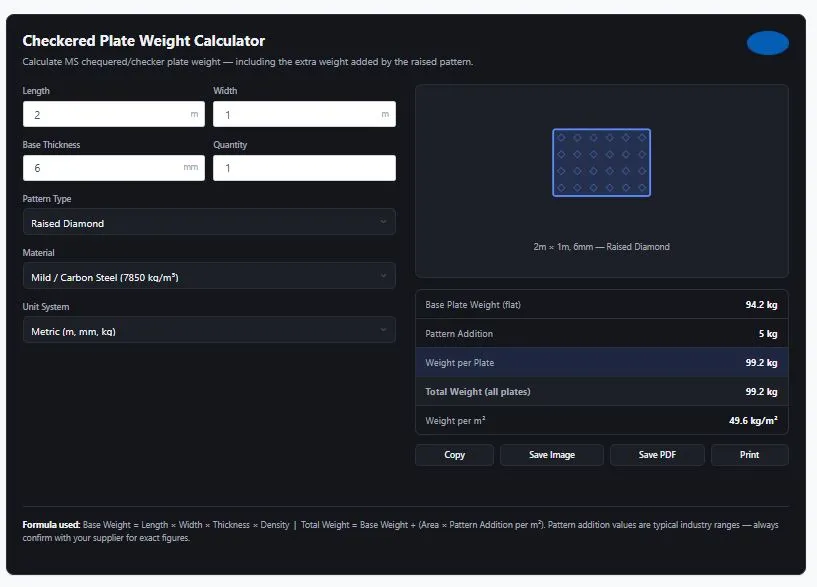
Typical Pattern Weight Additions
| Pattern Type | Typical Addition |
|---|---|
| Flat Plate (no pattern) | 0 kg/m² |
| Raised Diamond | ~2.0 – 3.0 kg/m² |
| Teardrop | ~2.5 – 3.5 kg/m² |
| Five-Bar / Lentil | ~1.5 – 2.5 kg/m² |
These are typical industry ranges, not exact universal values — the actual addition depends on the pattern depth and spacing used by your specific manufacturer. This calculator includes a custom option if your supplier provides an exact figure for their pattern.
For official Indian manufacturing standards governing chequered plates, see IS 3502:2009 from the Bureau of Indian Standards, which specifies dimensional and quality requirements for steel chequered plates.
Tips for Getting Accurate Results
- Always measure thickness from the flat area, not the raised pattern — measuring across the raised diamonds or teardrops gives a misleadingly higher thickness reading than the plate's actual base thickness.
- Use this checkered plate weight calculator's custom pattern option when possible — typical ranges are a good starting point, but your supplier's exact figure will always be more accurate than an industry average.
- Confirm which pattern type you actually have — Raised Diamond, Teardrop, and Five-Bar all add different amounts of weight, and visually similar patterns can sometimes belong to different categories.
- Double-check density for stainless steel grades — 304 and 316 stainless have slightly different densities (7900 vs 8000 kg/m³), which matters more on large orders.
- Round up for shipping/logistics planning — pattern weight additions are typical ranges, not exact figures, so budgeting slightly above the calculated weight avoids underestimating freight costs.
- Use "Weight per m²" to sanity-check supplier quotes — if a supplier's quoted weight per square meter is far outside typical ranges, it's worth asking which pattern type and thickness they're actually quoting.
FAQs
How do you calculate the weight of a checkered plate?
Calculate the base flat-plate weight using Length × Width × Thickness × Density, then add the extra weight from the raised pattern — typically 2 to 4 kg per square meter depending on the pattern type. This checkered plate weight calculator does both steps automatically.
Does the checkered pattern actually add weight to the plate?
Yes. The raised diamonds, teardrops, or bars are extra material stamped or rolled into the surface, adding real weight beyond what a flat plate of the same base dimensions would weigh — typically an additional 2 to 4 kg per square meter.
Why do I get different weight results from different checkered plate weight calculators?
Most calculators only compute flat-plate weight and ignore the pattern's added weight entirely, which makes their results lower than the plate's actual weight. This calculator accounts for the pattern separately, giving a more accurate total.
Is this checkered plate weight calculator free to use?
Yes, this calculator is completely free, requires no login or signup, and has no usage limits.
Disclaimer
The Checkered Plate Weight Calculator and all information on this page are provided by BytePriva for general estimation and informational purposes only. Pattern weight addition values used in this calculator are typical industry ranges based on common manufacturing practices; actual figures vary by manufacturer, pattern depth, and production method.
BytePriva, its owners, and contributors make no warranties, express or implied, regarding the accuracy, completeness, or reliability of this calculator or its results. To the fullest extent permitted by law, BytePriva shall not be held liable for any direct, indirect, incidental, or consequential loss, damage, or cost arising from the use of, or reliance on, this calculator or the information provided on this page.
By using this calculator, you acknowledge and agree to these terms. For structural applications or precise logistics planning, please confirm exact weights with your plate supplier or manufacturer.